
Telecommunications market research is more essential than ever in 2025. The industry is undergoing rapid change, shaping how networks are managed, services are delivered, and customers choose a telco partner. Mobile ecosystem players that fail to pivot accordingly risk missing out on new monetization opportunities and getting leapfrogged by the competition. Qualitative, quantitative, and competitive analyses help industry stakeholders identify the latest telecom trends, gain strategic recommendations, and benchmark against their competitors.
From the integration of telco Artificial Intelligence (AI) to evolving 5G business models, ABI Research provides invaluable insight into the biggest innovations, customer demands, challenges, and companies shaping the future of telecommunications. This resource takes a look at several reports, presentations, and market forecasts from our telecom industry-focused research areas.
Table of Contents
- Market Data Forecasts
- Competitive Benchmarking and Ecosystem Innovation
- Core RAN Research
- Satellite Communications
- Supporting Research: Telco Infrastructure Trends and New Service Models
- Related Telecom Industry Innovations and Adjacent Use Cases

Market Data Forecasts
Private Cellular Network Forecasts Market Data Overview
What Is It?
A market data analysis of the private cellular network opportunity. According to ABI Research, the Total Addressable Market (TAM) for private cellular networks will reach US$16.7 billion in 2025. Key drivers of adoption are private 4G/5G deployments in mission-critical verticals that require coverage in large spaces. This includes energy generation, natural resource extraction, manufacturing, healthcare, and logistics.
The market forecast compares private cellular revenue between 4G versus 5G, with 5G rapidly catching up. 5G’s share of the global private cellular network market will increase from 21% in 2025 to 38% by 2030. Finally, the research overview explores regional trends across North America, Europe, Asia-Pacific, Latin America, and the Middle East & Africa.
Table 1: Private Cellular Network Revenue by Region
|
Region |
Revenue |
2024 |
2025 |
2026 |
2027 |
2028 |
2029 |
2030 |
CAGR |
|
Europe |
(US$ 000s) |
963,904 |
1,366,475 |
1,874,775 |
2,675,641 |
3,909,344 |
5,759,769 |
8,601,600 |
36.7% |
|
North America |
(US$ 000s) |
1,255,254 |
1,819,461 |
2,593,293 |
3,781,531 |
5,620,976 |
8,413,922 |
12,938,243 |
39.6% |
|
Latin America |
(US$ 000s) |
191,088 |
482,867 |
638,546 |
905,557 |
1,382,467 |
2,037,669 |
3,052,313 |
48.6% |
|
Asia-Pacific Developed |
(US$ 000s) |
4,965,085 |
6,872,362 |
9,119,096 |
12,977,849 |
18,723,342 |
27,435,220 |
40,232,506 |
34.8% |
|
Asia-Pacific Developing |
(US$ 000s) |
982,562 |
1,279,526 |
1,745,325 |
2,661,990 |
3,782,922 |
5,373,441 |
7,851,763 |
34.6% |
|
Middle East & Africa |
(US$ 000s) |
79,538 |
543,034 |
704,560 |
1,012,646 |
1,571,876 |
2,286,706 |
3,260,301 |
70.0% |
|
Total |
(US$ 000s) |
8,437,431 |
12,363,724 |
16,675,596 |
24,015,213 |
34,990,927 |
51,306,727 |
75,936,726 |
36.9% |
(Source: ABI Research)
How Does This Research Support the Telecom Industry?
Demand for private 5G networks is on the rise, prompting telcos to pinpoint the high and low-growth segments. This data-driven analysis provides the outlook needed for telecom industry leaders to prioritize verticals, tailor product portfolios, and align geographic expansion strategies.
Future revenue outlooks are paramount to developing long-term business models for CSPs, Mobile Network Operators (MNOs), and infrastructure providers. Understanding the industries, regions, and cellular technologies that will drive the most demand and when that will occur ensures that Research and Development (R&D) budgets are allocated in the best way possible.

Network Cloud Infrastructure Market Data Overview: 2Q 2025
What Is It?
This data-driven presentation delivers a granular view of the global network cloud infrastructure landscape. The research pays special focus to 5G Standalone (SA) core transition and the industry’s shift from Evolved Packet Core (EPC) and Virtual Network Functions (VNFs) to Cloud-native Network Functions (CNFs). Market sizings and revenue forecasts for hardware, software, and services provide the knowledge that telco vendors and operators need to plan product roadmaps.
How Does This Research Support the Telecom Industry?
This market data overview can be used by Communications Service Providers (CSPs), core network software providers, and infrastructure vendors to successfully transition toward cloud-native architectures. Our granular analysis enables the industry to evaluate optimal timing for phasing out legacy EPC infrastructure, align product roadmaps with regional adoption rates, and identify which markets are accelerating 5G SA rollouts. The presentation also helps the telecom industry compare VNF versus CNF adoption.

Competitive Benchmarking and Ecosystem Innovation
Telco API Platforms for Internal Exposure
What Is It?
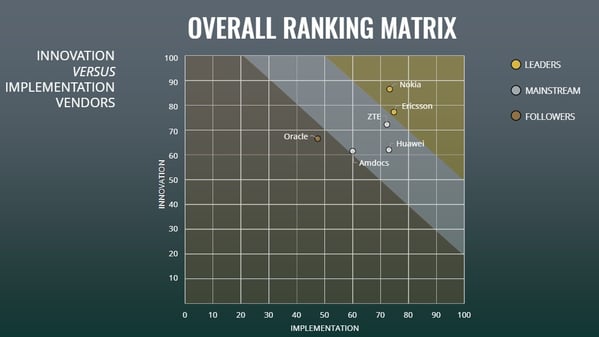
This competitive ranking assesses vendor solutions for the exposure of network Application Programming Interfaces (APIs) to applications internal to the operators’ network and network ecosystem. This provides a baseline level of enablement for exposure of APIs that is used for network Management and Orchestration (M&O), Business Support Systems (BSSs), Operational Support Systems (OSSs), and specialized telco applications.
In terms of results, Nokia and Ericsson were named as the only leaders in the competitive benchmark.
Relevant solutions in this market include:- The 5G Network Exposure Function (NEF)
- Network API platforms
- Service API platforms that are consumed by operators or their partners
- Services for core network exposure and API mediation between abstraction layers
How Does This Research Support the Telecom Industry?
Telco network APIs are increasingly pivotal to the CSP business model, ensuring smooth integration of new network features and applications. ABI Research’s unbiased competitive ranking assesses the key value propositions that win over CSPs as new clients. It also empowers network API vendors to size up their offerings against other market players. In turn, they can highlight areas of brand differentiation and develop highly desired functionalities that their product currently lacks.

DAS/DRS Vendors
What Is It?
This telecom industry market research assesses and compares nine Distributed Antenna System (DAS)/Distributed Radio System (DRS) vendors. ABI Research selected the prominent players offering DAS/DRS solutions, evaluating them in the wider context of the market. This report sets out the market positioning of each profiled company—leaders, mainstream, and followers—and provides strategic recommendations accordingly.
ABI Research developed this Competitive Assessment (CA) to present a comparative assessment and ranking of the following vendors offering DAS/DRS: ANDREW, Comba Telecom, Corning, Ericsson, Huawei, JMA Wireless, Nokia, SOLiD, and Wilson Connectivity. Ericsson was named the overall leader.
How Does This Research Support the Telecom Industry?
Reading this competitive ranking equips DAS/DRS solution providers with the knowledge they need to optimize product development. The assessment effectively shows marketing and sales teams at DAS/DRS companies what to highlight in their outreach campaigns to MNOs and enterprise clients.

Passive Antenna Vendors
What Is It?
This Hot Tech Innovators report assesses eight up-and-coming passive base station antenna vendors: HUBER+SUHNER, ZTT, JMA Wireless, SageRAN, KMW Antennas, Alpha Wireless, Kaelus, and CellMax. Our analyst team evaluated each company based on factors such as unique selling points, deployment flexibility, design innovation, and support for diverse frequency bands across mobile and fixed wireless networks.
The purpose of this report is not to rank or score these vendors, but rather to spotlight lesser-known firms that are carving out a place in a market historically dominated by large, longstanding providers (e.g., Huawei, PROSE, Ericsson). For an analysis of more established providers, read our blog, Top Passive Cellular Antenna Vendors in 2025.
How Does This Research Support the Telecom Industry?
Enterprises are shifting their purchasing habits for passive cellular antennas. As 5G networks become more complex, they seek antennas that offer flexible deployment and sustainability. The telecom industry is actively designing compact cellular antennas that support specific deployment contexts, such as crowded rooftops and energy reduction.
This ABI Research product offers a window into the most influential trends in antenna development. Moreover, it points out which innovative features are the most beneficial to CSPs.
Incumbent telco equipment vendors can use this report to compare their antenna portfolios with the rising stars that aim to cut into their market share.

Core RAN Research
AI RAN Market Developments
What Is It?
This technology market research report provides an analysis of how AI is being used in RAN networks. It offers revenue forecasts for AI-RAN technologies between 2025 and 2032, identifies early case studies, and compares Graphics Processing Units (GPUs) versus Central Processing Units (CPUs) in AI-RAN deployments.
The key companies covered in the report include NVIDIA, SoftBank, Ericsson, Nokia, Samsung, and T-Mobile. Our analysts explain how these companies are integrating AI into RAN solutions and assess their future role in the telecom industry.
Integration challenges are also covered in the report. Beyond identifying the challenges, we pinpoint linked solutions and their impact on AI-RAN. Challenges include protocol gaps, conflicts of interest for stakeholders, documentation fragmentation, testing complexities, cloud-native obstacles, performance shortcomings, and costs.
How Does This Research Support the Telecom Industry?
Telecommunications stakeholders will recognize the way AI is evolving to meet modern RAN deployments. Readers will identify areas of opportunity, distinguish between various technological integrations, and gain a rich understanding of competitive dynamics.

5G RAN Automation Platforms: Technologies
What Is It?
A close study of the technologies underpinning 5G RAN automation. ABI Research places a particular focus on the essential role of Agentic Artificial Intelligence (AI) and foundational AI models. The development of vertical Large Language Models (LLMs) is a more recent industry tech trend that aims to use the power of Agentic AI to improve operational and network efficiencies. Huawei’s Telecom Foundation Model, ZTE’s Nebula Telecom Large Model, and SoftBank’s Large Telecom Model (LTM) are notable examples.
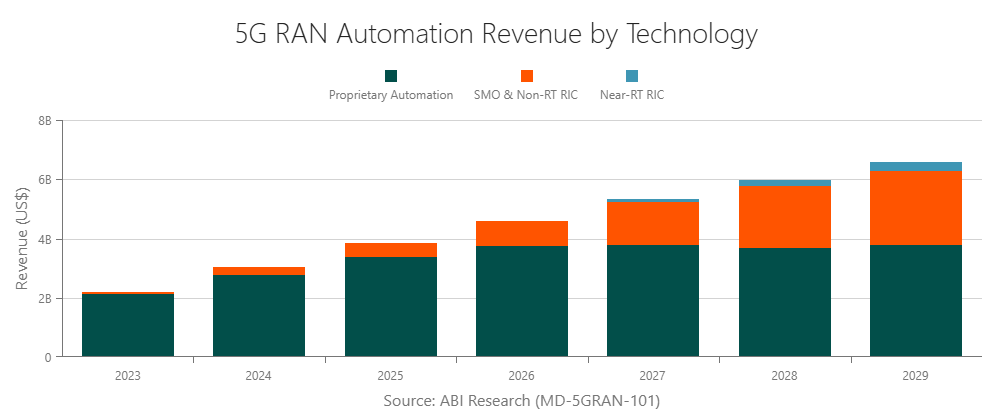
According to this ABI Research report, the 5G RAN automation market size is forecast to reach US$6.6 billion by 2029. Open RAN architectures are expected to see rapid adoption among mobile operators. “Open RAN automation technologies are expected to account for around 42% of the revenue share by 2030,” states Industry Analyst Larbi Belkhit. Belkhit continues, “acceleration is expected to occur post-2027 once brownfield networks in Western markets have undergone Open RAN network upgrades.”
Service Management and Orchestration (SMO) and Non-Real-Time Radio Intelligent Controller (Non-RT RIC), as Ericsson is involved with, will remain a more niche segment within RAN automation architecture.
How Does This Research Support the Telecom Industry?
As AI increasingly merges with cellular networks, this research helps telco operators, vendors, and software providers future-proof their RAN strategies. Analyst commentary offers valuable insights into the emerging need for new platform capabilities and how agent-based intelligence shuffles the network management playbook. As a result, telecom industry stakeholders will gain much-needed clarity on where the automation market is headed and how to position their offerings.

Satellite Communications
Software-Defined NTN: Architecting the Space Backbone of Unified Networks
What Is It?
A long-form report exploring the rise of software-defined Non-Terrestrial Networks (NTNs). Software-defined satellites and ground stations serve as the foundation for globally unified, cloud-native network architectures. The telecom industry ecosystem, including satellite operators, MNOs, Mobile Virtual Network Operators (MVNOs), Satellite Communications (SatCom) providers, and government/regulatory bodies, will be at the forefront of this transformation.
The research deliverable forecasts the number of software-defined NTNs in orbit and the key companies involved with launches (Amazon and SpaceX lead the way). Senior Analyst Andrew Cavalier also examines cloudification considerations like The 3rd Generation Partnership Project (3GPP) standardization and satellite payload requirements. At the end, the reader is presented with key opportunities and recommendations as the telecom industry aims to seize the potential of software-defined NTNs.
.png?width=992&height=420&name=number-of-software-defined-satellites-in-orbit%20(1).png)
How Does This Research Support the Telecom Industry?
Satellite and telco operators are increasingly intertwined as space-based Internet connectivity is highly reliable and useful for bridging the digital divide. Software-defined NTN is a key trend shaping the industry, as virtualization and cloud-native networks support more rapid deployment of new applications and services.
This journey requires space operators, MNOs, and other ecosystem players to adjust their space and terrestrial infrastructure. The report delves into the technical challenges to overcome, the role of telcos in this digital transformation, and how to achieve network unification.

Satellite Communications: Broadband Deployments & Subscriptions Market Overview
What Is It?
This presentation provides a detailed forecast of global satellite broadband subscriptions and revenue projections through 2033. As for methodology, our Space Tech team segmented its subscription forecasts by operational domain (land fixed, land mobile, maritime, or aviation) and frequency band (dual-band, Ku-band, Ka-band, or L-band). Meanwhile, satellite broadband revenue is broken down by geography, with market drivers also covered.
These research findings will be vital to crafting commercialization strategies that maximize financial and human capital.
How Does This Research Support the Telecom Industry?
Satellite communications is currently a hot topic in the telecom industry as governments and enterprises aspire to offer global coverage. It provides near ubiquitous connectivity across Direct-to-Cellular (D2C), NTN, Internet of Things (IoT), broadband, and backhaul use cases. Having access to this ABI Research market forecast is beneficial for telcos, equipment vendors, and regulators seeking clarity about how SatCom solution adoption will progress.
Not all frequency spectrums, operational forms, and regions are created equal. Pinpointing where the fastest-growing market segments reside ensures that telcos align their products and marketing campaigns with customer preferences.

Supporting Research: Telco Infrastructure Trends and New Service Models
Telco GPUaaS Opportunity
What Is It?
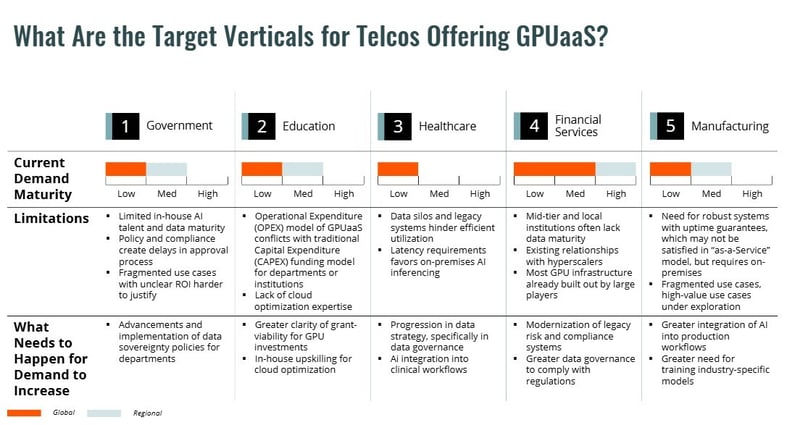
An examination of the rising telco GPU-as-a-Service (GPUaaS) market as telcos build AI factories. It highlights key drivers for GPUaaS investment, the top industry verticals, and regional trends. Key vendors and telcos profiled in the presentation include NVIDIA, SK Telecom, Dell Technologies, SoftBank, Verizon, Telenor, Aarna Networks, Nokia, and others.
Analysts break down the three main business models that operators can leverage for GPUaaS: facilitator, aggregator, and sovereign hyperscaler. At the end, strategic recommendations are made based on market direction and technical features available today.
How Does This Research Support the Telecom Industry?
The research deliverable helps the telecommunications industry quantify the revenue opportunity for supporting next-gen AI services with low latencies. Telcos are seeking new ways to monetize their data center infrastructure, and GPUaaS offers a promising way to do so.
Given their relative inexperience in distributing cloud computing resources to third parties, the telecom industry must map its data center project plans with expert-level analyses. Embarking on the GPUaaS journey without a well-researched approach risks misalignment with customer demand and targeting the wrong segments.

Enterprise FWA: Key Market Activities and Partnerships
What Is It?
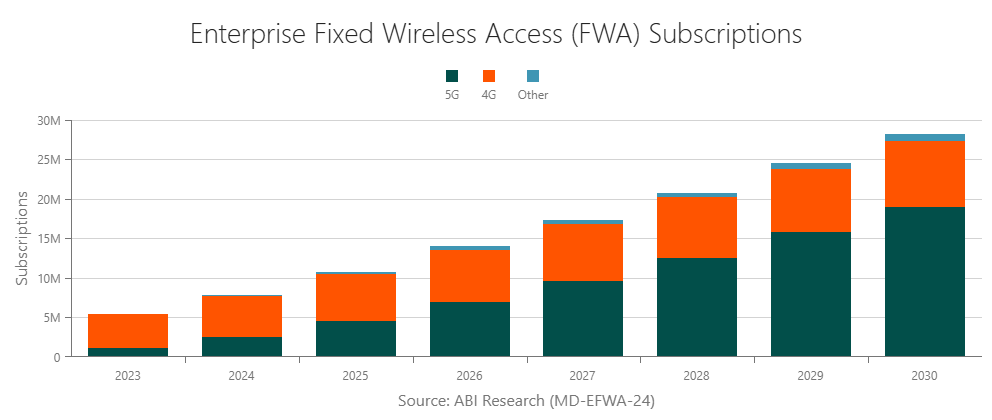
Headed by ABI Research Principal Analyst Leo Gergs, Enterprise FWA: Key Market Activities and Partnerships is an in-depth analysis of the Fixed Wireless Access (FWA) ecosystem. Key topics from the report include partnership models, Go-to Market (GTM) strategies, and commercial structures that drive successful FWA deployments.
A key theme from this product is that industry collaboration is crucial to the support of enterprise FWA growth. For example, T-Mobile recently partnered with Ericsson and Inseego to enhance its FWA capabilities. Collaboration ensures that security, provisioning, orchestration, and device management are adequately addressed. In addition to highlighting key trends and partnership strategies, Gergs’ team provides a regional market forecast for enterprise FWA subscriptions through 2030.
How Does This Research Support the Telecom Industry?
Fixed Wireless Access (FWA) was once quite niche, offering few monetization opportunities. Now, it is becoming essential for 4G/5G connectivity in underserved areas as enterprises increasingly digitalize. For example, telcos may not have installed fiber or cabling in a remote region with a low population. FWA steps up to provide last-mile connectivity without the need to install physical wiring. For telcos, it is one of the last viable paths to revenue growth in a mature connectivity market.
By reading this research report, CSPs, MNOs, and Internet Service Providers (ISPs) will be able to:
- Identify common partnership models and their unique capabilities
- Understand what is conducive to a successful FWA deployment
- Anticipate where enterprises will adopt FWA at the highest rates globally
- Learn the hallmarks of the best GTM strategy
- Assess how innovations like network slicing and Reduced Capability (RedCap) shape FWA development

5G-as-a-Service: Business Models & Challenges
What Is It?
In this market research report, ABI Research’s Enterprise Connectivity team provides a deep dive into the 5G-as-a-Service (5GaaS) landscape. Revenue forecasts through 2030 are broken down into three segments: Infrastructure-as-a-Service (IaaS), Software-as-a-Service (SaaS), and Network-as-a-Service (NaaS).
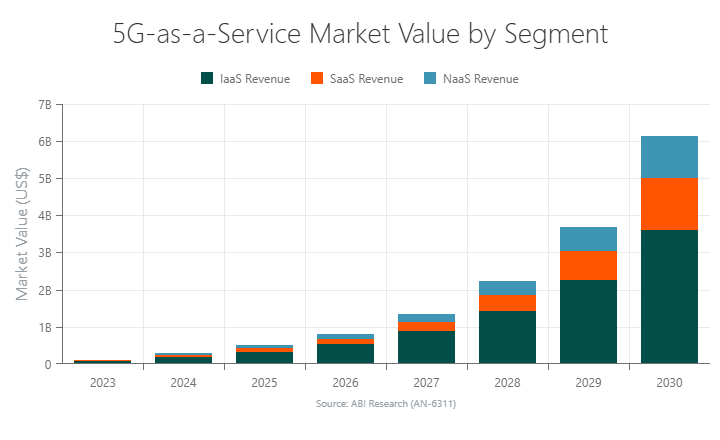
Beyond 5GaaS market forecasts, the report explains how the telecom industry is responding to the shift in demand for flexible, aaS business models. From network operators and telco equipment vendors to cloud partners, there is a competitive race to the top of the market. Boldyn Networks, Celona, Ericsson, Firecell, Nokia, NTT DATA, Velaspan, and Vodafone are all evolving their commercial strategies to accommodate the 5GaaS model.
Key drivers for 5GaaS are also discussed in this research product. There are economic, technical, and environmental factors that push and pull enterprises to adopt 5aaS solutions. Upcoming challenges and solutions are analyzed in the conclusion.
How Does This Research Support the Telecom Industry?
5GaaS is emerging as a critical route to market in 2025 as businesses aim for modular, scalable, and cost-efficient 5G deployment. We live in volatile macroeconomic times, requiring CSPs to put themselves in the shoes of their customers. Enterprises have a smaller appetite today for making high upfront purchases. The industry must recognize this fact and work toward flexible service models that 5GaaS supports. This report informs telecom product teams and strategic leaders on how their business models must adapt to the next phase of 5G commercialization.

Related Telecom Industry Innovations and Adjacent Use Cases
5G-Advanced Use Cases for Warehouses, Ports, and Airports
What Is It?
An overview of the 5G-Advanced opportunity in logistics. Low-latency automation has become essential to logistics firms as they contend with labor shortages and increased demand. Legacy cellular solutions cannot always meet the performance requirements an organization has, creating a connectivity bottleneck.
The report considers how 5G-Advanced features like Massive Multiple Input, Multiple Output (mMIMO) communications, network slicing, and RedCap address ongoing challenges faced by logistics providers.
Key companies across telecommunications infrastructure vendors, MNOs, and system integrators are covered in this research. The primary use cases of 5G-Advanced spotlighted include communications, remote-controlled machinery, autonomous vehicles, and supply chain tracking, among others. Eight real-world case studies are shared in the presentation to demonstrate how telcos are supporting the logistics industry with advanced 5G solutions.
How Does This Research Support the Telecom Industry?
The logistics sector is ripe for 5G revenue opportunities. This research report supports telcos in their goal to further commercialize the logistics space by examining why 5G-Advanced is being adopted.
By understanding unique challenges and the most desired connectivity features, the telecom industry can tailor its 5G offerings accordingly. Finally, the scope of the case studies gives telcos a glimpse at how their competitors are catering to the logistics sector.

ISAC Use Cases for Private Cellular Networks
What Is It?
This research report zeros in on one of the biggest telecom technology trends: Integrated Sensing and Communication (ISAC). ISAC networks combine radio communications and sensing functionalities into a unified framework, enabling cellular networks to go beyond connectivity. Besides transmitting data, ISAC networks detect, localize, and interpret objects and movements in the physical environment.
It is still early days for ISAC, and industry voices point to it being more of a 6G technology. Telcos need to decipher now which applications are likely to spearhead broader adoption. For instance, ABI Research sees primary use cases revolving around outdoor applications such as airspace, water, and outdoor site security. This report also compares ISAC with other sensing technologies, such as radar and Light Detection and Ranging (LiDAR), to get the full picture of where ISAC provides an advantage. The vendors and ecosystems analyzed include:
- The 5G Alliance for Connected Industries (5G-ACIA)
- The European Telecommunication Standards Institute (ETSI)
- Ericsson
- Tiami Networks
- ZTE
- SEW-EURODRIVE
How Does This Research Support the Telecom Industry?
ISAC unlocks many novel use cases that telcos could never achieve before. However, it is still a relatively newer concept in the telecom industry. Standardization is widely lacking, and operators may struggle to understand exactly how ISAC should be incorporated into their product portfolios. As commercial interest continues to grow, industry stakeholders must be aware of which use cases and verticals will drive early adoption. Our market intelligence report brings these insights to light.

Succeeding in the Telecommunications Industry with ABI Research
ABI Research provides telecommunications industry analysis across several topical domains to provide clients with a holistic overview of the latest trends. Whether it is transitioning to 5G Standalone (SA) or analyzing forward-looking innovations, our global analyst team has deep experience in preparing industry stakeholders for the future of telecom. Contact us today to find the right telecom research service for your organization.
Meet the ABI Research Telecommunications Technology Analyst Team

Malik Saadi, Vice President of Strategic Technologies
Research Focus: Malik Kamal-Saadi is head of the Strategic Technology Group at ABI Research focusing on transformative technologies and innovation across Telecommunications and Connectivity Technologies, Enterprise IT and OT Technologies, Cloud, Edge, and Distributed Computing, Artificial Intelligence, Data Warehouses, Robotics and Automation, and other adjacent technologies. In his role, Malik leads ABI Research’s thought leadership, consultancy services, syndicated services, strategic positioning, market forecasts, competitive assessments, and market analysis.

Jake Saunders, Vice President, Asia-Pacific & Advisory Services
Research Focus: Jake Saunders, Vice President, Asia-Pacific & Advisory Services, heads ABI Research’s Space Technologies & innovation research division. Jake brings highly developed analytical skills to the company, combined with years of expertise in the telecom technology market research business and a proven track record of operations management. He devotes particular attention to the Asia-Pacific market in relation to its mobile operator strategic positioning, satellite communications, infrastructure vendors, mobile device vendors, and chipset manufacturers.

Dimitris Mavrakis, Senior Research Director
Research Focus: Dimitris Mavrakis, Senior Research Director, manages ABI Research’s telco network and cloud computing coverage, including hybrid cloud platforms, digital transformation, and mobile network infrastructure. Research topics include AI and machine learning in telco networks, hybrid cloud deployments and technologies, telco software and applications, 5G, 6G, cloud-native networks, and both telco and cloud ecosystems.

Leo Gergs, Principal Analyst
Research Focus: Principal Analyst Leo Gergs leads enterprise connectivity and cloud and data center research at ABI Research. His work covers enterprise drivers, use cases, and provider strategies for technologies such as private cellular, SD WAN, and Fixed Wireless Access. He also analyzes key trends shaping the data center market, including the rise of neocloud providers, the growing importance of sovereign cloud models, and their implications for enterprise infrastructure, regulation, and workload placement.

Andrew Cavalier, Senior Analyst
Research Focus: Andrew Cavalier, Senior Analyst at ABI Research, focuses on satellite communications (SatCom) and space technologies. As part of the custom research team, Andrew also focuses on wireless networks, infrastructure, and other emerging technology industry sectors such as Internet of Things (IoT), cloud, cybersecurity, 5G, and Artificial Intelligence (AI).

Larbi Belkhit, Industry Analyst
Research Focus: Industry Analyst Larbi Belkhit is part of ABI Research's Strategic Technologies research group focused on 5G, 6G, and RAN automation research. He is responsible for producing qualitative analysis and market forecasts on indoor and outdoor network infrastructure, Fixed Wireless Access (FWA), Massive MIMO, and other trends impacting network technologies.

Sam Bowling, Research Analyst
Research Focus: Sam Bowling is a Research Analyst within ABI Research's Strategic Technologies team, focused on 5G, 6G, and Open Radio Access Network (RAN). Coverage includes passive antennas, Distributed Antenna Systems (DASs), Massive Multiple Input, Multiple Output (mMIMO), and other trends impacting network technologies.
Frequently Asked Questions
What is telecommunications market research, and why is it important?
Telecommunications market research is the quantitative and qualitative analysis of the latest trends and technical innovations shaping the telecom industry. It’s important because it helps industry stakeholders identify new growth opportunities, overcome key challenges, and understand their customers. ABI Research’s broad coverage helps telco equipment vendors, operators, and system integrators make evidence-based decisions to reduce risk and accelerate go-to-market strategies. Learn more in the article, Why Is Market Research Important for Technology Companies?
How does ABI Research support the telecommunications industry?
ABI Research offers numerous research reports, market forecasts, and competitive rankings to help the telecom industry pinpoint high-growth segments, analyze cutting-edge technologies, and apply best practices. Moreover, our analyst team hops on strategy calls with clients, attends telco-centric webinars, writes custom whitepapers, and educates your target audience. These efforts translate to superior market positioning, technology scalability, and revenue growth.
What are the key trends shaping the telecom industry in 2025?
According to ABI Research’s content library, the top telecom trends in 2025 are:
- AI-driven network automation to simplify network management and generate new revenue opportunities
- Private cellular deployments to improve security, reliability, and customization
- GPU-as-a-Service (GPUaaS) to support AI workloads in telco data centers
- Software-defined satellite networks to unify terrestrial and non-terrestrial networks
- Sustainable passive antenna development to meet climate regulations and reduce energy costs
- Enterprise Fixed Wireless Access (FWA) expansion to connect worksites and live events in hard-to-reach areas
- Migration to 5G Standalone (5G SA) to enhance network performance
- 5G-as-a-Service (5GaaS) business models to reduce upfront costs for cash-strapped enterprise customers
- Integrated Sensing and Communication (ISAC) to unlock telecom use cases beyond connectivity
- Network API Standardization to enhance Quality of Service (QoS), build network slices, and easily integrate new applications
Where can I find reliable telecom market research reports?
You can explore ABI Research’s complete library of telecom market research on our website. Each research service is tailored to meet the needs of product managers, strategists, Chief Technology Officers (CTOs), and commercial buyers.
We offer services across every corner of the telecom industry:
 Dimitris Mavrakis