

Fixed Wireless Access (FWA) continues to gain traction in the enterprise space as organizations require cellular connectivity for their digitalization projects. Communication Service Providers (CSPs) and Mobile Network Operators (MNOs) are increasingly looking to offer FWA connectivity to support enterprises that cannot depend on traditional fiber or cable broadband.
Many U.S. businesses operate in remote or underserved areas where fiber and cabling are challenging to install. Others may be contending with prohibitively high installation/management costs for their telco infrastructure. Fixed wireless access offers a simple, cost-effective path toward creating the cellular connectivity backbone that modern organizations need.
As pointed out by Industry Analyst Larbi Belkhit in a recent ABI Insight, all Tier One MNOs in the United States have expressed interest in the FWA opportunity. Several operators already have mature portfolios, with Verizon, AT&T, and T-Mobile US working on product differentiation.
According to ABI Research's latest findings, more than 50% of global enterprise FWA subscriptions will come from North America by the end of the decade. Much of the interest brewing for fixed wireless resides within the Small and Medium Business (SMB) segment, as Belkhit recently told Mobile World Live.
What Is Fixed Wireless Access?
Fixed Wireless Access (FWA) is a method for delivering high-speed Internet to homes and enterprises using wireless cellular networks. FWA leverages cell towers and radio signals to provide last-mile connectivity, meaning no fiber or cables are required.
5G FWA’s virtualization is an attractive feature for companies lacking broadband coverage in hard-to-reach regions. It also offers immense promise for businesses that must quickly scale their cellular infrastructure.
Fixed Wireless Access Versus Fiber Broadband
The biggest difference between fixed wireless access and fiber broadband is that fixed wireless does not require fiber or cabling. This presents a huge opportunity for enterprises that operate in underserved areas or want to reduce installation costs.
Fiber can theoretically deliver higher throughputs and superior latencies, but modern FWA connectivity solutions are more than capable of handling many enterprise applications. FWA is also a more sensible option when you only need broadband access for a limited amount of time.
Fiber broadband is more suitable for long-term 5G deployments where top-notch performance is the main priority.
What Benefits Does Fixed Wireless Access Provide?
Enterprises adopt FWA connectivity for a number of reasons, spanning both technology and business drivers. They partner with FWA providers for the following benefits:
- 5G Performance Gains: FWA uses 5G for high speeds and low latencies. In turn, this allows enterprises to run bandwidth-intensive applications without having to install fiber cables. Deployments are set up at a lower cost and more quickly, as soon as within hours/days instead of weeks.
- High Network Reliability with SLAs: FWA connectivity providers offer strong Service Level Agreements (SLAs) for enterprise-grade reliability. Failover, Quality of Service (QoS), and additional performance guarantees make a compelling case.
- Support for SD-WAN & Hybrid WAN: Adopting FWA gives enterprises flexibility with where Software-Defined Wide Area Network (SD-WAN) frameworks are integrated. This allows for backup Internet connectivity where wired options are insufficient, while also enabling centralized control and traffic steering.
- Enhanced Security: Fixed wireless empowers enterprise users to identify network threats across multiple sites. Users can also segment networks and isolate traffic for multi-tenant use over a single wireless link.
- Bridging the Digital Divide: Fiber cabling is challenging and economically unviable to install in remote/underserved areas. In contrast, FWA’s virtualized and easy-to-install nature is a good fit for Information Technology (IT) teams in these hard-to-reach worksites (e.g., mining, agriculture, etc.).
- Shift to OPEX: Enterprises increasingly seek as-a-Service offerings to reduce Capital Expenditure (CAPEX). With global macroeconomics in a volatile state, Operational Expenditure (OPEX)-based payment models are highly desired.
How Does Fixed Wireless Internet Work?
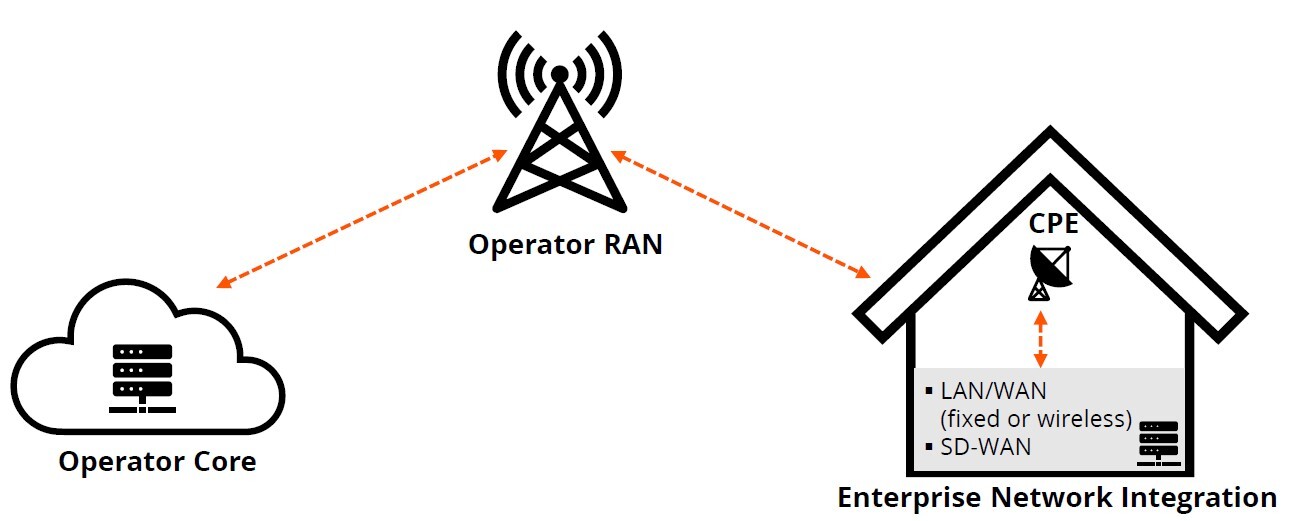
Fixed wireless access delivers 4G/5G connectivity at the last mile, as opposed to fixed-line infrastructure. A connection is established via communication between an MNO’s core & Radio Access Network (RAN) and the Customer Premises Equipment (CPE) installed at an enterprise location. The CPE, which can be installed indoors or outdoors, then connects to the internal enterprise network through Ethernet or Wi-Fi.
A key selling point of FWA is that it can be used alongside private cellular networks. In this case, the private RAN operates on-site, and FWA serves as a connectivity backhaul to external networks or cloud services.
Not all business use cases require the same speeds or reliability. This makes network slicing a key feature for Information and Communication Technology (ICT) teams interested in siloing off segments of the network. That way, they can meet specific performance, latency, and security metrics for various business applications. MNOs like Telefónica and T-Mobile US are active in trialing FWA slicing to unlock new ways to leverage cellular connectivity.
Figure 1: Illustration of How FWA Works
Advantages and Disadvantages of Fixed Wireless Access
The key advantages and disadvantages of fixed wireless are outlined below:
Advantages:
- Rapid deployment
- Low installation costs
- Flexibility & mobility
- Redundancy & resilience
- Reach into underserved areas
- 5G performance & reliability
Disadvantages:
- Variable network performance
- Line-of-sight & coverage limitations
- Security & compliance concerns
- Capacity limitations in high demand areas
- Operator dependence & SLA gaps
Fixed Wireless Access Use Cases
ABI Research has covered the top fixed wireless access use cases across five key business verticals. These use cases are identified in Table 1, analyzing the requirements for performance, coverage, cost & flexibility, integrations, and security & manageability.
Table 1: Fixed Wireless Access Use Cases and Requirements
|
Use Case |
Performance |
Coverage |
Cost & Flexibility |
Integration Requirements |
Security & Manageability |
|
Retail/Pop-up Stores |
Low bandwidth for Point of Sale (POS) & cloud applications Latency tolerance – 100 ms |
Outdoor CPE + Wi-Fi backhaul |
Must support low-cost, rapid deployment for temporary or small-footprint sites |
Needs a simple setup with the existing LAN/Wi-Fi Basic WAN failover support |
Moderate security: PCI-DSS compliance & basic VPN/QoS needed Remote diagnostics is key |
|
Office & Education Campuses |
Moderate throughput (-100 Mbps) Latency -50 ms is tolerable Best-effort suffices for office productivity and surveillance |
Outdoor FWA + indoor Wi-Fi Line-of-sight is important for CPE placement |
Very cost-sensitive: avoids trenching, good for fast rollouts Strong fit for OPEX models |
Easy integration with SD-WAN and LAN systems To be used for enterprise mobility Integration into the office IT & software infrastructure is required |
Basic segmentation and remote management are required Cloud-native platforms preferred |
|
Agriculture/Rural IoT |
Low throughput for telemetry Latency can be >100 ms in many cases |
Outdoor, wide-area coverage is critical (5-7 km cells) Low-band spectrum is ideal |
Requires low-cost rural broadband with minimal cellular infrastructure dependence |
Simple backhaul required for existing sensor networks Compatibility with farm IoT platforms |
Lightweight security and cloud management are sufficient Battery-powered sensor support is critical |
|
Nomadic networks |
Moderate throughput (50-100 Mbps) Latency <50 ms is acceptable for most applications |
Outdoor-focused with high mobility Quick deployment is essential |
Must support temporary, portable deployments Minimal setup costs |
Plus-and-play SD-WAN or VPN support is preferred Strong value for edge computing |
Strong endpoint control Remote cloud management Encrypted access |
|
Hospitality |
Moderate throughput Low-latency needed for POS, video, and guest applications |
Indoor + outdoor (lobbies, rooms, conference areas) Static devices |
Scalable OPEX model for seasonal and high-turnover usage Quick setup required for multitenant venues |
Needs to integrate with Wi-Fi, IPTV, and POS systems Integration into the hospitality venue's IT infrastructure |
Isolation of guest & staff networks Centralized access & content control |
When Should Your Business Use Fixed Wireless Access?
Enterprises should use fixed wireless Internet if they are in an underserved/unserved area, currently lack backhaul connectivity, need to track temporary or in-transit assets without trenching, and/or require quick installation.
MNOs and telco equipment vendors have designed their services and hardware to accommodate these specific pain points. Below are common scenarios where FWA is a more viable option for an enterprise than fiber.
- Located in an Underserved/Unserved Area: Farm workers are adopting Internet of Things (IoT) sensors and devices to monitor crop health and improve yields, but lack broad 5G coverage due to their remote locations.
- Currently Lacks Cellular Backhaul: A remote mining site lacks cellular backhaul because telcos have not installed fiber in a low-population area.
- Require Quick Installation: A retailer is losing profits and customers are unhappy because fixed wirelines take too long to install at new store launches.
- Tracking Temporary or In-Transit Assets: A construction firm installs FWA routers in mobile trailers to manage equipment and vehicles across rotating job sites.
To summarize, fixed wireless access offers flexibility, scalability, and cost-effectiveness that fiber cannot contend with. However, fiber broadband may be the preferred option when first-rate cellular performance is a must and fiber infrastructure is readily available at the enterprise site.
Further Resources:
 Dimitris Mavrakis