

With increasing legal obligations and ambitious net-zero targets set by Communications Service Providers (CSPs), alongside the rapid growth of global connectivity and data demand, these providers are actively seeking ways to enhance sustainability across their operations. Passive cellular antennas, critical elements of telco networks as discussed in our previous article, represent a significant opportunity to improve sustainability through energy efficiency and innovative design that reduce environmental footprint and lengthen the life span of products before replacement. To help achieve their ambitious environmental goals, CSPs must strategically manage antenna deployments and interoperability with other elements of the Radio Access Network (RAN). In fact, the fastest growing subsegment of passive cellular antennas is green and more sustainable antennas, driven by operator requirements for low environmental impact and increasingly tightening legislation.
ABI Research aims to support CSPs in this quest by pointing out the most important parameters and characteristics to look for in passive antennas and their vendors.
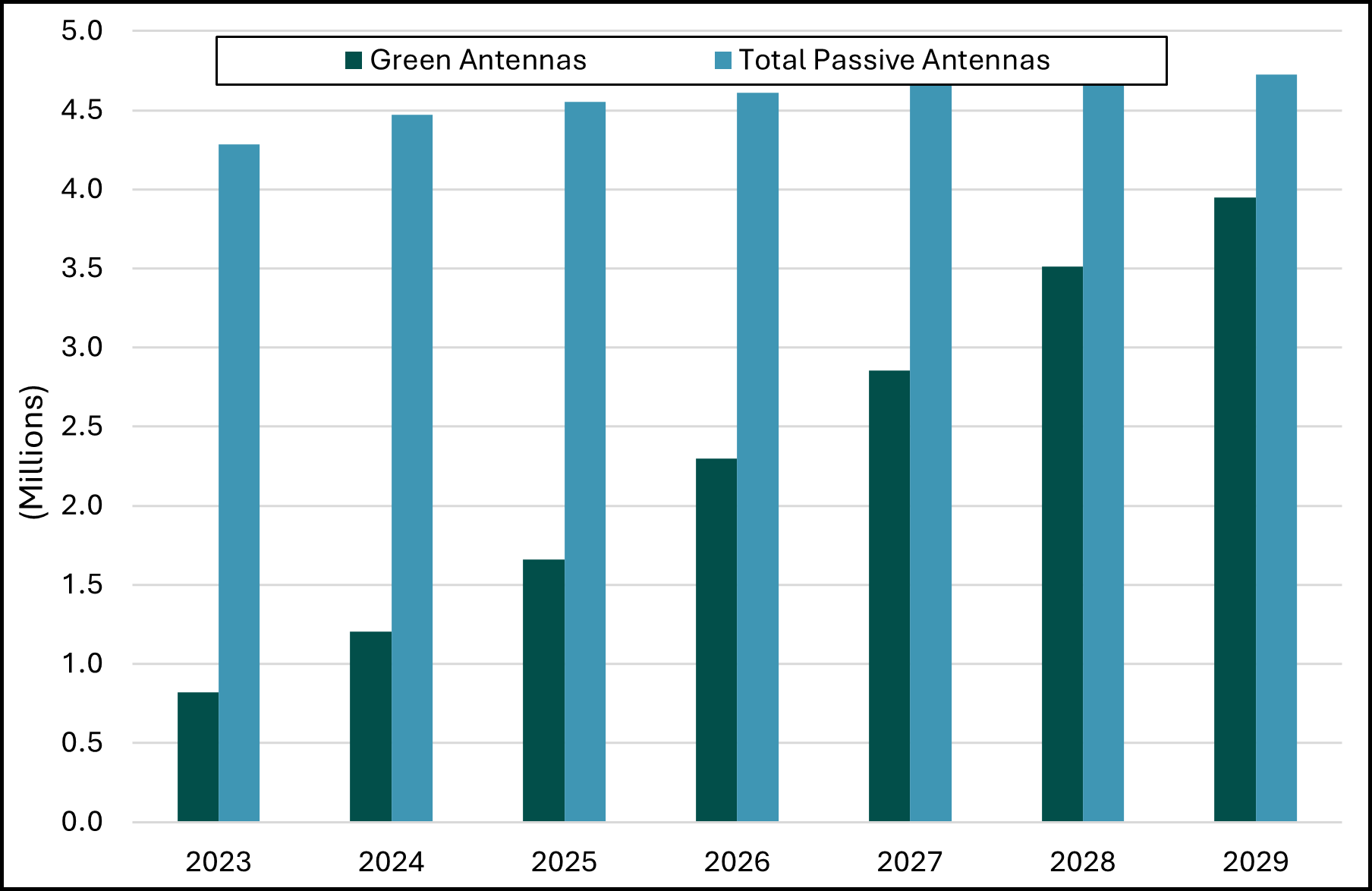
According to ABI Research definitions, a green antenna is one that is committed to environmental sustainability through energy efficient design, technologies that minimize footprint and sustainable, climate-friendly manufacturing processes. The following chart illustrates ABI Research forecasts for green passive cellular antennas compared to total antenna shipments.
Chart 1: Proportion of Green Cellular Antenna Shipments Within All Passive Antenna Shipments (2023 to 2029)
(Source: ABI Research)

Strategic Considerations for Sustainable Passive Cellular Antenna Deployments
Sustainability is a critical topic for CSPs that are now working to minimize the negative impact their networks have on the environment. A guidance document published in May 2025 by the NGMN discusses how vendors must improve product energy efficiency, enhance the accuracy and transparency of carbon data for their operations, and overcome variable Environmental, Social, and Government (ESG) maturity levels across supply chains. Many operators have committed to achieving net-zero emissions by 2040, 2035, or even 2030 in one case, making sustainability a central focus of their strategic priorities.
In addition to reducing energy consumption to meet sustainability goals, CSPs must lower their energy use to reduce Operational Expenditure (OPEX) related to network equipment. According to GSMA, energy costs account for 45% of network OPEX and 15% to 20% of total operational spending for an average CSP.
While there are few legally binding norms for measuring sustainability, many industries—including telecommunications—have embraced some widely recognized frameworks. This informal consensus enables greater transparency, accountability, and comparability across companies. For example, many telecommunications vendors structure their sustainability strategy around the following standards, initiatives, and ways of working:
- The United Nations (UN) Global Compact is a voluntary initiative guiding companies to adopt the Ten Principles[1]—covering human rights, labor, environment, and anti-corruption. Adopting and integrating these principles into strategies, policies, and culture helps companies meet core responsibilities to people and the planet.
- Use the Greenhouse Gas (GHG) Protocol to comprehensively measure, manage, and report GHG emissions across all three scopes in the value chain: Scope 1 (direct emissions), Scope 2 (indirect emissions from purchased energy), Scope 3 (value chain emissions—upstream and downstream)
- Set and validate climate targets with the Science Based Targets initiative (SBTi) for the entire company as a foundation. The targets should be absolute, aligned with the 1.5 °C trajectory and cover the full company value chain across all three GHG scopes.
- EcoVadis is also a commonly used credible sustainability rating platform that assesses environmental, social, and ethical performance on a company level. It helps businesses evaluate and improve responsible practices across their supply chains in an orderly, standardized way.
- Certify its operations in accordance with the environmental management standard ISO 14001. This gives a systematic approach to setting environmental objectives, measuring performance, and driving improvements.
This alignment around shared frameworks provides a de facto standard way of working for credible and consistent sustainability measurements.
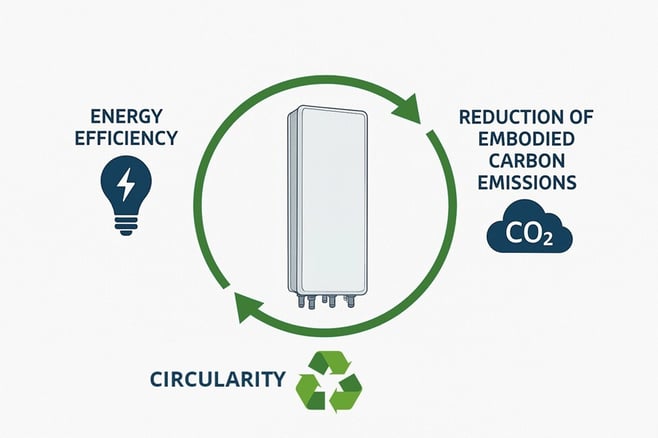
In terms of passive cellular antennas, CSPs must optimize the sustainability of their deployment choices and network infrastructure in three main areas, as outlined below.
Energy Efficiency
Passive cellular antennas are among the most extensively installed hardware elements in mobile networks. Relying on data sheets and simple radiation patterns does not necessarily lead to an objective assessment of their sustainability performance. CSPs need to evaluate advanced metrics, specifically beam efficiency in three dimensions, allowing network planners to adequately plan and optimize their networks. These antennas require high antenna efficiency and beam efficiency that directly impacts network performance, important metrics such as Signal to Interference and Noise Ratio (SINR), and ultimately, energy efficiency of the entire network.
Antennas with higher efficiency will lead to better end-user throughput, better cell-edge performance, and a reduction in overall base station energy consumption.
Embodied Carbon Emissions
As more CSPs committed to net-zero targets transition to renewable energy for their operations, embodied carbon—or the cradle-to-gate GHG emissions of antennas—is becoming an increasingly critical sustainability metric.
Addressing this challenge may be more complex than measuring energy efficiency and requires CSPs to thoroughly evaluate how their equipment vendors manage the entire value chain. This evaluation must consider not only vendors’ direct (Scope 1) and indirect (Scope 2) emissions, but also upstream Scope 3 emissions, which often constitute the largest portion.
Reductions in those embodied emissions can be achieved by designing products with more sustainable materials, reducing overall weight, minimizing waste through virtual prototyping, and promoting sustainable manufacturing practices among suppliers. Additionally, verifying climate commitments with component vendors and minimizing transportation emissions throughout both production logistics and final product delivery are essential steps in this process.
Circularity
Circularity is the final element of a holistic sustainability strategy for network equipment such as passive cellular antennas.
Responsible vendors should embrace a circular economy approach: designing antennas (and their packaging) using sustainable, easily recyclable materials; minimizing multilayer components and material diversity; and using the highest feasible proportion of recycled content. Packaging, in particular, should be 100% recyclable and contain as much post-consumer material as possible. Once products reach the end of their life, vendors should provide take-back programs and collaborate with certified e-waste partners to recover valuable materials. Wherever practical, products and components should be refurbished or repurposed, ensuring that all network equipment—including decommissioned antennas—leaves the field with the smallest possible environmental footprint.
Ericsson’s Role in Supporting CSP Sustainability Goals
Ericsson Antenna System designs and produces antennas emphasizing energy efficiency, lower embodied emissions and increased circularity. Ericsson is also using its own advanced test facilities in the design process, ensuring that the design fulfills its purpose in real-life use.
- For example, the latest antennas with trio net design maximize network impact by leveraging three interconnected dimensions: antenna design, pattern, and system. This combination unleashes 15% higher uplink throughput, 29% reduced radio output (live network benchmark case 1), and 35% lower mobile energy consumption (live network benchmark case 2) due to better Frequency Division Duplex (FDD) mid-band utilization, improved carrier aggregation, and a higher modulation and Multiple Input, Multiple Output (MIMO) scheme than previous antenna generation, as well as industry leading wind load, and safe & smart brackets.
- A 42% lower embodied carbon footprint compared to predecessor antennas was achieved by managing all aspects of the value chain from design, through production, and to delivery.
Ericsson Antenna System employs sustainability principles throughout the antenna lifecycle, using digital twins and simulations in Research and Development (R&D), reducing the weight of the products, adopting sustainable materials for the products and packaging, and using energy-efficient production methods. Additionally, antennas are produced and stored as close as possible to customers, ensuring short and sustainable delivery routes.
Ericsson’s E-Waste Management program ensures proper refurbishing or recycling, minimizing e-waste and enabling CSPs to comply easily with environmental regulations and helping fulfill their circularity goals.
A significant hurdle for CSPs is obtaining accurate and comprehensive carbon emission data from equipment manufacturers and suppliers. Ericsson uses a simplified Lifecycle Assessment (LCA) methodology for embodied carbon accounting and adherence to other widely adapted transparent reporting methodologies listed earlier in this article, such as GHG Protocol standards and reporting via sustainability reports and SBTi channels, to provide clearer, reliable data, enabling operators to make well-informed decisions.
Conclusion
CSPs must balance immediate efficiency gains with sustained strategic actions to achieve long-term sustainability goals. Immediate actions include improving antenna energy efficiency and optimizing operational processes using advanced technologies and renewable energy sources. Long-term commitments require cooperation with vendors that are committed to continuous investment in innovation and sustainable design, adopting sustainable materials, and refining lifecycle management practices.
As sustainability becomes central to the telecoms industry’s strategy, effectively managing passive cellular antennas is essential for operators aiming to meet their environmental targets. By taking a comprehensive approach—focusing on energy efficiency, embodied-carbon emissions, and circularity—CSPs can drive down both their environmental footprint and their operational costs. At the same time, CSPs should remain vigilant about vendors’ sustainability claims—verifying that partner standards align with recognized frameworks, rather than relying solely on marketing language. A careful review of measurement methodologies and certification credentials helps ensure that “green” commitments translate into genuine, verifiable progress.
Ericsson’s targeted solutions, coupled with a collaborative, science-based implementation model, offer a proven framework for operators striving toward sustainability excellence.
For a more in-depth analysis, read the Ericsson whitepaper, Embodied carbon in the telecom industry.
 Sam Bowling