

There will be nearly 13 million robots in circulation by 2030, according to ABI Research’s Commercial and Industrial Robotics Addressable Market, Segmentation, and Technologies Market Data Overview: 3Q 2025 report. From transporting materials to an automotive assembly line to welding a tube for a jet airliner, robotics is set in stone with the digital transformation story. This is especially resonant with the many companies contemplating reshoring projects in the wake of U.S. tariff policies.
Purchasing orders are on an upward trajectory as businesses address labor shortages and aim to improve efficiency, quality, and time-to-value. Lucrative opportunities are forming not just for robotics Original Equipment Manufacturers (OEMs), but also for connectivity providers, computing platforms, Artificial Intelligence (AI) software vendors, and technology implementers.
Leveraging ABI Research’s latest market forecasts, this article will share key forecasts and dissect trends shaping the robotics industry across the following five segments:
- Industrial robots
- Collaborative Robots (cobots)
- Mobile robots
- Humanoid robots
- Exoskeletons
Key Takeaways:
- The global robotics market size is nearly US$50 billion in 2025. This is an 11% increase compared to 2024. Growing at a Compound Annual Growth Rate of 14%, the market size will reach US$111 billion by 2030.
- Mobile robots dominate hardware and software sales. According to ABI Research market data, mobile robots generate 50% to 60% of total revenue through the rest of the decade. Material handling and Automated Storage and Retrieval Systems (AS/RS) are predominant applications.
- China is a regional giant. China’s bustling manufacturing sector is ripe for automation, accounting for 42% of industrial robot sales worldwide. North America and developing economies will see increased market shares, while European robotics adoption will remain flat.
- AI is integrating with robotics. Physical AI and closed-loop automation are significantly enhancing cobot capabilities. Yaskawa, KUKA, FANUC, ABB, and Palladyne AI are notable robotics vendors innovating in the AI space.
- A fledgling humanoid market. Humanoid robots are the fastest-growing segment, mostly due its nascent nature at the moment (learn more in our market outlook, including three potential scenarios). However, recent investment activity indicates strong momentum building up for humanoid developments.
- Exoskeleton segments are fueled by safety augmentation. Industrial organizations invest in exoskeletons to alleviate physical strain on workers. Market demand is also being stimulated by healthcare providers for rehab.
- Growing demand for software. According to our analyst study, robotics software will generate US$24.5 billion in revenue by 2030. Enterprises leverage software for analytics, perception, motion control, and similar use cases.

How Big Will the Robotics Market Be?
The global robotics market size will reach US$110.7 billion by 2030, a 2.5X increase over 2024’s US$45 billion size. This translates into a Compound Annual Growth Rate (CAGR) of 13.8% through the forecast period.
But which market segments offer the biggest revenue opportunity?
The five types of robots we analyzed span industrial robots, cobots, mobile robots, humanoid robots, and exoskeletons. Out of these form factors, mobile robots generate the most shipments and revenue, followed by industrial robots. The other types are far more technologically ambitious and cost more, with deployments being relatively nascent.
Table 1: Global Robotics Market Size by Type
|
Type |
Revenue (US$ Billions) |
2024 |
2025 |
2026 |
2027 |
2028 |
2029 |
2030 |
CAGR (2024–2030) |
|
Industrial Robots |
US$ Billions |
17.03 |
17.4 |
17.72 |
18.1 |
18.5 |
19 |
19.61 |
2.0% |
|
Collaborative Robots |
US$ Billions |
1.29 |
1.68 |
2.23 |
2.96 |
3.9 |
5.21 |
7.04 |
27.5% |
|
Mobile Robots |
US$ Billions |
25.87 |
29.98 |
34.9 |
40.89 |
48.57 |
59.54 |
75.37 |
16.5% |
|
Humanoid Robots |
US$ Billions |
0.02 |
0.07 |
0.59 |
1.81 |
2.94 |
4.88 |
6.54 |
137.7% |
|
Exoskeletons |
US$ Billions |
0.68 |
0.85 |
1.07 |
1.31 |
1.56 |
1.85 |
2.16 |
18.1% |
|
Total |
US$ Billions |
44.87 |
49.98 |
56.51 |
65.02 |
75.42 |
90.45 |
110.72 |
13.8% |
(Source: ABI Research)

How Are Mobile Robots Being Used?
Mobile robots will generate US$75 billion in revenue by the end of the decade, driven primarily by material handling and Automated Storage and Retrieval Systems (AS/RS) applications. The growth potential for mobile robots is aided by the fact that many markets are still untapped. The logistics industry is experiencing existential challenges like workforce shortages, supply chain reformation, and high turnover rates. Concurrently, there is increased consumer demand to keep up with. Mobile robots can be used to alleviate these challenges by expediting the loading/unloading of trucks, automating inventory management, and performing last-mile delivery services.
In warehousing, Autonomous Mobile Robots (AMRs) are used for material handling. This application currently accounts for 50% to 60% of total shipments and revenue for mobile robots. They often transport products for e-commerce, providing functions such as Goods-to-Person (G2P), a picking aid for workers, pallet transport, and truck loading within a warehouse.
While material handling is the leading use case today, ABI Research forecasts Automated Storage and Retrieval Systems (AS/RS) to take over by 2030. It will account for nearly half of total mobile robot shipments and 35% of revenue by then. Rail-Mounted Robots (RMRs), which cost significantly less than AMRs, are driving the demand for AS/RS applications.
Besides warehousing and manufacturing, our analyst team foresees strong growth for cleaning robots in retail, delivery bots in e-commerce, and AMRs in agriculture.
Software integration is the greatest for mobile robots, accounting for 84% of total software revenue in 2030.

China Will Continue to Lead the Industrial Robotics Market
Regionally, Asia-Pacific drives the most robotic shipments and revenue due to its strong industrial maturity. China alone accounts for 42% of worldwide revenue from industrial robots. Japan and South Korea make up a further 12.7% and 10.1%, respectively. By 2030, Asia-Pacific’s market share will dwindle from 72% to 62% as the United States and the Middle East & Africa play catchup. Meanwhile, Europe’s share of the industrial robot market will remain stable, increasing from 14% to 15.5%.
Industrial robots are the second largest segment within the robotics market, although growing at the slowest rate. While China will sustain its leader status, North American and European firms can use robotics in their reshoring/nearshoring initiatives. Industrial robots fit the bill for welding, material handling, machine tending, assembly & screwing, painting & coating, and other applications that can be automated.
These use cases bode well for the automotive industry, which accounts for roughly a third of total shipments and revenue. The electronics, machinery, and Food & Beverage (F&B) industries make up the bulk of the remaining revenue generation.
Some notable trends to keep an eye on within the industrial space include Artificial Intelligence (AI)-augmentation, the use of Graphics Processing Units (GPUs), offline programming tools, low-code interfaces, and software standardization.

How Is AI Used for Collaborative Robots?
Cobot revenue is projected to grow at a CAGR of 27.5% between 2024 and 2030, increasing from US$1.3 billion to more than US$7 billion. Robotics vendors interviewed by ABI Research have reported broad success with cobots.
The market opportunity for selling cobots is more uniform across use cases than other types of robots. Palletizing, machine tending, picking, inspection, and welding/gluing will all account for between 14% shipment share on the low end to 18% on the high end by 2030.
Cobots are ripe for innovation, with physical AI emerging as a big talking point. Despite its transformational impact, companies are wary of investing in AI-based robotics. At CES 2026, humanoids and Physical AI were the primary themes with a host of product launches and exhibitions from multiple vendors, notably from Chinese OEMs and U.S.-based semiconductor companies (learn more in the blog, AI Takes Center Stage at CES 2026: Analyst Perspectives Across Key Sectors).
Technology providers must demonstrate a clear Return on Investment (ROI) to customers.
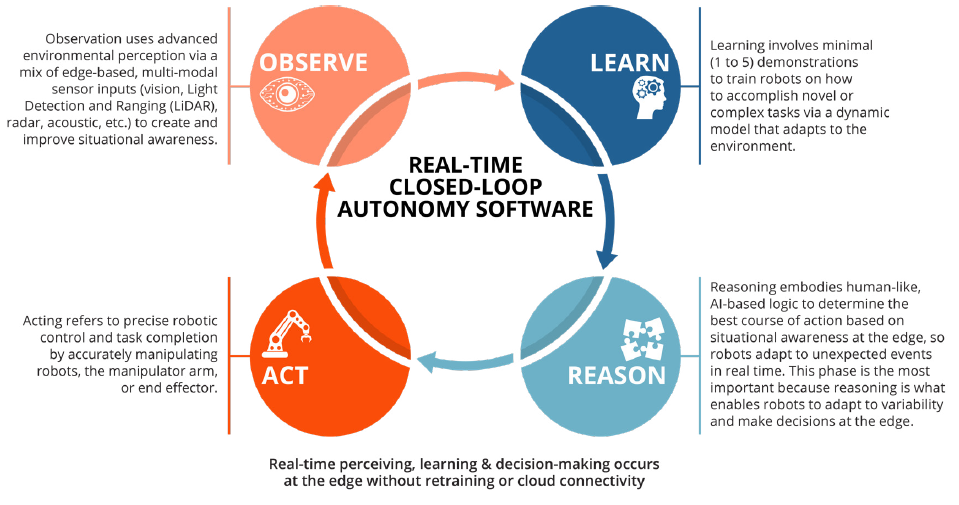
For example, Palladyne IQ offers closed-loop automation software that allows a cobot arm to observe, learn, reason, and act. This means the cobot arm constantly ingests new data from sensors, cameras, and other in-field technologies. That way, the cobot can rapidly adjust to changes within a dynamic work environment. The idea of AI-robotics integration is to avoid relying on outdated data and empower enterprises to react to irregularities in real time.
Palladyne IQ is not alone. Vendors like FANUC, Yaskawa, ABB, Siemens, Rockwell Automation, and NVIDIA are also designing AI tools to accelerate time-to-value for cobot deployments.
Figure 1: Closed-Loop AI Software Framework for Robotics

What Is the Projection of the Humanoid Robot Market?
The humanoid robot market size will reach US$6.5 billion in 2030. Humanoids are the fastest-growing type of robotic system analyzed by ABI Research, maintaining a 137.7% CAGR through the forecast period.
Humanoids are still very much in the early days of market establishment, being dwarfed by other robotic solutions. Today, humanoids account for less than 2% of the overall robotics market. Most applications will be tied to entertainment for the foreseeable future. It remains to be seen when humanoid technology will be ready for mission-critical applications at scale.
However, there are positive signals.
Technical maturity has progressed to the point where investors are all ears for humanoid robot suppliers. In February 2025, Axios reported US$350 million in Series A funding for Texas-based humanoid developer Apptronik. More recently, Chinese startups Robot Era and EngineAI have secured millions in funding as well. Meanwhile, Silicon Valley darling Figure AI is seeking a US$39.5 billion valuation, a 15X increase compared to its last valuation. These news headlines reflect a growing appetite among Venture Capitalists (VCs) and technology partners to finally invest in humanoids.
Table 2: Average Selling Price (ASP) for Each Type of Robot
|
Type |
2024 |
2025 |
2026 |
2027 |
2028 |
2029 |
2030 |
CAGR 24-30 |
|
Industrial Robot |
US$34,818 |
US$33,840 |
US$32,900 |
US$31,996 |
US$31,127 |
US$30,290 |
US$29,484 |
-2.3% |
|
Collaborative Robot |
US$32,357 |
US$31,592 |
US$30,823 |
US$30,050 |
US$29,274 |
US$28,495 |
US$27,714 |
-2.2% |
|
Mobile Robot |
US$49,238 |
US$48,132 |
US$46,765 |
US$45,126 |
US$43,005 |
US$40,501 |
US$37,272 |
-3.9% |
|
Humanoid Robot |
US$158,400 |
US$135,400 |
US$116,900 |
US$92,680 |
US$70,360 |
US$53,480 |
US$38,100 |
-21% |
(Source: ABI Research)
The average cost of a humanoid is US$158,400, making it the most expensive type of robot available on the market. The novelty of humanoid innovation carries a hefty price point that hinders adoption across consumer and enterprise sectors. However, as the ecosystem finds its footing, ASPs will come way down and reach near parity with mobile robots in the near-term future. By then, humanoid technology can be perceived as a more viable investment for customers.

Exoskeleton Revenue to Grow by 2.5X Between 2025 and 2030
Exoskeleton revenue is expected to reach US$2.2 billion by 2030, up from US$850 million in 2025. This equates to a 2.5X increase in market size. The heavier powered (active) exoskeletons drive most of the revenue, although the more lightweight passive exoskeletons drive more shipments.
Powered exoskeletons provide motorized assistance and advanced control. They are used for medical rehabilitation, as well as load-lifting for industrial workers, soldiers, and law enforcement. The less expensive, lightweight passive exoskeleton is equipped with springs, dampers, or mechanical linkages to assist with mobility. They benefit users by alleviating physical strain from labor-intensive tasks (e.g., lifting) and establishing an ergonomic posture. Both types of exoskeletons help reduce work-related injuries, saving organizations a lot of money.
Table 3: Average Selling Price (ASP) of Exoskeletons (2025 Forecasts)
|
Type |
Lower Body |
Upper Body |
Full Body |
|
Heavy Lift |
US$34,473 |
US$28,284 |
US$116,956 |
|
Medium Lift |
US$22,581 |
US$30,650 |
US$44,303 |
|
Light Lift |
US$18,760 |
US$13,304 |
US$30,458 |
Commercial and industrial applications spearhead the exoskeleton market, with revenue going head-to-head through our forecast. Indeed, these two sectors encompass 85% of global exoskeleton revenue. Within the industrial segment, automakers, aerospace manufacturers, and oil & gas suppliers invest the most in exoskeletons. These industries want to automate repetitive heavy lifting tasks that often lead to workplace injuries. In the commercial space, there is a strong case for exoskeletons to be used in healthcare, warehouse logistics, and freight services.
Exoskeleton revenue overshadows humanoid robots today. However, the latter will sidestep the former by 2027 as the technology ecosystem matures.

In Conclusion
To wrap it up, the global robotics market is growing at a healthy pace. It is defined by a number of headwinds driving increased demand for automation. Reshoring/nearshoring projects, labor shortages, and other challenges can be alleviated with robotics. Historically prohibitive price points will steadily decline throughout the rest of the decade, making robotics investment a reality for enterprises and consumers. Strategic partnerships between technology companies will also materialize as vendors aim to fill in the gaps in their robotics solutions. For instance, NVIDIA’s Isaac platform is used by many firms for implementing AI-based robotics.
Mobile and industrial robots will continue to lead the charge as the ROI case is already clear and ASPs are relatively reasonable to executive teams. However, AI software is revolutionizing cobots, promising quality and efficiency gains. Over time, more successful case studies for AI-enabled cobots will be demonstrated, drawing organizational buy-in.
Humanoid shipments are skyrocketing, and the investment landscape is extremely active. Early deployments are mostly reserved for entertainment applications. Think of the Optimus robot serving popcorn at Elon Musk’s Tesla Diner & Drive-In in Los Angeles. In the enterprise space, humanoids will be extremely beneficial for safety-critical applications. For example, they can perform inspections in hazardous oil & gas environments that are unsafe for humans. Again, humanoids are a nascent opportunity in non-entertainment sectors. Once the business case is made clearer and price tags come down, we expect broader adoption.
Exoskeleton vendors, while possessing the smallest revenue opportunity, are also witnessing strong growth potential as organizations aim to reduce workplace incidents. Powered form factors within the industrial and commercial sectors dominate, with military applications gaining traction.
On the innovation front, robotics is increasingly being integrated with other technologies. Physical AI, perception software, simulation tools, offline programming platforms, and open-source frameworks improve the functional capabilities of a robot. They help customers unlock novel use cases, automate specific tasks, and enhance safety.
While the forecasts shared, thus far, focused on robotics hardware, there is a growing appetite for software solutions as well. Our analyst team forecasts robotics software to generate US$24.5 billion in revenue by 2030. Mobile robot users across warehousing, agriculture, delivery, manufacturing, and ports are the top customers. Software tools are used for data analytics, operations & management, perception/machine vision, and motion control/human-machine interactivity.
Robotics is a pillar of Industry 4.0 technologies, going hand-in-hand with digital transformation. As organizations ramp up their digitalization projects, robotics OEMs, technology vendors, and System Integrators (SIs) will be seen as essential partners. For a more detailed analysis of the robotics market forecasts and trends, download ABI Research’s Commercial and Industrial Robotics Addressable Market, Segmentation, and Technologies Market Data Overview: 3Q 2025.
Take a look at our library of robotics research. Learn more
Frequently Asked Questions
How big is the robotics market?
According to ABI Research, the global robotics market size is US$50 billion in 2025. The market is projected to expand to US$111 billion by 2030, for a Compound Annual Growth Rate (CAGR) of 14%. More than half of this revenue comes from the sale of mobile robots.
How big is the mobile robot market?
The mobile robot market size is US$30 billion in 2025. ABI Research forecasts the market to grow at a CAGR of 16.5%, reaching US$75 billion in 2030. Key market drivers include material handling automation and Automated Storage and Retrieval Systems (AS/RS).
How big is the industrial robot market?
ABI Research projects the industrial robot market to surpass US$17 billion in 2025. That number is forecast to jump modestly to US$19.6 billion by 2030, for just a 2% CAGR. “China and the rest of Asia represent the largest regional markets, driven by their vast manufacturing sectors
How big is the collaborative robot market?
The collaborative robot market is forecast to reach US$1.7 billion in 2027. Growing at a CAGR of 27.5%, the market size is projected to more than double to US$7 billion by 2030. Leading cobot use cases include palletizing, machine tending, picking, inspection, and welding, and gluing.
How big is the humanoid market?
According to ABI Research, the humanoid market size will increase from just US$70 million in 2025 to US$6.5 billion in 2030. This equates to an explosive 138% CAGR. Initial market drivers will originate in the entertainment space.
How big is the exoskeleton market?
The exoskeleton market is projected to reach US$850 million in 2025. The market will grow at a CAGR of 18% through 2030, eclipsing the US$2 billion market. Key demand drivers come from industrial worker augmentation, freight transportation, and medical rehabilitation.
Supporting Resources:
- Industrial Robots [MD-IROBO-106]
- Collaborative Robots [MD-COBOT-103]
- Commercial and Industrial Robots [MD-CIROBO-110]
- Mobile Robots [MD-MOROBO-104]
- Exoskeletons [MD-XROBO-103]
Start with free research
Subscribe to ABI Research's weekly newsletter for access to our latest Analyst Insights, whitepapers, report samples, webinars, and more.
