

Robots are a cornerstone of a smart factory, automating a wide range of manufacturing tasks that are monotonous, physically straining, or even hazardous. However, real-world robotics deployments have not lived up to the revolutionary potential the industrial sector originally envisioned. Robot implementations are typically confined to specific applications, carry high costs, and are time-consuming. A recent ABI Research Industrial and Manufacturing Survey of 458 decision makers indicates that skill shortages and time constraints hinder roughly 9 in 10 manufacturers’ ability to implement and scale new technologies. These challenges serve as the impetus for industrial organizations to seek digital tools that simplify the creation of automation workflows.
My team recently analyzed the promise of Artificial Intelligence (AI) software in bringing robotic deployment concepts to life. Closed-loop AI software tools, such as Palladyne IQ, provide a low-code platform to expand use cases, offer superior data utilization capabilities, and accelerate time-to-value for manufacturers’ robot investments.
Achieving Manufacturing Automation with AI and Robotics
Workflow automation is the ideal end goal for manufacturers that purchase industrial robots, but rigid legacy systems have stalled progress. To achieve it, organizations would have to divert existing human and financial capital, rely on suppliers, and hire third-party consultants who possess the necessary expertise. Consequently, many automation workflows have largely been avoided by the manufacturing sector until now.
Figure 1: How Closed-Loop AI Software Automation Works
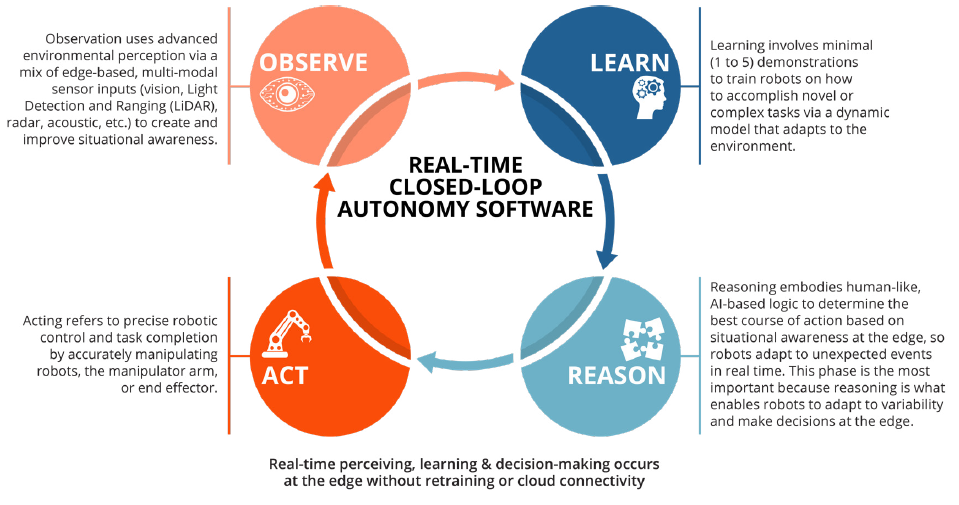 (Source: ABI Research)
AI software designed to democratize workflow automation is the next stage of robotics in manufacturing. Low-code environments mean you don’t have to hire highly skilled coders or worry about prolonged rollouts. Equally important, AI-based robotics unlocks use cases previously impossible due to significant complexity. These full-stack, closed-loop AI tools enable the robot to more accurately mimic human behavior by observing, learning, reasoning, and acting based on historical and real-time data (from vision systems, sensors, etc.) at the edge. This ensures that a deployed robot adjusts to real-time changes on the factory floor and automatically adapts to any irregularities.
After adopting closed-loop AI software for industrial robots, manufacturers can expect the following benefits:
- Time savings from accelerated programming
- Increased Return on Investment (ROI)
- Improved workplace safety
- Enhanced quality control
- Agility to accommodate a dynamic environment
Case Study: AI Enables Robots to Automate Dirty Jobs
The main calling card of AI-enabled robotics is to perform tasks that previously could not be automated. One of the best ways to demonstrate this is to consider the surface preparation and component cleaning processes. These tasks are critical to ensuring that high-quality manufactured goods are shipped out, but they are generally seen as undesirable from an employee standpoint. It exposes human workers to dirty surfaces and safety hazards, not to mention the physical toll it can inflict. Consequently, employee turnover is high for this job, resulting in costs from downtime and training newcomers. Therefore, an AI-enabled industrial robot or Collaborative Robot (cobot) arm would be a viable replacement.
For example, Palladyne IQ’s AI-based robotics software transforms surface preparation by enabling cobots to autonomously identify components, select cleaning tools, and perform inspections in a single shift. Its low-code, closed-loop system simplifies complex tasks, cuts retraining needs, and boosts accuracy, making automation cost-effective and adaptable for manufacturers. Such cases illustrate how AI-based robotics software empowers manufacturers to overcome traditional automation barriers and deliver efficient, scalable solutions for modern factories.
Achieving Lights-Out Automation Is Not a Matter of Flicking the Switch
AI-based robotics software is a core pillar of achieving lights-out manufacturing. Without these cutting-edge tools, manufacturers would have to constantly micro-manage their robots to double-check functionality and safety. While humans will continue to be “in-the-loop” for robotic applications for the foreseeable future, closed-loop AI software will be the key to creating fully autonomous workflows.
For manufacturers to replicate the previous case study and expand to other use cases, they must craft a clear roadmap for their robotics adoption. To access ABI Research’s best practices and learn more about how closed-loop AI software provides the adaptability and simplicity needed to scale robotic deployments, download the whitepaper, AI-Enabled Robotics Software for Manufacturing Automation Use Cases: Speeding Time-to-Value.
 Ryan Wiggin