

The automotive industry in 2025 faces a convergence of political, economic, social, technological, legal, and environmental disruptions that threaten its stability and growth. As vehicle Original Equipment Manufacturers (OEMs) contend with everything from international tariffs to labor shortages and shifting consumer behavior, maintaining competitiveness will demand agility and a digital-first mindset. This blog unpacks the major automotive industry challenges in 2025 and offers insight into how manufacturers are turning to technology to survive and thrive.
Table 1: Top Challenges Facing the Automotive Industry and Technologies to Address Them
|
Challenge |
Relevant Technologies |
Example Tech Providers |
|
Political Tensions |
Application Lifecycle Management (ALM) for tariff documentation Bill of Materials (BOM)/parts tracking Enterprise Resource Planning (ERP) for global trade visibility |
PTC (Codebeamer), Siemens (Polarion), Jama Software, Epicor, Infor |
|
Economic Strain and Cost Increases |
Additive manufacturing to lower production costs Manufacturing Execution System (MES) for process optimization Predictive analytics for operational agility |
Stratasys, 3D Systems, Nano Dimension, Oracle, Tulip, MachineMetrics, Sight Machine |
|
Talent Shortages |
Augmented Reality (AR)/Virtual Reality (VR) for training employees Robotics for labor efficiency Product Lifecycle Management (PLM) for workforce collaboration |
Averian, TeamViewer, ABB, KUKA, Festo, PTC, Aras, Epicor |
|
Regulatory Uncertainty |
PLM/ALM for compliance tracking Simulation tools Machine vision for defect detection Circular economy tools for climate action compliance |
PTC, ComplianceQuest, Ansys, Simul8, Cognex, Basler, Keyence |
(Source: ABI Research)
1. Political Tensions Escalate Tariff Pressures
The fate of the automotive industry is often influenced by governments and regional bodies as their policies wield unprecedented influence over global supply chains. Recent tariffs mandated by the Trump administration are a perfect example of this unpredictable challenge. As of May 3, the U.S. government imposed a 25% tariff on all imported vehicles and their components.
The impact on automobile manufacturers is profound—particularly for those relying on international supply chains (learn more about the tariff impact on the automotive industry in Research Director James Hodgson’s ABI Insight). GM, Ford, Stellantis, and foreign automakers with assembly plants in Mexico and Canada now face higher operational costs and disrupted logistics. For instance, Stellantis has paused production at certain Canadian and Mexican facilities, laying off hundreds of workers.
Chinese manufacturers are also entangled in this geopolitical web, with Electric Vehicles (EVs) from China facing a 100% U.S. tariff placed by the previous U.S. administration. Meanwhile, the European Union (EU) is taking a defensive stance, applying tariffs up to 45% on cheaper Chinese EV imports to protect local industries (learn more in the whitepaper, Navigating Tariff Turbulence In The Technology Sector).
2. Economic Strain and Cost Increases
Automobile industry problems extend beyond policy constraints. Rising costs of materials, energy, and labor are leading to unavoidable vehicle price hikes, which will dampen consumer demand. In the United States, vehicle imports rose to 7.68 million units in 2024, which was worth over US$219 billion. Yet these volumes are at risk of dissipating if affordability becomes a limiting factor.
Automobile manufacturers are further strained by wage pressures, fueled by strong trade unions in Europe and landmark compensation deals like that of the United Auto Workers (UAW). Cost escalations are now affecting every node of the value chain—from parts procurement to insurance premiums driven by pricier components.
|
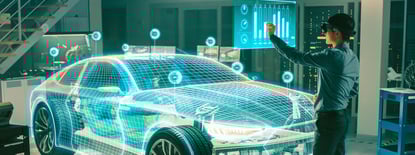
Learn how automotive manufacturers can use Extended Reality (XR) technologies to enhance vehicle design and accelerate time to market in these articles: How Automakers Can Use XR to Enhance Vehicle Design and Customer Engagement Best XR Adoption Path for Automotive Engineering and Design Teams
|
3. Talent Shortages Stall Vehicle Production and Innovation
Labor challenges are another major challenge that the automotive sector must tackle. The baby boomer exodus from the manufacturing sector is creating skills gaps in vital job roles. Robotics automation will continue to be a key investment area to make up for lost manual labor and boost throughput.
The industry also has problems hiring workers with the skills needed to digitally transform. For example, a recent survey found that roughly half of young people in Michigan—the top automotive manufacturing state in the United States—do not view the industry as an attractive field to work in. With a talent shortage in engineering and digital skills, OEMs are struggling to attract and retain the specialized workforce required to power modern production lines. The gap is particularly acute in roles related to vehicle autonomy, robotics maintenance, and Software-Defined Vehicle (SDV) architecture —skills essential for scaling Industry 4.0 initiatives.
OEMs must also consider whether they want to open-source their software or make it proprietary (learn how Hyundai and Li Auto are building in-house SDV expertise in Research Analyst Abu Miah’s recent ABI Insight).
4. Regulatory Uncertainty Impacts Long-Term Planning
Carmakers are caught between bold regulatory targets and ambiguous enforcement timelines. The EU’s goal of reaching 100% emissions reduction by 2035 for new vehicles remains, but recent policy adjustments now allow for 3-year averaging of Carbon Dioxide (CO2) compliance. Similarly, the United Kingdom is considering rolling back its 2027 emissions targets.
In the United States, EV regulation is left to state legislation. California is the most active in zero-emissions target-setting, with a few other states planning to follow similar paths. But for the most part, the EV regulatory environment in the United States is inconsistent, leaving Internal Combustion Engine (ICE) vehicles as a lucrative opportunity for the foreseeable future.
These volatile regulatory environments hinder automakers’ ability to make sound long-term decisions.
Managing Automotive Challenges with Technology
To navigate the multifaceted challenges in 2025, the automotive industry must embrace digital transformation. Technologies—ranging from design software and cloud computing to Manufacturing Execution System (MES) and AI-driven analytics—are becoming the backbone of agile operations. These tools not only help automakers reduce lead times and ensure compliance, but also provide the visibility and control needed to adapt to supply chain fluctuations in real time.
Looking to stay competitive in 2025 and beyond? Download ABI Research’s application analysis report, Auto Manufacturer Challenges: Consumer Sentiment, Regulators, Labor Force Dynamics and Tariffs. It takes a deep dive into the biggest challenges in the automotive sector in 2025 and outlines the role of technology leaders in accelerating vehicle production, maintaining regulatory compliance, and future-proofing operations.
 Ryan Wiggin
 Ryan Martin