
Page updated on January 15, 2026
ABI Research’s manufacturing trends outlook in 2026 reflects how the industry is balancing digital transformation, workforce constraints, and rising operational risk in an increasingly complex global environment.
The manufacturing industry is in flux. From tit-for-tat tariff policies and reshoring projects to skills shortages and global conflict, manufacturers find themselves on shaky ground. Meanwhile, customers continue to prioritize high-quality shipping (e.g., fast delivery, flexibility, packaging, etc.). This leaves manufacturers having to improve operational efficiency in the midst of uncertainty.
Technology remains a key investment area for the manufacturing sector. Artificial Intelligence (AI) deployments are maturing, with more robust capabilities being supported in discrete and process industries. Connected devices and industrial data management also emerge as increasingly essential tools as manufacturers digitally transform.
In this challenging environment, here are the top five manufacturing trends that ABI Research is watching in 2026.
Table of Contents
1. Digital transformation spending will ramp up in a big way across manufacturing industries
2. Urgency to implement AI across manufacturing operations
3. Manufacturers press the brakes on cloud-based software
4. Talent shortages constrain automation across manufacturing
5. Manufacturers aim to extract more value from industrial data
Digital transformation spending will ramp up in a big way across manufacturing industries
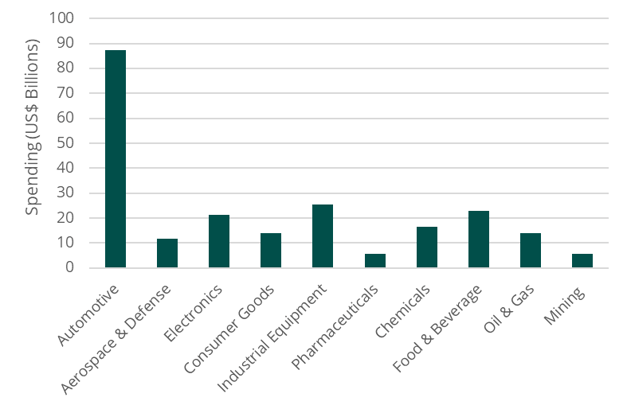
According to ABI Research’s most recent forecasts, the industrial & manufacturing sector will spend US$224.7 billion on digital transformation in 2026. This represents a Year-over-Year (YoY) growth rate of 13.8%.
But which sectors are embracing digital technologies to the highest and lowest degrees?
Automotive manufacturers are, by far, the top spenders, expected to invest US$87.3 billion this year. This means automakers account for 39% of total spending on digital transformation out of the 10 industries studied.
Digital transformation spending in the automotive industry is driven by the transition to Electric Vehicles (EVs). The electrification process requires vehicle Original Equipment Manufacturers (OEMs) to integrate new business models at their facilities. Beyond integrating hardware and software into production facilities, automakers will turn to professional services, cybersecurity tools, and connectivity partners.
Industrial equipment manufacturers follow the automotive industry, spending more than US$25 billion on technology in 2026. These companies need to invest in design software to make products that are both innovative and sustainable. AI is also being leveraged, reducing lead times and improving margins.
After that, food & beverage and electronics manufacturers invest a similar amount—US$ 22.8 billion and US$21.3 billion, respectively. Digital transformation spending for food & beverage firms is motivated by the need to manage tariff impact and build digital threads. The latter is key for plant managers to respond rapidly to fluctuating customer demand. Meanwhile, electronics manufacturers increasingly invest in technologies that provide operational flexibility and enhance quality control.
ABI Research’s 2026 spending forecast for all 10 industrial verticals is captured in Chart 1 below.
Chart 1: Digital Transformation Spending by Industrial & Manufacturing Vertical
World Markets: 2026
(Source: ABI Research)
Urgency to implement AI across manufacturing operations
Another defining manufacturing trend for 2026 is the growing urgency to deploy AI at scale. AI, Generative AI (Gen AI), and causal AI are increasingly used for quality control, predictive maintenance, cybersecurity, and other business applications.
According to Rockwell Automation’s State of Smart Manufacturing report, 95% of manufacturing firms have invested in AI/Machine Learning (ML) or plan to do so within the next 5 years. Manufacturers that continue to delay AI-based projects may soon find themselves treading water. While competitors leverage AI to solve common operational challenges, these laggards risk experiencing more frequent production downtime and poorer product quality.
ABI Research Distinguished Analyst Michael Larner predicts that more advanced manufacturing segments will use AI beyond predictive maintenance. He says, “Predictive maintenance will continue to be the critical use case where manufacturers start, but those further advanced in verticals such as the automotive and aerospace industries will be deploying projects where AI will support efforts to optimize operations, often via a digital twin.”
Larner expects process industries to also expand their AI usage in operations. He posits that “Process manufacturers will not be too far behind with manufacturers in the chemicals, pharmaceuticals, and food & beverage industries investing in AI tools that improve their ability to control their processes and proactively alert them when operations are at risk of wavering outside prescribed parameters.”
AI and Gen AI are clearly maturing across the manufacturing sector in 2026, often being scaled across multiple factories for individual companies. However, our analysts note that Agentic AI is unlikely to be scaled as widely this year. Most applications are high-stakes, such as worker safety and regulatory compliance. In these cases, Agentic AI requires a human in-the-loop to ensure optimal decision-making.
Manufacturers press the brakes on cloud-based software
Manufacturing Execution System (MES) software is essential for operational visibility and smart factory floor control. ABI Research forecasts spending on MES solutions to roughly double from US$20.7 billion in 2025 to US$40.3 billion in 2035.
The cloud is playing an increasingly important role within the MES market, providing scalability and cost advantages. However, the transition to cloud-based MES will be gradual due to data concerns.
The cyberattack on Britain’s largest automotive manufacturer, Jaguar Land Rover, weighs heavily on the minds of industrial leaders. The Cyber Monitoring Centre estimates the breach inflicted £1.9 billion ($2.5 billion) in economic damage, marking the most severe cyber loss ever recorded in the United Kingdom. As a ripple effect, manufacturers will be more comfortable deploying MES software on-premises, where there is more control over how and where data are stored. This will be especially prevalent in highly regulated industries such as aerospace & defense and pharmaceuticals.
ABI Research also expects a longer timeline for the shift to Manufacturing Operations Management (MOM) solutions as a result of cybersecurity challenges. MOM solutions are delivered through cloud-based Software-as-a-Service (SaaS) platforms, which manufacturers know can be vulnerable to breaches.
Take a deeper dive into these first three emerging trends and more by downloading ABI Research’s whitepaper, 62 Technology Trends That Will—and Won’t—Shape 2026.
Talent shortages constrain automation across manufacturing
Talent availability has emerged as one of the most consequential manufacturing trends shaping automation strategies. Industrial automation is a bedrock of digital transformation. But traditional automation skills are increasingly scarce and costly, pushing up the expense of maintaining legacy systems. ABI Research’s latest Industrial and Manufacturing Survey ranks recruiting qualified staff as one of the top five operational challenges.
To broaden available talent pools, industrial firms are looking to tap into the larger Information Technology (IT)-based software engineering workforce. This is an approach enabled by next-generation, IT-style Integrated Development Environments (IDEs). Examples include Siemens’ SIMATIC AX, Bosch Rexroth’s ctrlX WORKS, and Schneider Electric’s EcoStruxure Automation Expert.
Software-Defined Automation (SDA) is the next step in overcoming talent shortages. SDA decouples hardware and software, encourages a more open ecosystem, and supports the IT-style workflows that recent graduates prefer. After implementing SDA principles, manufacturers will gain the following benefits:
- Streamline the rollout of new systems
- Optimize development and resource allocation
- Remove IT/Operational Technology (OT) silos
- Scale industrial automation while maintaining flexibility
Download the report, The Software-Defined Automation Transition: Enablers and Challenges to Adoption, for deep insight into the drivers and inhibitors of SDA adoption technology in the industrial sector.
Manufacturers aim to extract more value from industrial data
Data are the bloodline of manufacturing technologies. Without access to industrial data, manufacturers will struggle to use Industry 4.0 solutions such as AI and digital twins. However, it’s estimated that manufacturers only use 5% of the data they generate. As new systems and Internet of Things (IoT) devices are introduced to the factory floor, there is a growing consensus that industrial firms must recalibrate their data management processes.
Beyond collecting and ingesting data, the data also need to be contextualized; for example, mapping data to specific hierarchies within the production process or defining relationships among assets, processes, and events. Technology vendors are developing solutions that can break down data silos and support real-time data analytics.
Interoperability must be achieved in order for these “digital threads” to be built successfully. For this to happen, ABI Research Analyst Carter Gordon believes vendor collaboration is in order. He states that “A robust network of partnerships enhances interoperability, as no single vendor offers a leading solution across every stage of the data value chain. This ecosystem is a necessity given the fragmented nature of existing systems.”
The four main vendor categories across the industrial data value chain are:
- Cloud solution providers (AWS, Microsoft Azure, IBM, etc.)
- Edge and DataOps software (HighByte, Litmus, Tulip, etc.)
- Manufacturing software providers (PTC, Siemens, General Electric, etc.)
- Industrial analytics and intelligence (Sight Machine, Palantir, Databricks, etc.)
In the saturated industrial data management market, vendors can differentiate themselves by supporting edge processing and prescriptive analytics. Processing and contextualizing data at the edge will increasingly be vital for manufacturers adopting AI. Edge processing provides low-latency, real-time analytics and the optimized data routing capabilities needed to run AI agents locally and securely.
Prescriptive analytics is an attractive case for the 70% of manufacturers that tell ABI Research they cannot prescribe action after collecting and normalizing data. Technology vendors should consider integrating prescriptive recommendations with production workflows. This will help automate corrective actions, but it’s important to offer human-in-the-loop interaction for maximum value.
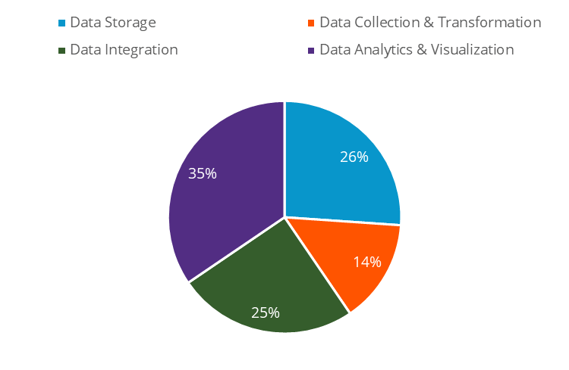
Manufacturers are expected to spend US$16.2 billion on data management solutions in 2026, an 8.7% increase YoY. Data analytics vendors stand to benefit the most as lucrative ML and AI models refine and provide their value in the industrial sector. ABI Research forecasts project data analytics & visualization tools to encompass 35% of total revenue for manufacturing data management this year, with that number increasing to 42% by 2035.
Chart 2: Manufacturing Data Management Revenue Share by Application
World Markets: 2026
(Source: ABI Research)
Identify the growth opportunities and key solution providers for manufacturing data management in ABI Research’s report, Industrial Data Trends & Technologies.
Related Reading
Manufacturing Software Trends and Outlook: ABI Research’s 2025 Recap
8 Manufacturing Trends Emerging in 2025
How Innovation Drives Manufacturing Transformation
Meet the ABI Research Manufacturing Analyst Team

Michael Larner, Distinguished Analyst
Research Focus: Michael Larner, Distinguished Analyst, is part of ABI Research’s End Markets team. His research examines how technologies such as data analytics, robotics, Artificial Intelligence (AI), the Internet of Things (IoT), and connectivity solutions are enabling discrete and process manufacturers, building managers, and facilities managers to address both external and operational challenges. He also examines the cutting-edge technologies driving transformation across the energy value chain.

Ryan Martin, Senior Research Director
Research Focus: Ryan Martin is a Senior Research Director at ABI Research covering new and emerging transformative technologies, including Industry 4.0, digital transformation, and the Internet of Things (IoT). He leads the firm's manufacturing, industrial, and enterprise IoT research efforts.

Carter Gordon, Research Analyst
Research Focus: Carter Gordon, Research Analyst, is a member of ABI Research’s Manufacturing, Energy & Buildings team. His research focuses on technologies that are driving digital transformation in the industrial and manufacturing sector.
Frequently Asked Questions
What are the top manufacturing trends in 2026?
The top manufacturing trends in 2026 include increased spending on digital transformation, wider adoption of AI, cautious use of cloud-based software, persistent talent shortages, and a stronger focus on extracting value from industrial data.
Why are manufacturing trends important for business leaders?
Manufacturing trends help leaders prioritize technology investments, manage operational risk, and stay competitive in volatile markets. Understanding these trends supports better decisions around automation, workforce planning, and digital strategy.
How is AI changing manufacturing operations?
AI is increasingly used for predictive maintenance, quality control, cybersecurity, and process optimization. More advanced manufacturers are also applying AI through digital twins to improve operational efficiency and reduce downtime.
To stay on top of more manufacturing trends in 2025 and beyond, subscribe to our research services:
 Ryan Wiggin
 Ryan Martin