

ABI Research surveyed 458 manufacturers to assess their pain points and technology investment priorities. The Internet of Things (IoT) is one key manufacturing technology we wanted to provide more clarity on.
We found that, overall, the IoT is perceived as a technology enabling broader digital transformation, rather than as an end in itself. This is true for both improving productivity and quality metrics, the two most important considerations for manufacturers. IoT devices provide the data that manufacturers need to build a connected environment, from the factory floor to the supply chain.
While the importance of IoT in manufacturing is growing, our survey reminds us of several challenges that still need to be addressed. This blog looks at five key findings from the survey, assessing how the IoT is being used in manufacturing and notable deployment hindrances. We also discuss the implications for IoT vendors.
Key Takeaways:
- Manufacturers are still early in their IoT journey. Most are evaluating suppliers, though there is wide variation across industries.
- IoT priorities differ between discrete and process manufacturers. There are significant divergences between process and discrete manufacturers in their operational challenges. Consequently, there are key differences when it comes to investments in automated data collection, asset tracking, supply chain visibility, Condition-Based Monitoring (CBM), and video.
- Data management remains the biggest barrier to IoT impact. There is broad confidence in collecting data from equipment, but limited confidence in analyzing data or using it within the broader enterprise. Manufacturers also have a poor perception of the workforce’s appreciation of the IoT and analytics.
- IoT vendors must solve real operational challenges, not just provide devices. Manufacturers want solutions that enhance quality, streamline workflows, strengthen networks, and offer strong onboarding and long-term support. IoT suppliers must message around and tailor their solutions to address different operational challenges. Additionally, they should partner with integrators who drive manufacturers’ broader digital transformation plans.

What stage are manufacturers at in the IoT implementation process?
Manufacturers’ initial investments toward Industry 4.0 have focused on networks and connectivity infrastructure, creating a reliable backbone to support future investments in connected devices. The other area in which manufacturers’ investments are more advanced is sensing and actuating devices to gather data locally and automate key machine functions.
By contrast, devices requiring connectivity have received less investment. Indeed, most of our survey respondents are still evaluating suppliers. While this highlights a lack of maturity in IoT implementations to date, it also highlights ample opportunity for suppliers of IoT solutions to develop relationships with manufacturers today.
Stage of IoT Technology Implementation in Manufacturing
*Response mapped to median answer

What this means for IoT vendors: With manufacturers poised for more investment in connected sensors and devices, solution providers should look to align themselves with manufacturers’ broader strategic operational priorities. They must partner with integrators who can demonstrate how IoT devices can contribute, in a broader automation conversation, to improving productivity and quality levels.
Who is adopting Condition-Based Monitoring (CBM) solutions?
Discrete manufacturers place a greater emphasis on Condition-Based Monitoring (CBM) than process manufacturers. Survey results show that the former is 1.28X more likely than the latter to rank CBM solutions as a top-three investment priority and 2X more likely to rank it as a top-two investment priority. This trend likely stems from the fact that it’s more expensive and complex for discrete manufacturers to replace their machines. Process industries, on the other hand, have more modular parts that can be swapped at a lower cost.
ABI Research also asked respondents about their investment plans for adjacent solutions such as Predictive Maintenance (PdM) and Root Cause Analysis (RCA). Discrete manufacturers were 1.13X more likely to rank PdM as a top investment priority due to their need to take action based on data from CBM solutions in which they have invested. Process manufacturers were 1.12X more likely to cite RCA as a top IoT investment area, driven by their need to understand issues within interlinked production processes.
What this means for IoT vendors: There is broad interest in investing in CBM solutions. IoT solution providers must understand what the end goal of a CBM solution is for different types of manufacturers: whether to reduce downtime, improve the quality of outputs, lower maintenance costs, or for other reasons. Solution providers’ messaging must not be a one-size-fits-all approach, but one that can be tailored to different processes and industries.
How are data management shortcomings impacting IoT deployment?
Over 65% of surveyed manufacturers are confident they can collect and normalize data from their assets. However, maturity levels varied widely based on the industry in question: while consumer goods, Food & Beverage (F&B), and automotive manufacturers expressed high confidence in their abilities to gather data, there were also clear laggards. In particular, the petroleum, pulp & paper, and metals industries have lower confidence.
While average confidence in gathering data from assets and equipment was fairly high across the board, manufacturers’ confidence dropped off significantly regarding their abilities to use these data for predictive maintenance (47%) or prescriptive analytics (30%). Only around one-third of manufacturers believed that their staff appreciated the potential of data analytics. This demonstrates not only an Information Technology (IT) challenge, but also a cultural one.
What this means for IoT vendors: Position Industrial IoT (IIoT) platforms as a means for manufacturing firms to improve data management, orchestration, and analytics capabilities. Moreover, educating production-line workers will be essential to securing organization-wide buy-in for IoT technologies.
How do manufacturers perceive automated data collection technologies?
Manufacturers cited a key need to digitize their data collection processes to improve quality and productivity levels. Processes today remain very paper-based, creating a number of challenges:
- Inconsistent record keeping
- Difficulty exposing data to analytics and RCA systems
- Slower error logging and lower production quality
Additionally, there was a correlation between companies automating data collection processes and companies with their main operational challenges related to staffing, retention, and workforce operations. This highlights how automated data collection technologies, such as IoT, can lower friction and time spent on menial tasks for production line staff. IoT solutions can also limit the impact of an experienced worker retiring.
Industries ranking digitizing data collection 1, 2, or 3 as a key investment
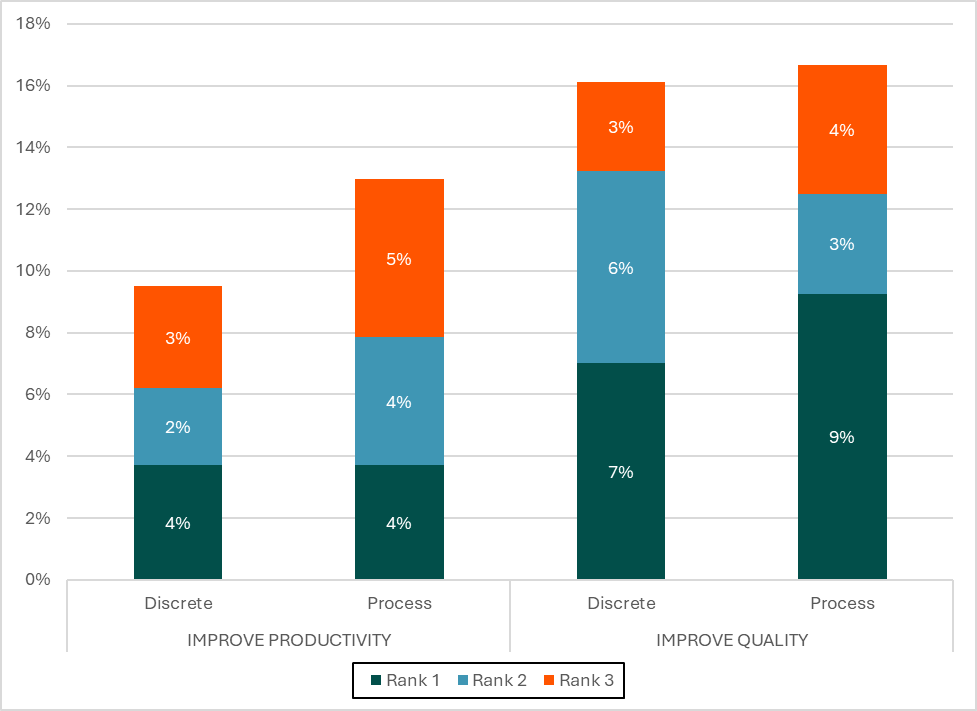
What this means for IoT vendors: Manufacturers still have an important data gap. While advanced analytics and sophisticated tools like digital threads are the long-term goal, solution providers need to address the first priority: gathering sufficient and reliable data from across operations. Without sufficient ground data across production, storage, and distribution processes, more advanced capabilities will remain a pipe dream.
What are the top challenges faced by manufacturers?
ABI Research asked manufacturers what their main challenges are across three lenses: business, operational, and technical. The top challenge from each category is identified below:
Business: Deploying technologies (29%)
IoT solution considerations: Solutions should be fit-for-purpose, easy to install, align with Information Technology (IT) goals, and come with robust onboarding support.
Operational: Improving quality levels (23%)
IoT solution considerations: IoT devices/sensor portfolios need to cover broad parameters for equipment assessment and offer high-fidelity data collection.
Technical: Network infrastructure performance (25%)
IoT solution considerations: Help IoT customers manage their networks and application-specific data residing within networks.
Conclusion
In summary, ABI Research’s survey echoes what manufacturers tell our analysts in conversations: they see the potential of IoT, but they view it more as an extension of broader connected operations. Manufacturers frequently do not know what they need to ask for; premature investments in IoT without a broader long-term roadmap will cause friction. Solution providers must be able to communicate the value of their IoT solutions within a broader manufacturing digital transformation narrative.
Manufacturers want a long-term IoT technology partner, not a one-off point solution. Vendors who can translate IoT solutions into measurable operational impact and provide after-sales support will be more successful at acquiring new customers in the manufacturing sector.
Get the Full Survey Findings: Download the full survey results in ABI Research’s report, Manufacturing Survey 2025: How To Sell IoT to Manufacturers.
 Michela Menting