
This blog post is written by ABI Research Industry Analyst Paul Shell, who was invited as a guest to the Snapdragon Summit. All experiences were hosted, but no additional compensation was received.
Qualcomm used its annual summit to lay out its Artificial Intelligence (AI) strategy with the focus on its Snapdragon smartphone and Personal Computer (PC) platforms. As anticipated, we heard details about its new flagship smartphone chipset, the Snapdragon 8 Elite Gen 5, which is now the third-generation silicon that offers true on-device Generative Artificial Intelligence (Gen AI) capabilities after the 2023 released Snapdragon 8 Gen 3. On the PC front, where Qualcomm has been fighting hard to disrupt the x86-dominated Windows market, the newly announced Snapdragon X2 will become the second-generation platform to offer on-device Gen AI.
From a marketing perspective, we can observe how Qualcomm’s broader “brand activation” strategy relates to its product roadmap and technological ambitions. While this is nothing new, we saw the crystallization of efforts to create a consumer—and to a lesser extent, enterprise—association with the Snapdragon brand, separate and distinguishable from the typically stronger Original Equipment Manufacturer (OEM) and Windows/Android ecosystem identities. The hope is, ultimately, for end customers to associate AI features and productivity use cases with smartphones and PCs powered by Snapdragon hardware, as opposed to Copilot+ (Microsoft/Windows) and Gemini (Google/Android). This would be no mean feat in a technological marketing space that is being saturated with references to AI.
Taking a step back, the on-device—and cloud-based—Gen AI industry is still relatively young, having kicked off with the release of the first public-access, cloud-based ChatGPT model in November 2022. While this ushered in a wave of trillions of dollars of data center investment and AI development to service and expand the capabilities of cloud-based models, almost all of which are accessible through mobile devices, the commercial success of on-device Gen AI has been less clear. Although the value proposition is a mantra by now—low latency, data privacy, and zero networking costs—this has resonated less with consumers, and Snapdragon marketing has turned to the more familiar themes of battery life and performance to differentiate its PC portfolio versus the x86 competition from Intel and AMD. Nonetheless, efforts to distinguish the Snapdragon X portfolio from its x86 rival should not be abandoned, regardless of how technically literate most consumers are deemed to be.
Related Content:
Snapdragon Summit 2025: Ambitious Agentic Vision, but Hurdles Remain
Major Themes:
Hybrid AI
We also heard more about hybrid AI spanning edge and cloud, which can be interpreted as a response to the weaker uptake of on-device AI, as well as the practical reality of galvanizing OEM and software ecosystems around the restrictive nature of deploying Gen AI solely on edge devices. Hints were made at imminent announcements related to an updated data center offering to expand the Cloud AI 100 card, but no concrete details were shared. The Chief Executive Officer (CEO)-to-CEO chat with HUMAIN’s Tareq Amin also explicitly mentioned a disruptive data center solution, which is easier to imagine than some of Tareq’s other claims about an imminent Agentic AI future, especially when considering HUMAIN’s existing partnerships with AI silicon challenger Groq.
Distributed Inference
It was also evident the emphasis made on devices other than smartphones and PCs: in particular, wearables and smart glasses, which will form part of a “distributed inferencing” approach, which includes smartphones and PCs. This will be a Snapdragon-centric offering, and despite spanning OEMs for a “less vertically integrated” result, the silicon will have to be united under Qualcomm’s portfolio. The broader Snapdragon offering also encompasses the automotive platform, which includes both infotainment and Advanced Driver-Assistance Systems (ADAS) capabilities.
The addition of the INT2 and FP8 data types to the smartphone and PC platforms will be able to support models with more parameters, but there is naturally a performance for accuracy trade-off. Nonetheless, the addition of INT2 goes beyond what AMD and Intel can handle on their current PC platforms.
Silicon Upgrades: Performance Boosts Across PC and Smartphone
The Snapdragon X (PC) and 8 (smartphone) platforms both debuted new silicon with strong generation-over-generation AI performance improvements. The smartphone hardware is the second to feature the custom Oryon Central Processing Unit (CPU), and the 8 Elite Gen 5 will be joined by other less performant Stock Keeping Units (SKUs) adopting the Gen 5 nomenclature. On the PC platform, the headline figure was the 80 Tera Operations per Second (TOPS) Neural Processing Unit (NPU), which beats Intel and AMD’s current offering, and the third-generation custom Arm-based Oryon CPU, with matrix extensions for AI workloads, which also goes beyond the vector extensions available on AMD and Intel PC platforms.
Benchmarking performance was widely touted with impressive improvements over previous generation silicon, as well as the competitors. ABI Research remains cautious about specific performance claims over competitors, and true performance will only be seen in independent tests once OEMs have released the first wave of smartphones and PCs containing the announced platforms.
Enterprise PC
Qualcomm has sought to disrupt the Windows PC market with an Arm-based Windows platform that, on the consumer side, has reverted to performance and battery life capabilities to take market share from Intel and AMD. Qualcomm has struggled more on the enterprise side, where software compatibility, lifecycle management, and security have traditionally been Intel’s strengths with its vPro offering, and AMD has fought tooth and nail to gain traction over the past 5 years. There are several signs of progress.
Snapdragon Guardian is a connectivity sub-system built into the hardware platform with always-on connectivity for enterprise security. This will leverage carrier Internet of Things (IoT) networks, which will be geography-dependent, and can locate PCs and wipe data remotely, without requiring the main System-on-Chip (SoC) to power up, via networks other than Wi-Fi. This manageability play will target large enterprises and differentiates from vPro through cellular connectivity.
Where on-device AI has yet to gain a foothold in consumer buying decisions, this is an area where enterprises are more likely to come on board. Independent Software Vendor (ISV) partners such as AnythingLLM were used to showcase the capabilities of the now 80 TOPS performance of the X2 PC platform for on-device inferencing of local data. SpotDraft, a legal services startup, presented its legal document drafting application that generates output, while retaining sensitive data locally.
These themes point toward a specific future vision for Qualcomm—one where the company facilitates the convergence of AI device form factors.
The Vision: Hybrid, Personalized, Agentic AI & the Convergence of Form Factors
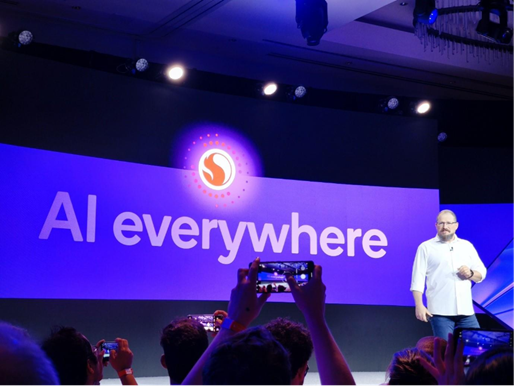
Qualcomm’s CEO Cristiano Amon set out a vision of a refreshed edge AI strategy converging mobile, PC, wearables, and automotive to enable agent-based use cases, such as contextually-aware personal assistants. Throughout the event, the agentic theme was deployed liberally, and many associated features and applications would, to date, simply have been referred to as “AI.” Nonetheless, the goal is to enable applications that are contextually aware, leveraging personalized knowledge graphs that inference user data processed with the expanding capabilities of the main NPU and the newly introduced—and silicon-specific—Sensing Hub and associated Personal Scribe. The intention was to make the case for edge devices as being essential to the future of AI.
Cristiano’s “Ecosystem of You” envisions horizontal AI platforms spanning devices with an agent at the core, calling Application Programming Interfaces (APIs) connected to banking, calendar, and messaging applications. Naturally, this agentic interface will see the dilution of individual applications, which also underscores the “AI is the new UI” theme, to which Qualcomm dedicated an all-hands presentation fronted by Vinesh Sukumar, AI/ML Product Leader. This could also be seen with Qualcomm’s collaboration with HUMAIN on a notebook device centered around on-device first (and hybrid AI) capabilities with a multimodal Agentic AI Arabic language model, which will launch late October for Saudi Arabian customers.
The convergence of device form factors was brought home by a fireside chat with Google’s Rick Osterloh that revealed plans to bring Android and Gemini to PCs with an evolution of the ChromeOS and Chromebook offering. While this is unsurprising, what is interesting is the plan for a common technical foundation for PCs, using the full AI stack and developer communities of both companies. This will likely involve a distinct hardware SKU from Qualcomm, separate from the Windows OS Snapdragon X platform, in keeping with the mid- to low-end price points of Chromebooks, to date. More embryonic plans include a common platform for industrial and manufacturing, as well as smart home applications for automation and robotics technologies. Again, it was evident that AI leveraging visual data from smart glasses will be a significant part of this collaboration.
AI-First Company
Qualcomm has laid out the technological platform for genuinely transformative AI technologies centered around agentic use cases at the edge. The basis for this is always-on sensing and personalized knowledge graphs of user data that will inform proactive decision-making for productivity-enhancing applications such as assistants and integrations with smart living and healthcare applications. The Agentic AI software ecosystem to support this, however, is not yet here, and the majority of the ISV demonstrations, although promising and revolutionary compared to where we were 3 years ago, demonstrated the maturation of the existing AI hardware capabilities (namely the heterogenous SoC with CPU, Graphics Processing Unit (GPU), and NPU for pre-agentic use cases). Nonetheless, these achievements demonstrate progress, as is evident in the Windows PC space, which has undergone disruption with the introduction of the X platform, and where Arm software compatibility issues continue to be ironed out. But the question remains whether power efficiency and performance advantages will be enough to gain significant market share, especially in the enterprise market.
What Qualcomm has set out to achieve is a multi-device AI platform with features unique to its silicon. Smartphones, earbuds, smartwatches, PCs, and smart glasses running on Qualcomm silicon can leverage personalized knowledge graphs to distribute inference across devices. But this will require coordination with OEMs, ISVs, and the maturation of (and industry coalescence around) data-sharing protocols to effectively manage such complex tasks. This is a complex undertaking and has similarities with Apple in terms of feature exclusivity to one brand, but Cupertino has ownership under one OEM and Operating System (OS) stack, which Qualcomm does not. Although this gives Qualcomm commercial reach in terms of a larger Total Addressable Market (TAM), it also necessitates much more complex coordination between the sprawling Android and Windows ecosystems, and ultimately necessitates that consumer and enterprise buyers associate agentic value (which is largely unproven) exclusively with Snapdragon-powered devices. The question remains whether this tight association and brand alignment will materialize, especially in the consumer market.
 Dimitris Mavrakis
 Larbi Belkhit