
Enterprise deployment of Agentic Artificial Intelligence (AI) into scaled production remains lower than industry expectations wouldsuggest. One of the major challenges is the unpredictability of Total Cost of Ownership (TCO) and Return on Investment (ROI) fromProof of Concept (PoC) to scaled production. The major challenge is that costs are dependent on numerous factors and ROI ischallenging to forecast.
Agentic Artificial Intelligence (AI) is bound to transform everything from Human Resources (HR) to telecommunications. In fact, ABI Research expects it to be the next big thing in business.
Agentic AI systems, powered by foundation models, can automate specific tasks or workloads by utilizing tools and applications.
Enterprises have widely adopted Generative Artificial (Gen AI) tools, but revenue gains are inconsistent. Agentic AI brings new hopes to the enterprise space, which is looking to move past copilots and start automating specific business roles or processes. Building on the technology transformation that Gen AI Proofs of Concept (PoCs) necessitated, many believe that agentic frameworks can deliver the value that was originally expected for Gen AI.
Agentic AI is still in its infancy. Although it offers hope, enterprises are cynical about Agentic AI’s business value after Capital Expenditure (CAPEX) loss and Return on Investment (ROI) disappointments from Gen AI projects. Given its infancy, several challenges stand in the way of mass commercialization of Agentic AI, including costs, security concerns, technical complexities, regulation, integration, and internal pushback.
ABI Research recently published several reports to assess the Agentic AI opportunity. We evaluated the Total Cost of Ownership (TOC) and ROI of AI agents, the challenges hindering deployments, and how AI vendors can reshape their business models to generate enterprise value creation.
Key Takeaways:
- Enterprises are still cautious about Agentic AI. Key challenges include ROI concerns, CAPEX, Operational Expenditure (OPEX), internal frictions, process integration, regulations, security, and a lack of AI skills.
- Questions remain about Agentic AI value. Developing and running Agentic AI carries hefty costs, including data transformation, agentic system development, employee upskilling, and many others. To justify these high costs, enterprises expect a healthy ROI, which is not yet clear.
- Can ROI surpass Total Cost of Ownership (TCO)? According to a recent ABI Research study, the answer is yes. Most Agentic AI deployments across single-agent and multi-agent deployments will provide ROI within 1 to 3 years. Human-centric, repetitive processes such as HR administration or call centers are a good fit for Agentic AI automation; however, expect agents to augment, rather than replace employees for the short to medium term.
- Agentic AI commercialization requires a calculated approach. Vendors have struggled to monetize Gen AI, being forced to provide copilots and other “value-add” features to remain competitive. Agentic AI has a much higher running cost, necessitating effective monetization models. ABI Research recommends that vendors shift to outcome-based pricing, which amplifies ROI, incorporates tight integration with ecosystem partners, and targets specific verticals/use cases (rather than platform approaches).

How Is Agentic AI Different from Generative AI?
The difference between Agentic AI and Generative AI is that Gen AI is primarily used for content creation, while Agentic AI is used to perform specific tasks. Enterprises use Gen AI to produce marketing materials, enhance chatbot assistants, and identify patterns in data. In contrast, Agentic AI solutions complete tasks and processes using foundation models.
Agents can interact with systems, processes, applications, datasets, tools, and even each other to automate processes. Agentic systems have been initially developed to target specific applications. For example, banks can use Agentic AI technology to automatically classify customer complaints. Or as another example, manufacturers use Agentic AI to update order processing records.
Although new Gen AI models bring reasoning capabilities that enable multi-step “thought processes,” they still rely heavily on human intervention. This leads to creating prompts at each step of task completion. Agentic AI can automate each step in a process from start to finish.
What Are the Biggest Challenges with Agentic AI?
Despite its revolutionary potential, Agentic AI is far from mass commercialization due to a variety of challenges. These challenges stem from both the demand (enterprise) and the supply (technology vendor) side of the market.
For enterprises, the top challenges are:
- Regulation & governance are key barriers for critical industries, even with Humans-in-the-Loop (HITLs).
- Cost challenge is a roadblock in PoCs with GenAI failures sticking in C-suite memory. Concurrently, the lack of visibility over ROI hinders a clear line being drawn from costs to value creation.
- Operations and implementation remain challenging, especially given brownfield integration concerns.
- Unclear value proposition & distinction from Gen AI have limited enterprises’ willingness to invest in Agentic AI.
- AI strategies are often siloed, which limits the adoption of Agentic AI systems. Enterprises need tightly integrated systems for agents to pull from various data sources and span various business units.
- Lack of AI talent creates a bottleneck with huge reliance on System Integrators (SIs) for support.
- Data may have gone through transformation with Gen AI, so it remains a significant bottleneck for enterprise implementation.
For AI technology suppliers, the most prevalent challenges with Agentic AI commercialization include:
- Gen AI chatbot/copilot Go-to-Market (GTM) struggled to achieve desired monetization; Agentic AI monetization needs to be re-architected around outcome-based pricing.
- Market saturation forces vendors to provide AI tooling as a value-add.
- Reliance on consumption-based pricing, coupled with large running costs, decreased the margin for Agentic AI tooling.
- CAPEX/ROI balance is still unclear, limiting perceived value in the short term.
- Vertical experts lack cohesive products/solutions; For the time being, they are in a very early strategic position, despite being essential for valuable implementation.
- Market structure dictates a huge partner ecosystem that could impact business & revenue models (profit-sharing arrangements).
With these challenges being widespread, enterprises and tech vendors are unsure if Agentic AI is worth the investment.
Will Agentic AI Provide Business Value for Enterprises?
Technology decision makers continue to be skeptical of Agentic AI. According to UiPath’s 2025 Agentic AI Report, just 37% of Information Technology (IT) executives in the United States say they are currently using Agentic AI.
Disappointing Gen AI projects have left a sour taste in their mouths. Agentic AI deployments carry significant CAPEX, something that businesses have no desire for.
Beyond upfront CAPEX, Agentic AI requires employee upskilling and agent running/management costs. Agentic AI also requires 2X to 5X more tokens per workflow compared to Gen AI implementations. For larger Agentic AI systems (with multiple agents), that number is between 5X and 9X more expensive.
Questions remain regarding whether or not these costs can be outweighed by long-term value.
Despite these cost concerns, ABI Research anticipates strong value creation from Agentic AI. Most implementations break even in year 2.
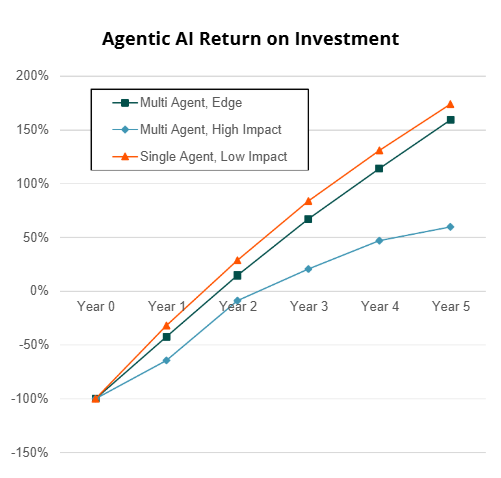
According to our recent report, most enterprises can expect to see an ROI from Agentic AI by year 2. Single-agent deployments will yield a 29% ROI after 2 years of deployment, driven by efficiency gains and associated human capital reductions.
Low-risk use cases within HR and customer service are forecast to experience the greatest ROI from Agentic AI. These sectors are ripe for automating simple workflows like job screening and query resolution.
Staying with HR for a moment, a 10,000-employee enterprise can expect HR headcount to drop by 40% to 50% by the third year after adopting Agentic AI. AI agents will handle tasks like debriefing new employees, updating policies/documents, and handling inquiries. By year 5, Agentic AI would generate 174% ROI. The methodology of this study assumes that the enterprise has a 100-employee HR team with the average salary being US$50,000/year.
The HR use case highlights the accelerated ROI from low-impact, single-agent use cases. However, high-impact, multi-agent systems are expected to provide significant value in industrial settings. Predictive maintenance on offshore oil rigs will yield a 159% ROI by year 5, and an automotive manufacturing supply chain agentic AI system will yield a 60% ROI after 5 years. Agentic AI automates equipment checks, repair scheduling, demand forecasting, inventory management, route optimization, and similar tasks.
This ABI Research study exemplifies that, despite high CAPEX (and OPEX), Agentic AI is a worthy investment for businesses. It automates a wide range of applications, helping reduce labor costs.
Beyond HR, customer experience, and industry, a recent Google Cloud study indicates that Agentic AI is also being used for marketing, cybersecurity, and software development. Regardless of the use case, Agentic AI accelerates workflows and goal achievement, while minimizing the number of employees required to do so.
How Can a Technology Vendor Build Commercially Viable Agentic AI Solutions?
To build viable Agentic AI solutions, technology vendors must reevaluate the three aspects of commercialization: product, go-to-market, and monetization. ABI Research provides strategic actions for each component.
Product
Developing Agentic AI tools is the first step in commercialization, involving everything from ecosystem partnerships to Large Language Model (LLM) training. Technology vendors should:
- Embrace Multi-Vendor, Multi-Agent Ecosystem: Develop ecosystem partnerships based on common protocols and drive alignment to support solution buildout.
- Ensure Orchestration, Transparency, and Regulation: Integrating this directly into Agentic AI solutions is critical to address demand-side concerns.
- Build Solutions That Target Specific Processes & Verticals: Horizontal platforms impede deployment; given the requirement for AI talent, building more targeted solutions is critical. Verticalized or even application-specific solutions will be better placed.
- Ensure Control & Flexibility of Models and Infrastructure: Agentic AI frameworks need to be able to shift quickly in line with business drivers and technology innovation (especially model innovation).
Go-to-Market
Next, it’s time to formulate a business plan that clarifies how the Agentic AI solution will be brought to market. The GTM strategy includes identifying target markets & processes, collaborating with reliable integration partners, and demonstrating proven value to enterprise customers.
- Target Verticals & Specific Processes: Agentic AI requires transformation & deep integration within processes. GTM motions need to be very targeted and aligned with vertical or even process experts.
- Identify Operational Partners to Support Implementation: Agentic AI compared to Gen AI requires deeper integration & transformation. As pointed out in the ABI Research report, Agentic AI: Opportunities & Challenges, Global System Integrators (GSIs) and system designers will grow as channel partners and implementers.
- Prove Solution ROI to Customers: Moving from value add to monetization will likely lead to customer drain, unless there is a clear link to ROI. Bridging the gap through case studies and clear timelines will help build an ROI narrative.
Monetization
Finally, AI technology companies must carefully consider how they will monetize their agentic solutions. As reported in a recent ABI Insight, monetization remains a significant challenge for vendors trying to productize Agentic AI at scale.
Here are ABI Research’s recommendations based on the market dynamics observed by our analysts:
- Shift Away from Consumption-Based or Token-Based Pricing: as-a-Service (aaS) models heavily disincentivize customer usage of Agentic AI, translating into a lack of value generated through PoCs.
- Introduce Solution or Outcome-Based Pricing: Given ROI uncertainty, outcome-based pricing will provide guarantees for long-term value.
- Aim to Monetize Internal AI Talent Through Service Delivery: A major challenge for end customers is access to GSIs and internal AI talent. Agentic vendors should monetize internal talent through enterprise services.
Conclusion
Agentic AI is undoubtedly a transformational technology for businesses of all sizes and industries, albeit not always to the same degree. However, the adoption of AI agents has been limited to date.
There are several reasons why enterprises are largely hesitant to invest in Agentic AI, from both the demand side and the technology supplier side of the market. However, uncertainty about Agentic AI’s value is the biggest obstacle to wider adoption.
ABI Research’s recent study should help dispel doubt in Agentic AI’s long-term value. High upfront costs are exceeded by ROI within a relatively short period of time. After 5 years post-Agentic AI adoption, TCO will be dwarfed by ROI, up to 174%. Reduction in employee headcount is the greatest contribution to this value creation.
AI technology vendors, such as Amazon Web Services (AWS), Salesforce, Databricks, and LogicMonitor, must align their commercialization blueprint with customer behaviors. Partnerships, flexibility, target use case identification, ROI demonstration, and regulatory compliance are essential to successfully sell Agentic AI solutions.
Beyond that, Agentic AI vendors must shift to outcome-based pricing models. Vendors like Zendesk and Intercom already excel in this area, offering process-specific agentic solutions. The idea is to tie Agentic AI to very specific business goals tailored to certain business departments. Examples include patient treatment planning in healthcare, automated process resolutions in manufacturing, and stock reduction in retail.
The journey to mass commercialization of Agentic AI has been rocky and chaotic. But over time, ABI Research expects agentic solutions to gradually mature and find steady ground, much like the maturity cycle of LLMs.
For further analysis of the latest Agentic AI developments, please refer to the following ABI Research reports:
 Dimitris Mavrakis
 Larbi Belkhit