
Recent report findings from ABI Research suggest the Generative Artificial Intelligence (Gen AI) software market is on a rapid growth trajectory with high expectations for both hardware and software. Our most recent forecasts project the Gen AI software market size to increase from US$63billion in 2025 to nearly US$220 billion by 2030.
This dramatic expansion, forecast at a Compound Annual Growth Rate (CAGR) of 29%, demonstrates the market’s bullish predictions for the transformative power of Gen AI across industries and global markets.
Key Takeaways:
- $220B in Gen AI software. According to ABI Research, the Gen AI software market size will hit $220 billion by 2030. Businesses are rapidly adopting it for marketing, sales, customer service, operations, and product development.
- Europe and China are the fastest-growing markets. Gen AI solutions will grow at a 45% annual rate in Europe and China, with Chinese tech leaders driving much of the expansion.
- On-device AI revenue skyrockets. From 2025 to 2030, on-device Gen AI revenue will grow 33X. On-device AI unlocks novel productivity applications across both consumer and enterprise spaces.
- $434B in enterprise value creation. Our team projects Gen AI to create $434 billion in yearly enterprise value by 2030. This is fueled by the need to streamline tasks and improve new services.
- Retail captures 33% of value. By 2030, retail and e-commerce will generate one-third of Gen AI’s value creation. Leading use cases include visual search, smarter chatbots, and website optimization.
Table 1: Gen AI Software Market Size, 2025 to 2030
| Region | Revenue | 2025 | 2026 | 2027 | 2028 | 2029 | 2030 | CAGR 24-30 |
| North America | (US$ Millions) | 34,383 | 41,793 | 48,532 | 55,115 | 64,275 | 72,584 | 17.0% |
| Latin America | (US$ Millions) | 637 | 939 | 1,261 | 1,575 | 1,890 | 2,200 | 28.9% |
| Europe | (US$ Millions) | 5,094 | 10,331 | 17,648 | 22,046 | 26,466 | 30,793 | 45.5% |
| Middle East & Africa | (US$ Millions) | 2,547 | 5,635 | 7,563 | 8,661 | 10,397 | 12,097 | 40.6% |
| Asia-Pacific (excluding China) | (US$ Millions) | 8,277 | 13,618 | 18,278 | 22,833 | 27,411 | 31,893 | 34.1% |
| China | (US$ Millions) | 12,734 | 21,601 | 32,775 | 47,242 | 58,604 | 70,384 | 45.1% |
| Total | (US$ Millions) | 63,672 | 93,917 | 126,057 | 157,472 | 189,044 | 219,951 | 28.9% |
North America Leads Gen AI Adoption, as Asia-Pacific Gains Momentum
While North America currently dominates investment in Gen AI applications, the Asia-Pacific region is expected to become the market leader by 2027.
This shift will be driven by the rapid deployment of Gen AI in the region’s expansive industrial and enterprise sectors. Major Chinese tech companies like Huawei, Tencent, and Alibaba are taking a bullish approach to open source Artificial Intelligence (AI). For example, Huawei’s investment in AI hardware drives growth in AI spending in the region.
The market is primarily fueled by cloud-based and edge-based AI software. Enterprise services currently account for about 53% of the market as of 2025, though this share will slightly decrease as more sectors expand their use of Gen AI.
How Much Value Will Gen AI Create for Enterprises?
Much of the early hype surrounding Gen AI has been focused on consumer applications, such as chatbots like ChatGPT. Despite this, the real opportunity lies in its untapped potential in the enterprise.
According to a recent study from our analysts, Gen AI use cases in enterprise settings will create US$434 billion in value annually by 2030 across 12 sectors. This immense value stems from its ability to reshape various business functions, from automating routine tasks to creating entirely new products.
Which Industries Are Getting the Most Value from Gen AI?
Several business sectors are poised to benefit significantly from Gen AI adoption.
The marketing, advertising, and creative sectors emerged as early adopters, accounting for an estimated 46% of Gen AI’s enterprise value creation. These industries leverage AI for tasks such as digital content creation, transforming Two-Dimensional (2D) assets into Three-Dimensional (3D) assets, and automating ad copywriting.
However, this dominance is expected to wane, with their share decreasing to 25% by 2030, as other sectors ramp up their investments in Gen AI solutions.
Retail and e-commerce are forecasted to account for a significant 33% of the Gen AI value creation by 2030, up from just 7% in 2024. The sector will capitalize on AI-driven technologies like visual search tools, enhanced chatbots, and automated website optimization. As these applications scale, they will revolutionize customer interactions and streamline operations. These benefits will make retail one of the fastest-growing segments for Gen AI.
Already one of the biggest users of traditional AI, the financial services industry will capture around 20% of Gen AI’s enterprise value by the end of the decade. Gen AI-powered applications in this sector will focus on stock market analysis, cybersecurity improvements, and automated client communication. With AI systems handling vast datasets, financial firms can enhance decision-making processes, protect sensitive information, and improve client-facing operations.
While marketing, retail, and finance are set to dominate Gen AI adoption, other industries are also beginning to see the potential. Companies in utilities, manufacturing, legal services, entertainment & multimedia, pharmaceuticals, telecommunications, and education are anticipated to invest billions in Gen AI-powered applications by 2030. These sectors will benefit from AI’s ability to streamline operations, boost innovation, and support new products and services.
Generative AI Supplier Ecosystem
Numerous company types can take advantage of the booming Gen AI market. Nearly every enterprise on Earth will leverage the technology one way or the other, opening up almost limitless possibilities for technology vendors.
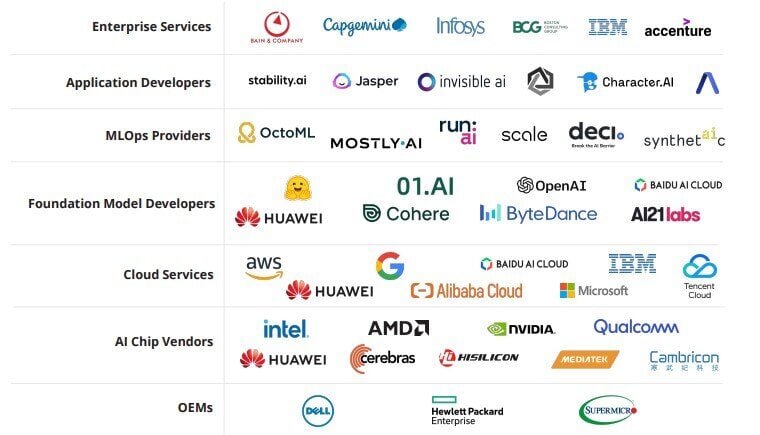
Companies like IBM, Capgemini, Huawei, OpenAI, Amazon Web Services (AWS), Google, Alibaba Cloud, Microsoft, AMD, NVIDIA, and Qualcomm are some of the many active players in the Gen AI space. In early 2025, Chinese startup DeepSeek shook up the market, claiming to rival OpenAI's models at a fraction of the cost.
ABI Research identifies 7 company types that can exploit the growing demand for Gen AI solutions. Figure 1 includes these company types and the organizations in these categories.
Figure 1: Companies in the Generative AI Market
Conclusion
The Gen AI market is on the cusp of exponential growth, with its applications expanding far beyond consumer-facing technologies.
As the enterprise space continues to embrace Gen AI, industries like retail, finance, and manufacturing are poised to reap substantial rewards. With projected spending on software reaching US$220 billion by 2030, Gen AI is set to become a cornerstone of business transformation in the years to come.
However, our analysts stress that key challenges must be addressed before enterprises can fully harness Gen AI.
Some notable obstacles to Gen AI implementation include skills gaps, the cost of Large Language Model (LLM) training, data privacy concerns, chip shortages, safety regulations, the trustworthiness of data, power consumption, and geopolitical tensions.
In our free whitepaper, Assessing Enterprise Generative AI Opportunities and Challenges, you can explore these challenges and future expectations for Gen AI.
Frequently Asked Questions
How big is the generative AI software market in 2025?
According to ABI Research, the generative AI software market will be worth $64 billion in 2025. North America makes up about 54% of the market.
How big will the generative AI software market be by 2030?
According to ABI Research, the generative AI software market size will reach roughly $220 billion by 2030. Gen AI software adoption will be fueled by a mix of cloud, no-device, and edge-based solutions. North America's market share will decrease to 33% by 2030 as European and Asian enterprises experience explosive growth rates.
What kind of value can enterprises expect from generative AI?
Across 12 industries analyzed, enterprises can expect about $434 billion in annual value by 2030. Gen AI reshapes workflows, automates tasks, and enables entirely new products and services.
 Dimitris Mavrakis
 Larbi Belkhit