
Authors: Leo Gergs, Research Director; Malik Saadi, Chief Research Officer
ABI Research’s never-before-done study reveals how data center capacity is expanding to meet tomorrow’s AI demands. Identify where power capacity is growing across workloads, regions, and operators.
Key Takeaways:
- Data center capacity is scaling at an unprecedented pace. Global active data center capacity is forecast to grow sixfold between 2025 and 2035, climbing from 24.4 Gigawatts (GW) to 147.1 GW. This growth is driven by enterprise Artificial Intelligence (AI) adoption, hyperscale expansion, and increasing rack-level power density (kW/rack).
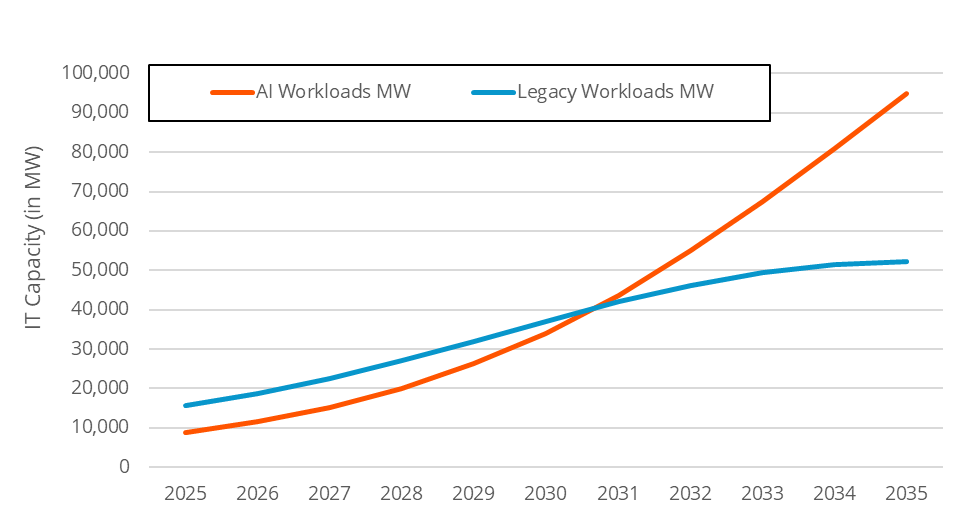
- AI workloads will overtake legacy workloads by the early 2030s. While legacy workloads still dominate today, AI is expected to account for more than half of total data center capacity by 2031 as Generative AI (Gen AI) and Agentic AI scale.
- Growth is uneven across regions, favoring AI-ready markets. North America leads in absolute capacity, Asia-Pacific and Europe maintain strong momentum, and the Middle East is emerging quickly due to large-scale AI investments.
- Hyperscalers and neoclouds are shaping the future data center landscape. Tier One hyperscalers remain dominant, considering their global footprint and significant financial resources. However, ABI Research sees neocloud providers growing fastest as enterprises seek AI-first and region-specific infrastructure.
In 1Q 2026, ABI Research launched a first-of-its-kind study into data center capacity growth worldwide. Led by our CRO, Malik Saadi, and Principal Analyst, Leo Gergs, this market outlook provides a data-driven analysis of how and where data center infrastructure is scaling. Moreover, the forecasts reveal shifting energy demands for enterprise AI.
From a high-level perspective, we expect active data center Information Technology (IT) power capacity to make a 6X jump globally between 2025 and 2035. Growing at a Compound Annual Growth Rate (CAGR) of 27%, capacity will increase from 24.4 GW to 147.1 GW.
But how is data center capacity expanding geographically? Where is AI making an impact on data center construction? Which data center operators are increasing IT load densities the fastest?
For a more granular breakdown, here are several key insights from the study.
Stats to Know
6X increase in active data center IT capacity by 2035.
122 GW of new data center capacity to be added over the next decade.
55% of data center capacity is from Tier One hyperscalers in 2026.
More than half of data center capacity will be for AI-dedicated by 2031.
AI Workloads to Overtake Legacy Workloads by 2031
ABI Research forecasts that AI workloads will demand more data center IT capacity than legacy workloads by 2031. Enterprise AI adoption has been sluggish due to Return on Investment (ROI) uncertainties. As a result, just 38% of data center demand will be driven by AI workloads in 2026.
As Gen AI and Agentic AI tools increasingly scale through the 2020s, analysts expect AI workloads to represent 51% of active data center capacity by 2031. And by 2035, AI workloads will safely clear legacy workloads, accounting for 64% of energy consumption at data centers. By this time, AI use cases will have shifted from training to inference.
Rack-level power density and cooling efficiency become the defining constraints for data center growth. Data center reference designs are gaining momentum for this reason, providing a proven framework for quickly building new data centers with key metrics in mind (learn more in Research Analyst Paris McKinley’s blog, Rethinking Data Center Design for a New Era of Scale and Complexity).
It should be noted that legacy workloads will remain a substantial use case. Legacy infrastructure will complement AI workloads by supporting Graphics Processing Unit (GPU) orchestration, data movement, and storage. By leveraging lower-density server racks, data center operators can balance facility-wide utilization.
Chart 1: Active Data Center IT Power Capacity by Workload (AI Versus Legacy)
World Markets: 2025 to 2035
(Source: ABI Research)
| Key Insight: AI infrastructure buildouts are outpacing grid capacity. To build resilience and accelerate innovation cycles, the data center industry must embrace on-site energy solutions (microgrids and Small Modular Reactors (SMRs)), advanced cooling technologies, Orbital Data Centers (ODCs), and other emerging innovations. These technologies will be just as integral to the next chapter of AI as Large Language Models (LLMs) and software. Learn more in our article, Building AI Infrastructure for a World Short on Power. |
Geographic Expansion of Data Centers
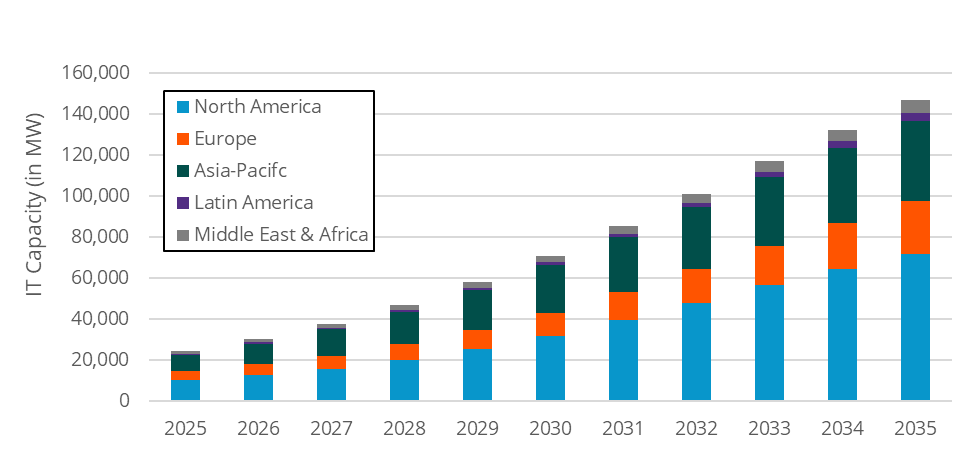
Our study also assesses regional data center capacity trends. The growth projections below reflect geographic disparities in AI maturity, economic strength, and hyperscaler presence.
- North America drives the most data center growth, with 42% of total electrical capacity being stored in the region as of 2026. This is unsurprising, as the biggest hyperscalers in the world are headquartered in North America. Hyperscalers construct and manage large-scale facilities optimized for high available power capacity, dense rack unit configurations, and low PUE. At a CAGR of 25%, active capacity in the region will increase from 10.2 GW in 2025 to 71.8 GW by 2035. This will push North America’s share of data center capacity to 49% by the forecast’s end.
- Asia-Pacific is the second-largest region for data center growth. ABI Research expects it to maintain roughly 30% share of active data center capacity worldwide over the next 10 years. A plethora of AI initiatives are underway across the region, aimed at boosting local economies and enhancing enterprise services. In response, hyperscalers are expanding their data center infrastructure, notably in Southeast Asia. For example, Microsoft opened new data center regions in Malaysia and Indonesia in 2025. Prioritization is typically reserved for areas with sufficient grid availability, scalable rack footprints, and a lower risk of stranded power.
- Europe, while technologically mature, will experience a relatively slower growth rate than North America and Asia-Pacific. At a 20% CAGR, Europe’s active power capacity at data centers is forecast to increase from 4.5 GW in 2025 to 26 GW in 2035. Tier Two hyperscalers and neoclouds reign supreme in the region.
- The Middle East is expected to expand its data center IT capacity at a 19% annual growth rate, increasing from 1.3 GW to 6.3 GW. This rapid growth highlights the significant AI investments being made in the region, including a reportedly US$40 billion fund by the Kingdom of Saudi Arabia. The U.S.-Saudi Investment Forum in November 2025 underscores the pivotal role of the Middle East in scaling AI infrastructure. Some of the biggest tech leaders in the world, such as Elon Musk and Jensen Huang, attended the event.
- Latin America is the smallest data center market by a wide margin. While its 27% CAGR is the fastest worldwide, that is more of a sign of the region’s immaturity in building AI infrastructure. In other words, there is much more room for improvement. Hyperscalers are active across Latin America, but scale is limited due to enterprises’ laggard AI ambitions. According to ABI Research, active data center IT capacity in the region will increase from 1.3 GW in 2025 to 3.8 GW in 2035.
Chart 2: Active Data Center IT Power Capacity by Region
World Markets: 2025 to 2035
(Source: ABI Research)
Hyperscale Data Center Growth Leads the Way
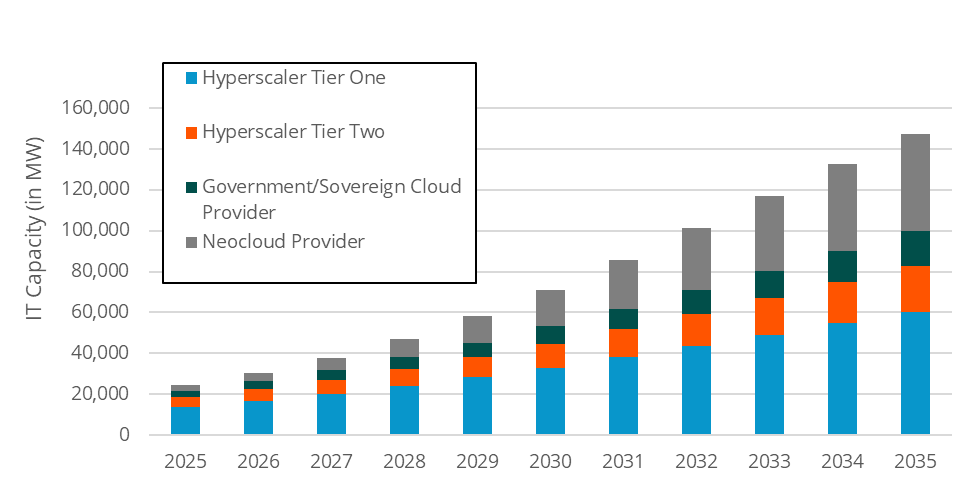
Tier One hyperscalers (AWS, Google, Microsoft, etc.) are the top growth drivers in the data center sector, with active IT capacity increasing from 13.8 GW in 2025 to 60.2 GW in 2035. These operators already have deep roots in the AI value chain across North America and Western Europe. Moreover, as alluded to earlier, hyperscalers are investing heavily in data center expansion into Southeast Asia and the Middle East.
Interestingly, ABI Research reports a wide gap between Tier One hyperscale available/under-the-roof power capacity and active capacity. This is a future-proof strategy, intended to ensure that upcoming enterprise AI use cases can be supported.
While Tier Two hyperscalers (Oracle, IBM, etc.) are the second-largest data center operator group in 2026, neoclouds are expected to sidestep them by 2028. Neoclouds are forecast to add 43.4 GW of data center capacity by 2035. In contrast, Tier Two hyperscalers will only expand by 17 GW. The neocloud market is the fastest-growing segment (33% CAGR), as AI-first and region-specific data center infrastructure becomes essential for enterprises.
Finally, government/sovereign cloud providers will expand their data center footprint by 13.6 GW by 2035, reaching 16.8 GW in total capacity. Geopolitical instability has compelled governments to protect data by ensuring it is localized. Asia-Pacific leads all regions in sovereign cloud capacity additions as AI initiatives and data privacy take precedence in digitalization projects. As per ABI Research forecasts, Asia-Pacific will represent more than 50% of total active capacity across the sovereign cloud realm throughout the forecast period.
Chart 3: Active Data Center IT Power Capacity by Operator
World Markets: 2025 to 2035
(Source: ABI Research)
Final Remarks
Data center capacity is set for explosive growth over the next decade across regions and operator types. Enterprise AI applications and government initiatives demand significant horsepower to facilitate. Cloud service providers are the gatekeepers of the cutting-edge technology platforms required for this digital transformation.
Hyperscalers continue to open new regions as AI matures in developing countries. These cloud giants are swelling data center capacity beyond current demands to prepare for the AI-first future. At the same time, neoclouds are rising stars in the market. This is due to organizations increasingly seeking cloud solutions that are compliant and use case-specific. Sovereign cloud operators will also experience substantial growth, with government policy in Asia-Pacific and Europe being the main catalysts.
AI workloads are expected to drive the most demand for data center capacity by the early 2030s. This shift will have major implications across the sector, including cooling capabilities, utilization ceilings, AI scalability, and real estate considerations. Without a doubt, the next decade will be defined not by incremental expansion but by how effectively data center infrastructure aligns with AI-driven demand.
About This Study
ABI Research launched this study to address a growing gap between AI data center investment and actual workload deployment. AI infrastructure announcements continue to outpace realized demand.
Traditional market forecasts typically focus on Information Technology (IT) spend, server shipments, or megawatt announcements. However, they do not capture how much data center capacity is truly being used versus what is already built or reserved. By modeling active, available, and under-the-roof capacity, this research provides a clearer picture of AI readiness, utilization, and future risks across regions and operators (excluding colocation). Download the full forecast to gain a complete view of how AI data center infrastructure is evolving.
Meet the Authors

Malik Saadi, Chief Research Officer
Research Focus: Malik serves as ABI Research’s Chief Research Officer, overseeing the company’s global research agenda to ensure depth, market relevance, and alignment with client priorities across all coverage areas. He previously led the Strategic Technology Group at ABI Research focusing on transformative technologies and innovation across Telecommunications and Connectivity Technologies, Enterprise IT and OT Technologies, Cloud, Data Center, Edge, and Distributed Computing, Artificial Intelligence, Data Warehouses, Robotics and Automation, and other adjacent technologies.

Leo Gergs, Principal Analyst
Research Focus: Leo leads enterprise connectivity and cloud and data center research at ABI Research. His work covers enterprise drivers, use cases, and provider strategies for technologies such as private cellular, SD WAN, and Fixed Wireless Access. He also analyzes key trends shaping the data center market, including the rise of neocloud providers, the growing importance of sovereign cloud models, and their implications for enterprise infrastructure, regulation, and workload placement.
Frequently Asked Questions
What is data center IT capacity?
Data center IT capacity refers to the portion of a data center’s operational power that energizes computing and networking systems. This includes server capacity, interconnect infrastructure, switching, and in-rack or server-level cooling that directly supports IT workloads.
What is the forecast for data center capacity?
ABI Research forecasts that global active data center IT capacity will grow sixfold between 2025 and 2035. Capacity is expected to increase from 24 GW to 147 GW, growing at a 27% CAGR and adding 122 GW of new capacity over the decade.
How is active data center IT capacity distributed by region?
North America leads with 42% of total capacity in 2026 and is forecast to reach 49% by 2035. Asia-Pacific maintains roughly a 30% global share, and Europe grows at a slower pace. The Middle East and Latin America expand rapidly from smaller bases due to increasing AI investments.
When will AI workloads overtake legacy workloads for data center capacity?
AI workloads are forecast to overtake legacy workloads by 2031. By that year, AI will account for 51% of data center IT capacity, growing to 64% by 2035 as Gen AI and Agentic AI scale.
How is data center capacity measured?
ABI Research measures capacity by decomposing available peak power into current operational capacity and future redundant capacity. Operational capacity is split between IT capacity and back-end infrastructure, and then further broken down into server, compute, memory, storage, and accelerator components to translate power into server and accelerator volumes.
Explore more data center market trends here.
Start with free research
Subscribe to ABI Research's weekly newsletter for access to our latest Analyst Insights, whitepapers, report samples, webinars, and more.

 Dimitris Mavrakis
 Larbi Belkhit