
“You can't look at the competition and say you're going to do it better. You have to look at the competition and say you're going to do it differently.” – Steve Jobs, Co-Founder of Apple
Apple is one of the most successful companies to exist, with innovation fueling its brand loyalty. As his quote above infers, the late Steve Jobs emphasized the need to diverge from what the competition already does.
Competitive Intelligence (CI) is central to capturing the Apple “ethos.”
CI enables businesses to foresee what others typically cannot. It may be changing customer attitudes, a niche market gap, or something equally elusive.
Sports teams infamously spy on their competitors to gain an edge. The New England Patriots' “Spygate” is the most well-known case in recent years, but similar stories echo across the sports world. In the business sector, countless companies have been involved in corporate espionage to gain an upper hand. These stories highlight the intense pressure that organizations feel to succeed.
One thing must be clear: this is not what competitive intelligence is. Instead, it is a legal business practice that relies on readily available sources such as analyst reports, social media, company websites, product announcements, etc. Businesses convert this legally obtained information into actionable insight.
This guide to competitive intelligence explains what it is, how to gather it, and why it’s essential to future-proof brands.
Key Takeaways:
- Competitive intelligence fuels smarter strategy. Transforming raw market data into insight empowers businesses to anticipate shifts, outmaneuver competitors, and uncover new avenues for growth.
- CI is grounded in ethics, not secrecy. It relies on public, verifiable sources such as analyst research, regulatory filings, and online activity.
- AI is redefining the CI process. AI tools scan massive datasets in seconds, detect emerging patterns, and empower companies to act with speed and precision.
- Robust CI builds resilience. By continuously monitoring competitors and technology trends, organizations can pivot early, challenge internal assumptions, and maintain a shared strategic direction.
What Is Competitive Intelligence?
Competitive Intelligence (CI) is the process of gathering, analyzing, and interpreting information about competitors, markets, and industry trends to support better business decisions. The goal is to leverage qualitative and quantitative insights to help organizations understand their position within the competitive landscape.
At its core, CI turns market research into strategic foresight. It is done by tracking competitors’ products, customers, pricing, partnerships, messaging, and technological innovation. This information enables a business to anticipate a competitor’s next moves and uncover new opportunities. Sometimes, gaining a competitive advantage means taking risks that others avoid, as 64% of CEOs told IBM they plan to do in 2025.
Competitive intelligence also includes data-driven insights such as market forecasts and competitive benchmarking. Forecasts provide a window into the products that competitors will focus more on in the coming years, ensuring a business keeps pace. Competitive benchmarking, such as ABI Research Competitive Rankings, quantifies vendors’ positioning within a market. From there, a firm can identify competitive threats, as well as areas where it can establish brand differentiation.
To put it more simply, competitive intelligence guides leadership decisions, product strategy, and marketing/sales outreach with objective facts.

Why Is Competitive Intelligence Important?
Competitive intelligence is vital to business success because strategic decisions demand context. You can make educated guesses based on social media updates, press releases, and industry blogs, but they only go so deep. Moreover, business leaders have a limited amount of time to collect the information they need.
Quick and clear intelligence is essential to fending off competitive threats and rapidly responding to market dynamics. Without this foresight, organizations risk mistiming product launches, investing in the wrong priorities, and overlooking critical opportunities.
The result? Competitors will climb the wave while your organization is left treading water.
Consistent CI initiatives enable companies to:
- Anticipate market shifts before they occur, enabling proactive planning.
- Benchmark performance against competitors’ strengths and weaknesses.
- Validate assumptions about customer demand and emerging technologies.
- Support executive alignment, ensuring all stakeholders are on the same page.
CEOs and business leaders have little tolerance for uncertainty. Competitive intelligence research brings forward-looking clarity to navigate market volatility and disruptive changes.
How Do You Gather Competitive Intelligence?
Competitive intelligence is gathered through primary and secondary research methods. This can be as simple as scrolling through a competitor’s website or as comprehensive as reading a market research firm’s competitive analysis.
Common sources include:
- Public Information: Financial filings, government databases, website pages, press releases, product announcements, patents, and job postings.
- Industry Publications and Analyst Reports: Valuable for identifying industry trends, benchmarks, and market forecasts.
- Competitor Feedback: Insights gathered from third-party surveys help gauge competitors’ strategic plans.
- Conferences, Webinars, and Trade Shows: First-hand observation of competitor messaging and partnerships.
- Digital and Social Media Monitoring: Tracking brand sentiment, marketing campaigns, and customer discussions.
- Internal Intelligence: Input from sales, marketing, and product teams who monitor competitors directly.
Common methods include:
- Competitive benchmarking to compare product features, payment models, Go-to-Market (GTM) strategy, and market positioning.
- Market trend analysis to uncover enabling technologies and shifts in customer preferences.
- Scenario modeling and forecasting to anticipate potential competitive responses.
- AI-assisted research tools that automate data collection and highlight the most relevant developments.
Table 1: Sources of Competitive Intelligence
|
Source Type |
Description |
Example Insights You Can Gather |
|
Public Information |
Includes websites, filings, patents, press releases, and job postings. |
Competitor product launches, hiring patterns, and financial performance. |
|
Industry Reports & Publications |
Analyst and market research reports covering benchmarks and trends. |
Market size estimates, growth forecasts, technology shifts. |
|
Competitor Feedback |
Insights from third-party surveys or partner feedback. |
Competitive strengths and weaknesses, brand perception. |
|
Conferences & Trade Shows |
Observing live competitor demos, booths, and partnerships. |
Upcoming product roadmaps, messaging focus, and target markets. |
|
Digital & Social Media Monitoring |
Tracking mentions, ads, or customer discussions online. |
Marketing strategies, customer sentiment, engagement tactics. |
|
Internal Intelligence |
Information from sales, marketing, and product teams. |
Direct feedback from clients and competitive deal insights. |
Examples of Competitive Intelligence
1. Product Lifecycle Management (PLM) Vendor Assessment
What is it?
This study compares 10 leading PLM vendors that serve large discrete manufacturers in industrial sectors. It ranks each company (scored on a scale of 0 to 100) by innovation and implementation capabilities, such as digital twin usability, product traceability, global reach, and commercial success. The findings pinpoint the PLM features that manufacturers seek and how vendors can improve.
How does it support competitive intelligence?
The assessment benchmarks competing PLM vendors and highlights what drives business success. Product leaders can apply these insights to sharpen their strategy and spot market openings before competitors do.
2. 5G Mobile Device Vendor Market Shares
What is it?
This data-driven analysis tracks market share across smartphones, tablets, notebooks, and broadband equipment. CI teams can leverage these data to assess shipment trends, regional growth, and the impact of supply chain/economic factors. The research reveals which vendors are growing fastest in each region and where new opportunities are arising.
How does it support competitive intelligence?
These insights help companies anticipate competitor movements and optimize 5G device portfolios. Decision makers are better prepared to target the right markets and form stronger technology partnerships.
3. Digital Transformation Benchmarking for Aerospace and Defense
What is it?
This benchmarking index presents a digital maturity matrix for 22 major Aerospace and Defense (A&D) manufacturers. Firms such as Airbus and Honeywell lead in using digital twins, Artificial Intelligence (AI), and analytics to boost efficiency and sustainability. Others are evaluated for areas where digital adoption still lags.
How does it support competitive intelligence?
The benchmarking reflects how digital technology adoption influences competitive standing within the A&D industry. CI teams can use the findings to learn from their peers and close performance gaps.
How Can Artificial Intelligence Help Businesses Gain a Competitive Advantage?
AI accelerates competitive intelligence efforts by quickly translating information into actionable insight. According to Crayon’s 2025 State of Competitive Intelligence report, AI adoption among competing teams has seen a 76% Year-over-Year (YoY) increase. The top use cases include generating summaries and analyzing datasets.
Competitive intelligence research requires gathering information from many corners of an industry, from research reports to company websites. The human brain can only ingest so much information and make sense out of it. AI excels at recognizing patterns in text, data, and other vital information, making it the perfect fit for CI teams.
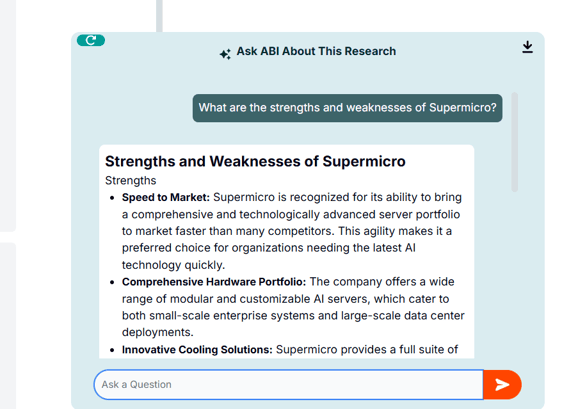
For example, ABI Research’s Ask ABI tool leverages Large Language Models (LLMs) to summarize research reports. If users are short on time, they can simply ask the AI-powered tool the questions they need answered.
If I worked in the AI server market, I might ask, “What are the strengths and weaknesses of Supermicro?” This company was ranked first in our AI Server OEMs competitive assessment, so it serves as the gold standard for product innovation. Instead of having to read the full report, I can rapidly analyze my competitors.
Ask ABI can also be used to synthesize data from multiple sources.
The guiding questions on our product pages provide a starting point for deeper exploration.
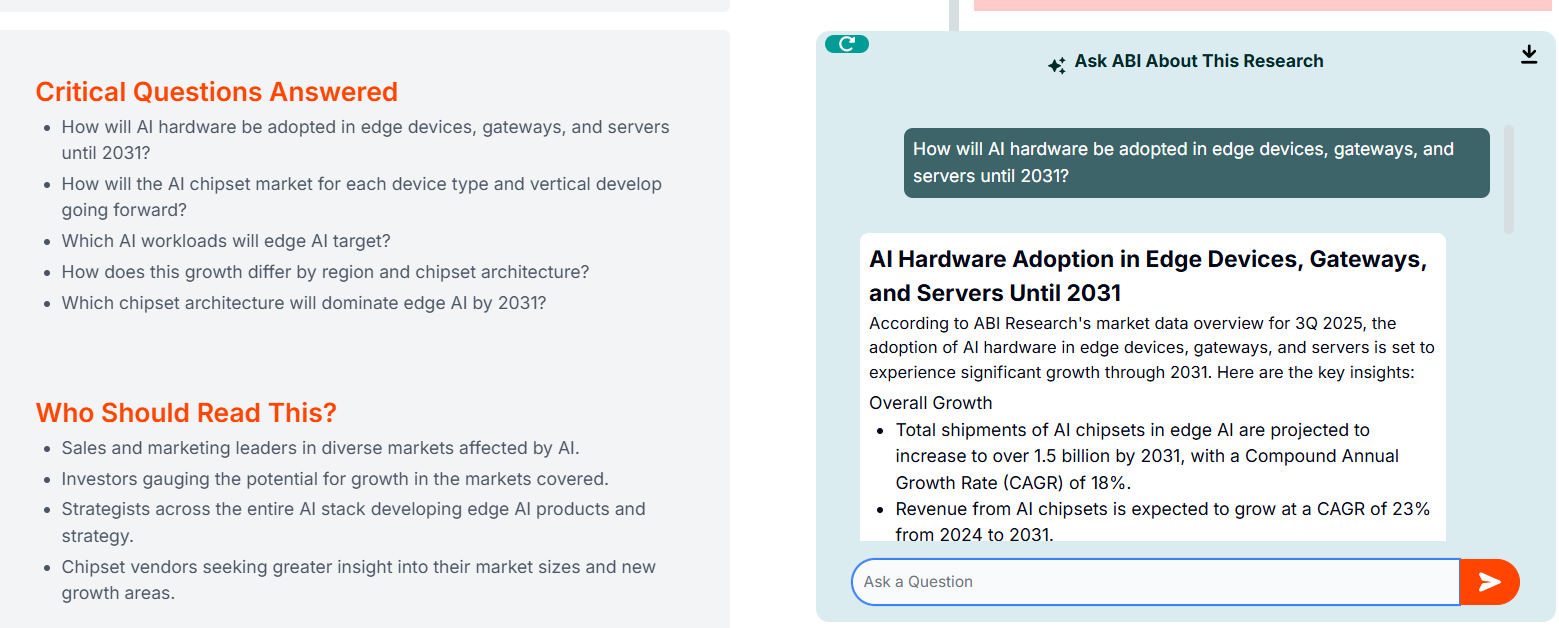
These AI-generated insights help identify market gaps that can be filled and align product portfolios with industry trends. You can also ask AI to make strategic recommendations based on the research findings.
AI should be viewed as an accelerant for competitive intelligence. Humans are still the fuel for creativity and final decision-making. Moreover, people are better suited to tailor the findings for specific stakeholders within an organization. AI just cuts through the clutter.
Of course, general-purpose Gen AI tools like ChatGPT, Perplexity, and Claude are useful for recognizing patterns in customer feedback, pricing models, and product comparisons. But the best outcomes are driven by AI tools trained on specific resource libraries.
Conclusion
Competitive intelligence empowers businesses to make strategic decisions with confidence and precision. By keeping tabs on competitor activity, customer feedback, and industry trends, organizations are equipped with the timely information required to gain a competitive edge.
CI leaders can gather intelligence from various sources, ranging from analyst expertise to publicly disclosed documents. Much of the data and granular analyses that competitive intelligence entails is difficult to collect in-house.
Technology advisory firms like ABI Research offer a steady dose of benchmarking, forecasts, and consultancy services to help organizations stay one step ahead. Learn more about how we solve critical competitive & market intelligence challenges, and schedule a strategy session today.
Frequently Asked Questions
What is Competitive Intelligence (CI)?
Competitive intelligence (CI) is the process of gathering and analyzing information about competitors, markets, and industry trends to make smarter business decisions. It helps companies understand their position in the market, anticipate competitors’ moves, and identify new opportunities.
Why is competitive intelligence important?
Competitive intelligence provides business leaders with the context needed to make confident, informed decisions. Through intelligence gathering, organizations can anticipate market shifts, benchmark performance, validate customer and technology assumptions, and align internal strategy.
How do businesses gather competitive intelligence?
Competitive intelligence is gathered through a mix of primary and secondary research methods. Common sources include financial filings, patents, websites, analyst reports, and social media. Methods such as competitive benchmarking, trend analysis, forecasting, and AI-assisted research tools help teams interpret data and anticipate market developments more efficiently.
What is the goal of competitive intelligence?
The goal of competitive intelligence is to help businesses make better decisions by understanding their competitors and the market. It provides clear insights that guide strategy, identify new opportunities, and reduce risks. In short, CI helps organizations stay one step ahead in a changing business environment.
How can AI enhance competitive intelligence?
AI speeds up competitive intelligence by turning large volumes of data into easily digestible insights. AI excels at summarizing reports, identifying patterns in datasets, and surfacing key findings across multiple sources.
What are some examples of competitive intelligence in action?
Notable examples include competitive benchmarking and market share analysis. Benchmarking compares a company’s products, performance, and strategy against competitors to highlight strengths, weaknesses, and differentiation opportunities. Market share analysis tracks growth across regions, product categories, and customer segments to reveal where competitors are gaining traction.
 Dominique Bonte