
Since the release of ChatGPT in 2022, Large Language Models (LLMs) have dominated tech conversations. While Generative Artificial Intelligence (Gen AI) has captured attention with its ability to produce content, a new development is emerging: Agentic Artificial Intelligence (AI). Unlike Gen AI, which focuses on generating text, images, or code, AI agents are built to take meaningful action. They can navigate multi-step processes, make autonomous decisions, and integrate seamlessly into enterprise systems.
ABI Research indeed posits that Agentic AI is well-positioned to be the next big thing in enterprise operations, spanning various industries. However, certain challenges must be overcome before mass commercialization.
As technology leaders increasingly pursue intelligent automation, ABI Research sees Agentic AI playing a pivotal role in the next wave of digital transformation. This article explores its business value, deployment challenges, real-world applications, and the core components to scale AI agents across business functions.
Key Takeaways
- Agentic AI can do things that Generative AI cannot. AI agents can automatically perform tasks based on logic and specific business goals.
- There have already been a number of success stories across telecom, banking, manufacturing, oil & gas, and retail.
- There are five different commercial models that technology vendors can leverage when offering Agentic AI solutions. Selection depends on industry, use cases, and customer pain points.
- Building customized AI agents using fine-tuned models will be a popular choice among enterprises. This ensures agents are trained on specific datasets and for their business processes.
- Potential hallucinations, security concerns, and corporate culture are key challenges to deploying Agentic AI organization-wide.
- To build and scale Agentic AI, the market requires aggregators & orchestrators, vertical experts, and monitoring platforms that ensure agents can be audited.
What Is Agentic AI and Why Does It Matter?
Agentic AI refers to autonomous software agents, powered by LLMs, that perform structured tasks within enterprise environments. AI agents interact with enterprise applications, extract relevant data, classify documents, solve problems, and even update systems, all with minimal human involvement.
Unlike chatbots or copilots that require constant user prompting, Agentic AI operates based on goals, processes, and feedback loops. These agents are built to understand context, learn from memories, make decisive choices, and execute workflows from start to finish. This creates compelling business benefits, including:
- Faster decision-making
- End-to-end process automation
- Reduced human error
- Scalability across business functions
Current Examples of Agentic AI in Business
While still in its early stages, Agentic AI frameworks are gaining traction in digitally mature industries. Software specialists, hyperscalers, and data specialists are all very active in developing AI agents. Notable examples of Agentic AI in business include:
- Telecommunications companies using AI agents to support broadband self-service
- Financial services providers automating complaint and response handling processes
- Manufacturing firms using Agentic AI to extract data from order forms and populate Enterprise Resource Planning (ERP) systems
- Oil & gas enterprises deploying AI agents for predictive drilling and regulatory compliance
- Retailers optimizing inventory and customer service with embedded AI assistants
One real-world case study is the Crédit Agricole bank using an AI agent to handle customer complaint classification. The agent integrates with internal systems, performs data extraction and classification, and generates suggested responses. The result is response accuracy rising to 95%, and overall handling time dropping significantly.
In another case, a German manufacturer embedded an AI agent into its ERP and order processing system. The agentic solution, provided by Beam AI, recognized incoming orders, extracted relevant data, and automatically updated records. The deployment of the AI agent translated to 96% of order updates being automated, an 89% reduction in manual processing time, and 23% fewer manual errors.
These use cases underscore the business value of Agentic AI, particularly where repetitive tasks and structured decision-making dominate. However, full autonomy is unlikely for the foreseeable future. Instead, ABI Research expects humans to continue to be in-the-loop or on-the-loop to verify agent output.
Commercial Models for Agentic AI
Technology leaders are exploring how to monetize Agentic AI at scale. Several strategic approaches have emerged:
- Agent builders embedded within AI platforms, enabling custom development
- White-label vertical agents for specific sectors (e.g., customer support, supply chain)
- AI Agent-as-a-Service (Agent-aaS) offerings that deliver turnkey automation solutions
- Implementation and managed services for orchestrating multi-agent setups and security
- Enterprise data management to provide the proprietary information to fuel AI agents
Technology vendors aiming to seize these commercial opportunities must provide added value for enterprise customers. For instance, Microsoft offers Azure builds AI Agent services that combine model access, enterprise readiness, and built-in automation. Meanwhile, Robotic Process Automation (RPA) vendors like UiPath are beginning to merge process automation with agentic capabilities, allowing businesses to deploy and orchestrate AI agents across departments via a Software-as-a-Service (SaaS) subscription model.
Telecommunications providers are also showing interest in deploying Agentic AI. SK Telecom, for instance, partnered with Perplexity to launch “Aster,” an AI agent delivered both as a national solution and a white-labeled export. Meanwhile, Deutsche Telekom and Google Cloud announced a collaboration on a multi-Agentic AI assistant at MWC25. The agent, built on Gemini 2.0, analyzes real-time network behavior, detects bottlenecks, and performs self-healing features. ABI Research is also studying the potential for on-device Agentic AI, whereby agents can improve customer experiences by unlocking novel productivity applications.
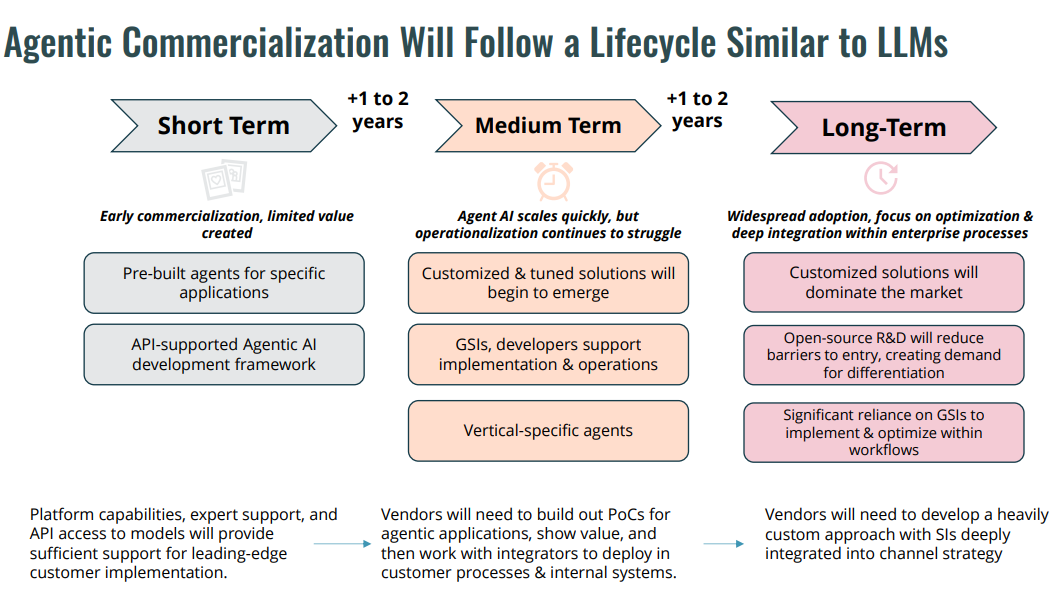
These diverse use cases and business models all point toward Agentic AI representing more than technical evolution. It should be seen as a new product category with strong commercial appeal. Our AI & Machine Learning analyst team anticipates that customized solutions will dominate the Agentic AI market. Like the previous examples alluded to, businesses find the greatest value from AI agents that are fine-tuned to their specific datasets and enterprise processes.
Challenges Hindering Agentic AI Scale-up
Despite its promise, Agentic AI implementation comes with several challenges spanning operations and corporate culture. For starters, LLMs have struggled to scale in mission-critical use cases due to performance issues. Hallucination risks will be compounded by Agentic AI systems that will likely draw on multiple LLMs to fulfill individual tasks. Expect vendors to draw on deterministic frameworks (e.g., knowledge graphs) to ground agents in truth and improve accuracy.
Another key challenge is overcoming security concerns. A recent survey of 1,000 Information Technology (IT) and business executives found that security vulnerabilities and AI-based cyberattacks are the top two risks associated with Agentic AI implementation. AI agents require access to sensitive enterprise data, applications, and workflows. This raises concerns about data privacy, security, and regulatory compliance. Case in point, enterprises will prefer to deploy Agentic AI models in Virtual Private Clouds (VPCs) or on-premises, rather than on third-party cloud platforms.
Transparency is another hurdle to scaling Agentic AI in business. As AI agents take more autonomous actions, organizations must be able to track decisions, audit behavior, and explain outcomes. Concerns around bias and misuse must be addressed before full-scale rollouts. Transparency into how Agentic AI models work is especially prevalent in highly regulated industries like healthcare and banking.
A further roadblock to Agentic AI adoption is organizational readiness. Although technical barriers have largely been addressed, many enterprises still under-prioritize Agentic AI in their budgets and strategic planning. Risk aversion, siloed teams, and a lack of developer-friendly tooling will slow adoption. Additionally, C-suite executives are always wary of falling for technology buzzwords. Therefore, vendors must demonstrate how building Agentic AI solutions will provide value beyond the thinly veiled term “automation.” What specific job functions does it execute? How much more accurate and efficient are AI agents compared to human counterparts? Highlighting the answers to these kinds of questions should be ingrained into the outreach strategy.
So while AI agent technology is maturing, cultural and governance challenges remain significant. Without leadership buy-in and investment prioritization, Agentic AI could struggle to scale at the pace vendors wish.
Core Components Required for Agentic AI Growth
ABI Research outlines three foundational pillars necessary to unlock the Agentic AI opportunity at scale:
- Aggregators & Orchestrators: These systems manage multi-agent, multi-vendor environments. They provide centralized control over agent behavior, compliance, and data governance. This ensures that Agentic AI deployments align with both internal policies and external regulations. Hyperscalers, vertical Independent Software Vendors (ISVs), telcos, and RPA providers are expected to lead here.
- Vertical Experts: Successful agent deployment hinges on domain knowledge. Enterprises need agents tailored to specific roles and processes, not just generalized LLMs. This means that vertical ISVs and process experts must guide the development of AI agents with high accuracy, reliability, and contextual understanding.
- Monitoring & Auditability: Enterprises can’t afford “fire and forget” AI. Robust monitoring platforms are essential to logging decisions, tracking data flows, and ensuring that AI agents can be audited. This is crucial for accountability and trust, and could become mandatory under future AI regulations.
Together, these components form the foundation for building a healthy, scalable Agentic AI ecosystem. Without them, enterprises risk deploying brittle or opaque systems that erode trust and miss their potential.
Final Thoughts
So, is Agentic AI the next big thing for enterprises? ABI Research believes the answer is yes, with a caveat. As this article has presented, the commercial value for AI agents is clear: faster workflows, lower operational costs, and richer customer experiences. But Agentic AI development comes with unique challenges that Gen AI does not. Success will depend on whether organizations can overcome integration complexity, build strong data governance models, and prioritize investment in the underlying infrastructure (e.g., cloud computing, data hygiene tools, etc.) needed to support Agentic AI applications.
Caveats aside, Agentic AI could represent a paradigm shift in business. It can redefine what enterprise automation looks like in the era of many so-called technical marvels.
For a closer study of Agentic AI in business and how to generate long-term Return on Investment (ROI) from its deployment, download ABI Research’s application analysis report, Agentic AI: Opportunities & Challenges.
Frequently Asked Questions
What is Agentic AI?
Agentic AI refers to Artificial Intelligence (AI) systems that can autonomously devise plans, make decisions, and take actions to achieve specific goals without constant human input.
What can Agentic AI do for my business?
Agentic AI can streamline business operations, automate complex workflows, and make real-time decisions. This can help your business save time, reduce costs, and respond faster to changing conditions.
What is the difference between Gen AI and Agentic AI?
Generative Artificial Intelligence (Gen AI) creates content like text, images, or code based on prompts, while Agentic AI goes a step further by autonomously planning and executing tasks to achieve specific goals.
What are some examples of Agentic AI systems?
Microsoft Azure AI Agent services, Beam AI, ServiceNow AI Agents, UiPath Agent Builder, and Deviniti AI Agents are several examples of Agentic AI systems available to enterprises.
Will Agentic AI replace RPA?
ABI Research does not believe that Agentic AI will replace Robot Process Automation (RPA). Instead, many RPA solution providers, such as UiPath, are leveraging Agentic AI to augment their existing products. Agentic AI adds layers of intelligence, flexibility, and autonomy to support new RPA use cases.
Explore our AI & Machine Learning research today.
 Dimitris Mavrakis
 Larbi Belkhit