

On June 19, 2025, in Shanghai, China, a collaborative “AI Core for ACN Summit” was held during MWC Shanghai, which leading global mobile operators and vendors from China, Japan, and Europe convened to delve into innovative Artificial Intelligence (AI) core technologies, especially Agentic AI, signifying a constructive step forward in technological cooperation.
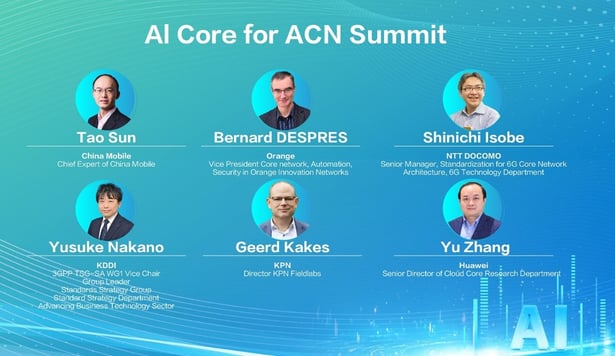
Visions of AI Core for ACN
In his keynote speech, Xiaodong Duan, the Vice President of the China Mobile Research Institute stated that The 3rd Generation Partnership Project (3GPP) had already started the next-generation system architecture study, expecting that AI-related innovation, especially Agentic AI and its protocol design, will enable the mobile telecommunication sector to implement the latest cutting-edge technologies, and thereby speed up mobile network upgrades and transformation.
Tao Sun, Chief Expert of China Mobile, introduced that his company’s vision of next-generation network is can, which provides trusted access, interconnection, and task cooperation for multiple AI agents. China Mobile envisions AI agents as new users and as one of the possible killer applications of next-generation mobile networks. It encourages the industry to work together to investigate end-to-end agentic frameworks, ACN protocol design, network connectivity for AI agents, AI agents for network connectivity, etc.
Shin-ichi Isobe, Senior Manager at NTT DOCOMO, emphasized an AI-centric network, especially the operator’s Innovative Optical and Wireless Network (IOWN) concept. The next-generation network’s value is to maximize the Return on Investment (ROI) and utility of AI and robotics, discussing the requirements of in-network computing technology and the various lifecycle issues for Agentic AI and 3GPP.
Yusuke Nakano, Group Leader at KDDI, presented its vision for an AI-driven architecture for mobile networks. It covers zero-touch operation, multi-agent-based incident recovery and Intent-Driven Networks (IDNs). He concluded the presentation by emphasizing the need for integrating AI in network operations to enhance efficiency, customer experience, and competitive advantage.
Lulu Tian, Senior Manager from China Mobile Research Institute, announced an ACN experimental suite from China Mobile that connects with multiple types of AI agent such as robotics, drones, Augmented Reality (AR) glasses, and digital AI agents. It supports both China Mobile Research Institute’s Net4Agent and Agent4Net. Net4Agent is capable of providing trusted access, a dynamic sub-network, computing offloading, and coordination among multiple AI agents. Agent4Net takes on Agentic AI for network functions and AI agent protocol design, and enables network capability exposure.
Geerd Kakes, Director of KPN Fieldlabs, introduced its target architecture: Holistic Service-based Architecture (HSBA) + AI Service Management and Orchestration (SMO), which has both the agent-based interface and service-based interface within its AI SMO, various kinds of AI agents, including a planning, assemble, connection, and execution agent that will interwork with agentic functions such as the “actor[1]”, “toolbox[2]”, and “memory”. He also reminded the audience about the trade-off between autonomy and human oversight under the European Union’s (EU) AI Act regulation.
Bernard Despres, VP for Core Network, Automation, Security at Orange, presented the operator’s AI-centric network vision. This highlighted how the operator is implementing AI for network services and how it is adopting network-related AI and automation at scale. Bernard further explained how current functions of the core network (e.g., mobility management) could be modified and how additional AI-related functions could be introduced; for example, for data storage and processing by using agent-to-agent protocols
A Frank and Open Discussion
During the “Next generation Core Network Development and Promotional Planning” panel session, two Asian operators (NTT DOCOMO and China Mobile), two terminal vendors (Qualcomm and Vivo), and four vendors (Huawei, Ericsson, CICT Mobile, and ZTE) discussed the following topics: 1) with the recent growth in Agentic AI architecture concepts and technologies, how could Agentic AI architecture bring new opportunities and transformation to network architecture evolution?; 2) facing the scaling of millions, even billions, of AI agent, how should telco operators provide new functionalities or new network protocols; and 3) there are always challenges regarding the interoperability and upgrading of the installed base of terminal and network equipment, which slows down service innovation. How should we improve the coordination and upgrades between terminals and networks? Finally, it was widely agreed by the panel that an “Agentic AI should be one of the key innovations for AI core network architecture,” and this should be standardized, where practical.
Summary Insights from an Analyst
At the conclusion of the summit, Jake Saunders, Vice-President – Asia, ABI Research, summarized the key outcomes: 1) operators are not far behind the innovation curve of the Agentic AI era; 2) several leading global operators have demonstrated their AI for network connectivity, network connectivity for AI, AI agent for network connectivity, network connectivity for AI agent, and AI core strategy; and 3) based on that expertise, experience, and momentum, these pioneering Mobile Network Operators (MNOs) and vendors are keen to contribute these next-generation New Core network architecture innovations in future 3GPP standardization discussions. This collective innovation effort has the potential to prime the telecoms sector for transformational opportunities and benefit the worldwide cellular ecosystem beyond 2030.
 Dimitris Mavrakis
 Larbi Belkhit