

Malaysia Is Gearing up to Be a Major AI Hub
In early January 2026, the Department of Statistics Malaysia (DOSM) released its Gross Domestic Product (GDP) estimates; 4Q 2025 data showed that GDP grew by 5.7% Year-over-Year (YoY), while full year 2025 stood at 4.9%. Malaysia’s economy is moving up the ranks of developing economies—where agriculture and mining still play a major role in GDP contributions—but now the manufacturing (+6%) and services (+5.4%) segments are also showing strong growth. These are very respectable metrics, but it is clear that the Malaysian government, helmed by Prime Minister Anwar Ibrahim, plans to take Malaysia to the cutting edge of technological development.
In October 2025, Prime Minister Anwar Ibrahim announced that US$630 million (RM2.56 billion) had been allocated to the Ministry of Communications to bolster communications infrastructure, strengthen national values, and stimulate the “orange economy” (creative arts and design, both digital and physical). Furthermore, US$1.45 billion (RM5.9 billion) will be put forward for Research, Development, Commercialization, and Innovation (RDCI) initiatives that include constructing a Malaysian sovereign Artificial Intelligence (AI) cloud.
Malaysia wants to build out and reinforce its own foundations for AI development. Malaysia has developed its own Malay Large Language Model (LLM), “Intelek Luhur Malaysia Untukmu (ILMU),” which launched September 2025. All data and servers for ILMU are hosted within the country. The government believes ILMUchat will play an invaluable role in education, healthcare, government services, and other sectors.
International investment in the Malaysian economy is a significant growth driver. In the first 9 months of 2025, total Foreign Investments (FI) increased by 47.5% YoY, with Singapore, China, the United States, the British Virgin Islands, and Japan representing 73% of total FI (US$27.4 billion) in Malaysia. These investments have been a win-win for Malaysia and their FI contributors, and given Malaysia’s determination to join the top tier of developed economies, like Singapore and Dubai, the country will need to maximize the amount of investment it can secure. Until there is a greater reproachment between the United States and its global allies with China and its partners, countries and companies will need to cultivate the respective relationships and chart the optimum course through the complexities as best they can.
To maximize growth for its economy from the cloud and AI service opportunity, Malaysia will need access to both the Western and Chinese innovation ecosystems.
Malaysia Plugging into the Global AI Investment Opportunity
These investments in Malaysia do not come as a surprise. Investment in AI is accreting significant worldwide interest and investment. Reuters reported that, as of 2024, nearly US$1.6 trillion had been invested in AI technology. From ABI Research’s own research, total AI-enabled software-alone investments were US$54 billion in 2024. By 2028, AI-enabled software purchases are expected to reach US$238 billion.
AI is not just about having instant answers at your fingertips, but also enabling the next wave of industrial and commercial applications. ABI Research has assessed the worldwide commercial and industrial robotics (humanoid, Automated Guided Vehicle (AGV)/Autonomous Mobile Robot (AMR)) and the small Unmanned Aerial System (sUAS) ecosystem markets to be a combined US$233.8 billion opportunity by 2030. AI agents will be able to monitor and coordinate the activities of robots and drones, improve operational performance, and simplify human/robotic interactions.
For many countries, the next tier of economic growth will be tied to how well they can leverage the AI economy, digital transformation, robotics, and connectivity “mesh” (both cellular and fiber-optic) to empower their industries and society.
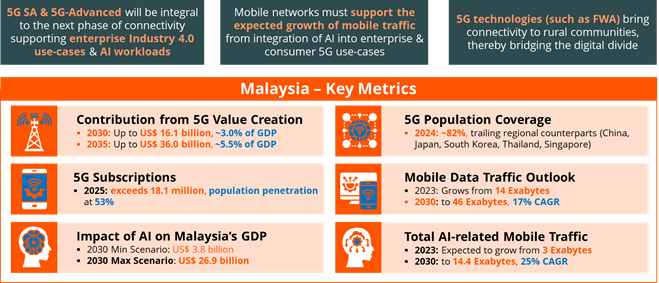
Malaysia’s investments across several industry sectors have been paying off. 5G population coverage (82%) is rapidly closing the gap with 4G (95%). The number of 5G subscriptions exceeds 18.2 million, representing 53% of total subscriptions. Based on the International Telecommunication Union (ITU) figures, average mobile traffic per subscription in Malaysia has increased from 24.3 Gigabytes (GB) to 28.9 GB per month between 2023 and 2024. It is not just Malaysia’s consumers that are harnessing 5G, it is also the country’s business enterprises and government. From ABI Research’s own studies, under the “current 5G network deployment trajectory,” contributions from 5G to Malaysia’s GDP is forecast to reach US$12.4 billion in 2030 and US$23.7 billion by 2035. Fundamentally, 5G enables a wide swath of use cases across consumer, enterprise, and public services:
- Video streaming
- Fixed Wireless Access (FWA)
- Remote operations
- Autonomous vehicles
- Robotic operations
- Machine vision
- Digital twins/condition-based monitoring
- Differentiated network services
- AR, VR, and XR
- Mobile AI applications
- Drone delivery
- Cloud-based services
Figure 1. AI and 5G’s Contributions to Malaysia’s Economic Outlook
(Source: ABI Research)
Harnessing the Dividend Multiplier
AI applications and services will be adopted in the office and the home, but it will also be used by end users “on the go” and for enterprise and public service applications related to highways, transportation hubs, shopping malls, and construction sites. AI requires connectivity—fiber-optic and 5G cellular. The AI compute functionality of portable devices will steadily improve over time, but these devices will still need to reach out to sovereign, private, or regional data centers for more heavy-duty AI compute loads. AI applications provide the opportunity for an additional accelerant to Malaysia’s economy. AI applications and services are still being honed, but the long-term potential is without question. The state of AI applications development essentially reflects the automation of online content, end user content creation, and the rollout of Generative AI functions. On the horizon is Agentic AI, where one or more agents can seamless and reliably coordinate end-user, enterprise, and/or public service tasks and operations (see Figure 2).
Figure 2. AI Opportunities and Capabilities in Telecom
(Source: ABI Research)
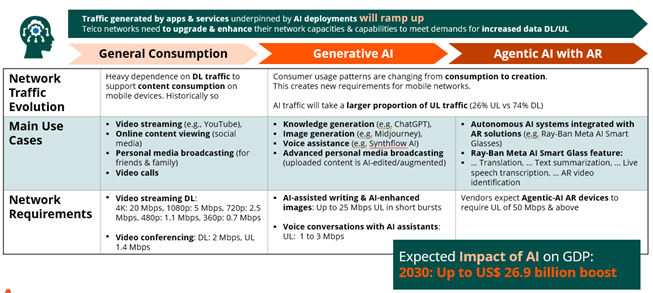
The evolution of the AI applications roadmap will contribute substantially to consumer applications, augmenting research processes and enterprise applications. ABI Research anticipates the impact of AI on Malaysia’s GDP to have an upside potential of ~US$26.9 billion by 2030. However, these growth scenarios are codependent on prior investment, enterprise and government commitments, upgrades to telecommunications infrastructure, government and business commitment, university Research and Development (R&D), and personnel training.
Delivering More than 5G Data
The “current 5G network deployment trajectory” essentially supports consumer applications with 5G enhanced Mobile Broadband (eMBB) network capabilities. AI will have a material impact on mobile traffic. In Malaysia, total AI-related mobile traffic is expected to grow from 3 Exabytes (EB) per month to 14.4 EB between 2023 and 2030. The additional investment in 5G Standalone (SA)/5G-Advanced (5G-A) not only supports the low latency requirements of many AI applications and handles the additional “delta” of mobile AI traffic, but it also boosts the functionality of 5G-enabled enterprise and public services.
5G-Advanced-based Ultra-Reliable Low Latency Communications (URLLC) supports mission-critical services such as autonomous and robotic operations, as well as large-scale Augmented Reality (AR)/Virtual Reality (VR)/Extended Reality (XR) deployments and applications. Network slicing increases the reliability of networks to meet stringent Service-Level Agreements (SLAs) for enterprise and public service-related AI operations. Other new applications include 5G Reduced Capability (RedCap) terminals, ambient Internet of Things (IoT) that enables passive IoT devices, and Integrated Sensing and Communications (ISAC) for low-altitude economies.
By supporting the ramp-up of AI applications and services, and value-added 5G services, the migration from 5G Non-Standalone (NSA) to 5G SA/5G-A could unlock an additional US$12.3 billion in GDP contributions by 2035, increasing 5G contributions to Malaysia’s GDP to US$36 billion.
Key Considerations
Countries like Malaysia are being presented with the opportunity to leapfrog into a “digital first, AI-ready” economy. AI applications and 5G SA/5G-A-enabled services could potentially boost Malaysia’s economy by a combined US$62.9 billion by 2035. There are, however, hurdles to address:
- National Data Integrity: Telco networks need to ensure that their cellular and fiber-optic networks can meet the demands of the AI-accelerated economy by supporting high-speed data throughput and low latency, and by enabling policy control/authorization and novel services development.
- AI Sovereignty: “AI tech” is not a single technology. It requires semiconductors, connectivity, software, services, investment, etc. Each Southeast Asian economy will need to build a domestic foundation of AI services and locally-integrated AI development.
- Maximized Access to Foreign Investment: While the regional and global trading and investment environment remains complex and challenging, to maximize growth and in-region trade relationships, Southeast Asian markets like Malaysia will need to maintain access to Western and Chinese innovation ecosystems. Ensuring access to both spheres of influence minimizes geopolitical fallout, while continuing to attract FI and economic activity.
Learn More: Download the whitepaper,5G Impact Assessment — Malaysia, to understand how 5G and AI will shape Malaysia’s digital economy and drive measurable GDP growth across industries and public services.
 Leo Gergs
 George Chowdhury
 Dimitris Mavrakis