

At MWC26, it was evident that AI has moved beyond early-stage implementations, evolving into a transformative, agentic force that spans digital intelligence and physical systems.
Artificial Intelligence (AI) was the dominant narrative at MWC Barcelona 2026 (MWC26). Across keynote presentations, exhibition booths, and industry discussions, AI is increasingly positioned as a universal technology capable of addressing operational inefficiencies, enabling new digital services, and transforming industries.
The proliferation of AI terminology across the show floor reflects a deeper shift in how the industry understands the technology. What was once primarily discussed in the context of Machine Learning (ML) algorithms has evolved into a much broader ecosystem encompassing generative models, specialized compute infrastructure, automation platforms, and autonomous physical systems.
However, many of the value propositions currently associated with AI are not entirely new. Similar themes were already emerging in earlier discussions around cognitive computing and intelligent automation.
At MWC 2016, a panel titled Artificial Intelligence & Cognitive Computing examined how AI platforms could evolve into service ecosystems capable of extracting insights from large datasets and enabling new digital services. I had the pleasure of moderating the panel. It included participation from industry leaders such as Werner Vogels (Amazon), Michael Karasick (IBM Watson), and Qualcomm Research, reflecting early industry thinking around cognitive computing platforms and AI-enabled services.
The following year, MWC 2017 expanded the discussion toward the role of AI in automation and robotics. The Artificial Intelligence: Automation and Robotics panel, also moderated by me, explored how AI could drive the development of machines capable of performing complex tasks across sectors such as manufacturing, logistics, agriculture, and services. The session featured speakers from Huawei, Infineon Technologies, Vodafone, and Small Robot Company. Crucially, the panel illustrated the early convergence between semiconductors, network infrastructure, and AI-driven robotics platforms.
While these discussions anticipated many of today’s themes around automation, robotics, and intelligent systems, what has changed since then is the scale and maturity of the technologies enabling AI deployment. Advances in hyperscale cloud computing, AI hardware accelerators, the emergence of the transformer models, the maturity of Large Language Models (LLMs) and Generative Artificial Intelligence (Gen AI), and large-scale data ecosystems have transformed AI from a conceptual capability into a deployable technology stack spanning digital and physical systems.
Therefore, AI should no longer be discussed solely as a software capability. Instead, it is increasingly framed as a multi-layer ecosystem spanning models, infrastructure, enterprise platforms, networks, and intelligent machines.
Table 1: Evolution of the AI Narrative at Mobile World Congress
(Source: ABI Research)
|
Year |
Industry Narrative |
AI Focus |
|
MWC 2016 |
Cognitive Computing |
AI platforms extracting insights from large datasets and enabling enterprise services |
|
MWC 2017 |
AI Automation & Robotics |
AI driving automation, robotics, and machine intelligence in physical systems |
|
MWC 2023 |
AI as Algorithms |
Machine learning, deep learning, and neural network models |
|
MWC 2024 |
Generative AI |
LLMs, Gen AI infrastructure, AI hardware acceleration |
|
MWC 2025 |
Autonomous AI Systems |
Agentic AI, AI copilots, multimodal AI |
|
MWC 2026 |
Physical AI |
Embodied AI, robotics, AI factories, AI-driven systems |
This evolution illustrates a fundamental shift: AI is no longer treated as a single technology category, but as an ecosystem spanning digital intelligence and physical systems.

AI’s Expanding Role Across the Technology Ecosystem
The growing prominence of AI at MWC reflects its expanding role across the entire technology stack. However, the widespread use of the term “AI” often obscures the fact that the market is composed of multiple distinct technology layers, each with its own economic drivers, technology suppliers, and adoption timelines.
At the foundation of this ecosystem are AI models and transformer models, including LLMs and multimodal architectures capable of extracting knowledge from data and automating cognitive tasks. OpenAI, Google DeepMind, Meta, Anthropic, DeepSeek, xAI Grok, and Mistral AI have adapted by developing foundational models powering Gen AI services.
Supporting these models is a rapidly expanding AI infrastructure layer, which has become one of the fastest-growing segments of the global technology market. This includes Graphics Processing Units (GPUs), Neural Processing Units (NPUs), AI accelerators, and specialized data center architectures designed to train and deploy large-scale models. Semiconductor vendors such as NVIDIA, AMD, Intel, Qualcomm, and Huawei, alongside hyperscale cloud providers, including Amazon Web Services (AWS), Microsoft Azure, Google Cloud, and Alibaba Cloud, are investing heavily in AI infrastructure to support the rapid growth of AI training and inference workloads.
Above the infrastructure layer sits a growing ecosystem of agentic systems and orchestration frameworks that enable enterprises to operationalize AI within business processes. Companies such as Microsoft, Salesforce, ServiceNow, SAP, Oracle, Amdocs, and Palantir are embedding AI copilots, agent frameworks, and workflow automation capabilities into enterprise software platforms.
AI is also becoming deeply integrated within telecommunications and network infrastructure, where technologies such as AI-Radio Access Network (RAN), Artificial Intelligence Operations (AIOps), and closed-loop automation enable operators to manage increasingly complex network environments. Vendors that include Huawei, Ericsson, Nokia, Samsung Networks, and ZTE, alongside telco operators such as China Mobile, Deutsche Telekom, Vodafone, and SK Telecom, are exploring how AI can optimize network operations and automate service management.
The final evolutionary shift of AI is that it is beginning to power a new generation of applications and physical systems, including robotics platforms, autonomous vehicles, and intelligent industrial automation systems. Companies such as Tesla, NVIDIA, Boston Dynamics, Hyundai, Agility Robotics, Unitree, Xiaomi, Siemens, Figure, Apptronik, UBITECH, and FANUC are developing AI-enabled machines capable of interacting with the physical world and performing increasingly complex tasks autonomously.
Key Takeaways and Recommendations
Considering its rapid evolution, AI should no longer be viewed as a single technology category. Instead, it represents a multi-layer ecosystem spanning AI models, infrastructure, enterprise platforms, networks, and physical systems.
Industry stakeholders should avoid treating AI as a monolithic market. Each layer of the AI ecosystem has distinct hardware requirements, adoption timelines, and economic drivers.
Every Year, AI Gets Smarter; Every Year, the Industry Understands It Less!
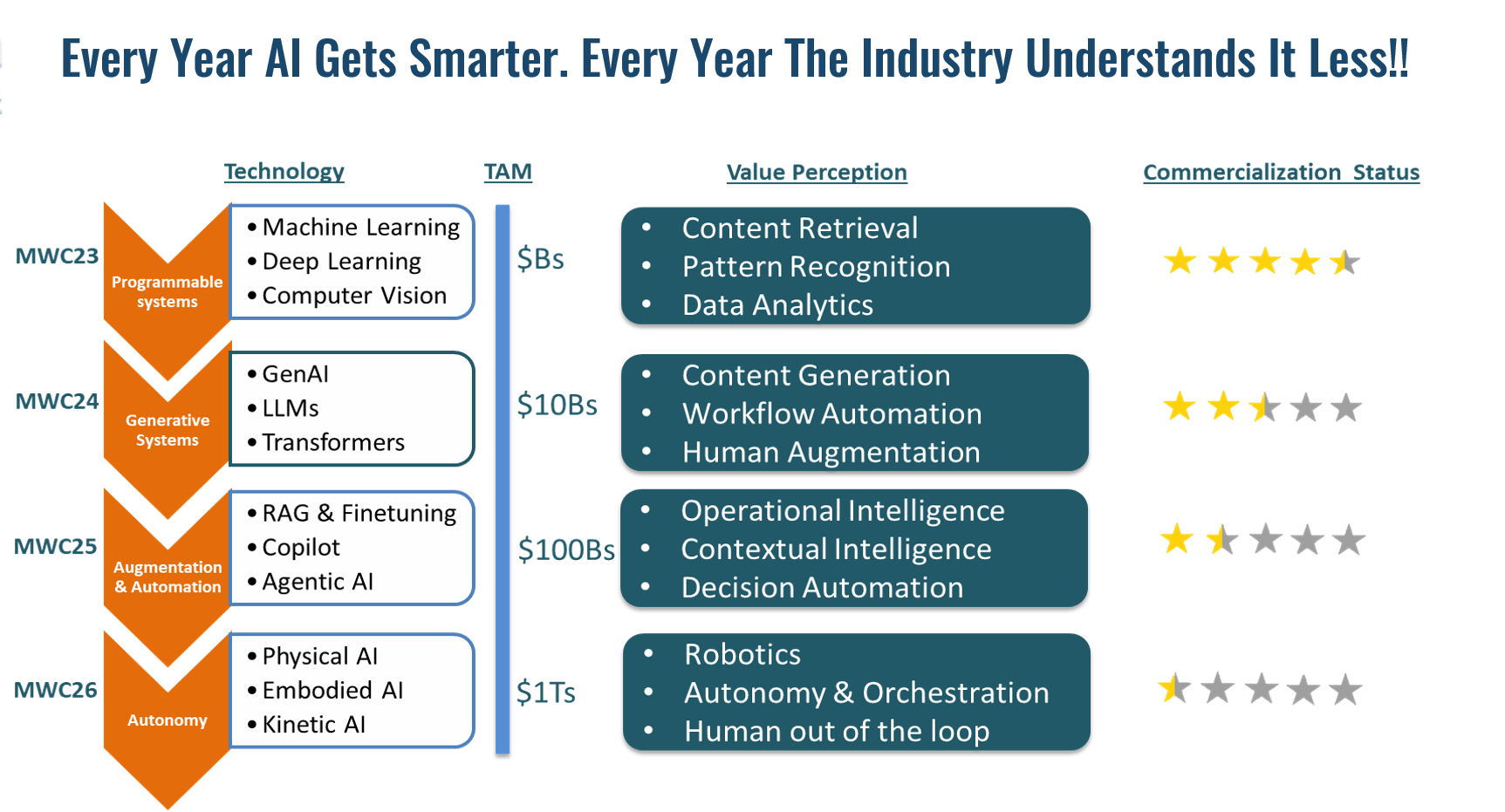
Companies developing AI strategies should focus on identifying where they can create the most value within the AI stack, rather than attempting to address the entire ecosystem. Infrastructure providers such as NVIDIA, AMD, and hyperscale cloud providers are positioned to benefit from accelerating demand for AI compute resources, while enterprise software vendors and platform providers will capture value from automation frameworks and AI-enabled services.
Telco operators and network vendors should prioritize integrating AI capabilities directly into network architectures through technologies such as AI-RAN and AIOps. They should also develop mission-critical frameworks using AI-native networks to improve operational efficiency and manage increasingly complex network environments.
Looking further ahead, the most transformative long-term opportunities are likely to emerge in AI-driven physical systems, including robotics, autonomous machines, and industrial automation platforms.
In many ways, the tech industry is not discovering the future of AI; it’s finally building the infrastructure required to realize a vision that was already being debated on the MWC stage nearly a decade ago.
Download the Whitepaper
For ABI Research's full analysis of MWC26 and the evolution of AI across industries, download our whitepaper, MWC Barcelona 2026: Will Finally Crack the Connectivity Monetization Code?

Start with free research
Subscribe to ABI Research's weekly newsletter for access to our latest Analyst Insights, whitepapers, report samples, webinars, and more.

 Larbi Belkhit