
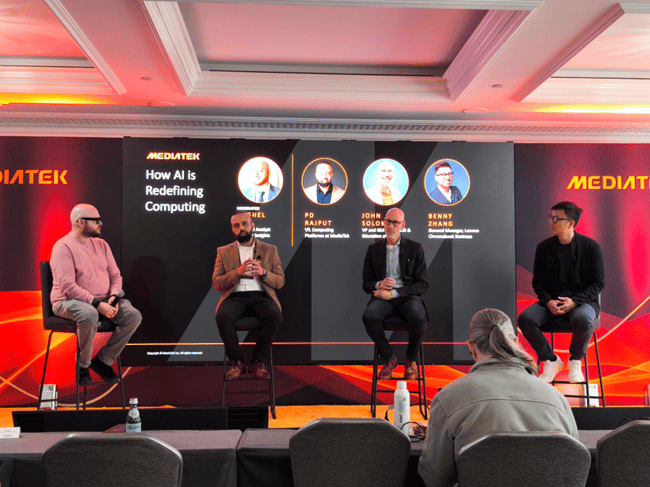
My time at MediaTek’s Analyst Day in San Francisco drove home several foundational aspects of the company’s transition from its status as a follower to a company at the forefront of innovation. This feels like a fast metamorphosis, even for MediaTek’s executives, as they outlined the brand awareness vis-à-vis Qualcomm, Apple, and Google in the mobile and client segments, and more recently, custom Application-Specific Integrated Circuit (ASIC) players like Marvell and Broadcom in the data center space. Much like Qualcomm, MediaTek is on a brand activation drive and wants buyers to recognize the chipsets in devices “powered by” their Systems-on-Chip (SoCs) and ultimately direct spending toward their coffers.
MediaTek’s traditional plays in smartphones and tablets are increasing attention in the flagship segment where margins are larger and can absorb more of the shock from memory costs. But there is also an increasing focus on Chromebook (or adjacent) devices that will leverage Google’s progressing drive into laptops with Android. The Internet of things (IoT)/Edge Artificial Intelligence (AI) proposition was outlined, with a maturing developer platform under the leadership of Sameer Sharma, and the collaboration with NVIDIA on the DGX Spark compute workstation was also held up as an example of the deep collaboration between both companies.
The most significant emerging focus, however, was on data centers, with MediaTek expecting substantial revenue growth off the back of its expanding, high-margin custom ASIC proposition and successful collaborations to date. Unsurprisingly, much of this will come from the North American AI data center build-out, and this segment is seen as the single largest growth opportunity expected to have a tangible impact in 4Q 2026.
Compute (Client Devices)
MediaTek’s compute business group contains its Arm-based Chromebooks powered by Kompanio (soon to be under the Dimensity nomenclature as with smartphones) and the DGX Spark powered by the GB10 chip developed in partnership with NVIDIA. Most of these product lines are now “AI first” due to the integrated Neural Processing Unit (NPU), and in the case of the of DGX Spark, the AI developer-centric use cases. As with other silicon vendors, MediaTek anticipates an inflection point for local inference workloads, recently catalyzed by the OpenClaw moment and the demand for localized agents. The opportunity now includes enterprise agentic servers, with four DGX Sparks able to run in parallel as one coherent node.
In terms of potential volumes, a more significant update includes the progress of Android for PCs with MediaTek set to use its Chromebook silicon to bring Android to PC form factors. Ecosystem progress has been steady with the first substantive announcement made at Snapdragon Summit, where Qualcomm was first off the line to court Google for a deeper Android PC collaboration. Google envisions a “cascading” of models from edge to cloud, with a need to overprovision device capabilities to insure for future model progress. Nonetheless, this will not be a premium PC segment; volumes matter, and the proposition will build on the Chromebook and Android smartphone and tablet legacy where MediaTek has excelled to date.
IoT & Edge AI
We heard about the strategy for the Internet of Things (IoT) portfolio, which includes the Genio series of processors and revolves around an increasingly verticalized approach for, among others, smart retail, consumer smart home, and industrial/robotics. It’s also here that MediaTek is pushing for performance with the upcoming Genio Pro silicon that will bring the platform to 50+ Tera-Operations per Second (TOPS) for navigational capabilities in Autonomous Mobile Robots (AMRs) and drones, as well as multi-channel Vision-Language Models (VLMs) for security applications. Key areas of progress include the expanding ecosystem partnerships across AI hardware manufacturers such as Grinn, distributors, System Integrators (SIs), and application developers like Irida Labs. This is an area where the portfolio will increasingly come up against Intel’s Core Ultra 3 and its rival’s more mature developer platform.
The connectivity, mobile SoC performance, and multimedia legacy are the foundations on which MediaTek’s edge AI portfolio is built and will guide the direction of the evolving developer platform. This latter part is key to enablement and, ultimately, commercial scalability.
AI Data Center
It piqued my interest to hear that AI data centers were consistently called out as the single most significant revenue growth opportunity (also due to its relative size over mobile). Ten years after from the launch of the first enterprise switch, the portfolio has grown and evolved alongside the engineering capabilities and ability to execute. This is centered around the development of Intellectual Property (IP) for scale-up and -out interconnect, the support of important standards like NVLink, UALink, and UEC, and heterogeneous integration across the stack to support use cases that need end-to-end optimizations.
MediaTek recognizes that the new unit of compute is at the rack level, no longer at that of individual server nodes, but at a systems-level, encompassing more of the stack. A key differentiation here is in MediaTek’s holistic approach to its supply chain relationships, which it leverages to realize an edge in Time to Market (TTM) and execution. The custom ASICs that go to data center customers (including Google) are on TSMC’s leading nodes, where capacity is allocated long in advance. The physical proximity of both Taiwanese corporations’ offices means that executives can “go next door,” not to mention the cultural congruence of the two behemoths. Crucially, capacity allocated to mobile platforms could be shifted to satisfy the higher margin data center ASICs, proving crucial to gaining a TTM edge, which matters more for AI data center-scale investments, where small delays result in missed opportunities, lost revenue, and underutilized capacity.
Recommendations
Overall, I believe that MediaTek’s messaging should double down on areas where it sees genuine differentiation over its rivals. I see this residing in the collaborative and flexible nature of the company’s engagements, which are exemplified by the partnership with NVIDIA and the “permission to play” in the AI data center space where, previously, Broadcom and Marvell dominated. The relationship with TSMC must be underscored as a key foundation on which the ability to execute is built.
For MediaTek to continue staking its claim in the AI era, it must continue to push the performance envelope. Regarding IoT/Edge AI, the bar has been set high by Qualcomm, Intel, AMD, NVIDIA, and an increasing number of SoC players like Ambarella in the vision AI domain. This is where enablement is key and verticalized offerings—particularly for regulated and slow-moving domains like healthcare and industrial—that combine hardware and software in reference designs can make all the difference.
The data center piece is growing rapidly and the flexible, collaborative ASIC partner messaging is compelling and should be amplified as an important differentiator over Broadcom and Marvell—especially as a supply chain diversifier for hyperscalers and a counterweight to vendor lock-in. MediaTek also has the advantage of covering the edge, alongside data center infrastructure, which said rivals do not. As, in Google’s words, models are “cascading” from the cloud to the edge, both realms will continue to play a role, so if MediaTek can bridge that gap, particularly for partitioning workloads between its edge and cloud silicon, that will create a stickier ecosystem proposition. Finally, the North American concentration of its recent growth may be commendable for its market size, but elsewhere, sovereign AI propositions are fueling build-out that will not touch American data centers, bypassing much of the U.S.-centric supply chain. Southeast Asia and Europe, in particular, are two spaces to watch outside of China.
Conclusion
Overall, MediaTek’s flexibility and adaptability—alongside the collaborative DNA—have proven key to winning customers over its rivals across edge and cloud business groups. This has allowed it to penetrate the North American market where its Silicon Valley-based rivals have long reigned supreme. Earlier fruits of this labor include the deep partnership with NVIDIA across DGX Spark, IoT, data center, and automotive, which has provided useful lessons and growth opportunities.
The fast-changing nature of edge AI and the expansion of MediaTek’s Total Addressable Market (TAM), particularly in IoT/edge AI and data center, means that it now comes up against established giants like Intel, AMD, Broadcom, and Marvell. While all have their part to play, MediaTek’s scale in mobile platforms, alongside the deep supply chain partnerships, gives it an edge over smaller vendors, which only becomes clearer during a supply chain crunch.
 George Chowdhury
 Dimitris Mavrakis
 Larbi Belkhit