

A Building Automation System (BAS) addresses many challenges faced by building managers. People forget to turn the lights off, equipment maintenance takes too long, and temperatures often fail to strike the right balance for comfort. These issues increase energy and maintenance costs, while making for a poor occupant experience.
Building automation systems collect data from devices and systems throughout a facility to generate rich insights into how operations can be optimized. Many time-consuming tasks now require no or minimal human intervention.
As building owners/managers increasingly aim to reduce costs and enhance energy efficiency, there is untapped potential for smart building technology vendors and automation hardware suppliers to capitalize on. By 2030, ABI Research forecasts that nearly 29 million buildings (23% of all commercial properties) will be equipped with some form of building automation. This is up from 12 million buildings (15%) in 2024. The top verticals adopting building automation the most are offices, education, hospitality, healthcare, and retail.
Key Takeaways
- Building automation tools are witnessing stronger uptake as facility managers aim to cut energy costs, improve occupant experiences, and comply with government regulations.
- A Building Automation System (BAS) has proven highly valuable. It ensures resources are used efficiently, provides real-time monitoring capabilities, and minimizes the need for human oversight of building equipment.
- The technologies behind building automation include Internet of Things (IoT) sensors, digital twins, user interfaces, and wireless connectivity.
- Building automation systems are still nascent in commercial real estate. Technology providers must build stronger educational campaigns and ensure their solutions seamlessly integrate with other systems. In many cases, strategic partnerships will be necessary to meet the demands of building management stakeholders.
What Is a Building Automation System (BAS)?
A Building Automation System (BAS) automates mechanical and electrical systems within a building. A BAS enables facility managers to improve building performance, conserve energy, reduce operational/maintenance costs, and comply with sustainability regulations. This can help extend a building’s life span, avoid hefty fines, and improve occupant experiences.
Common use cases included in a BAS are:
- Heating, Ventilation, and Air Conditioning (HVAC)
- Connected lighting
- Security & access control
- Fire safety
- Energy control
- Occupant comfort
- Crowd management & safety
How a Building Automation System Works
A building automation system works by collecting and contextualizing data from connected assets like Internet of Things (IoT) devices, sensors, actuators, and controllers. Facility management teams possess a digital twin of building operations, allowing operators to continuously monitor, analyze, and optimize performance. BAS users identify predefined parameters (e.g., temperature, humidity, etc.) and Key Performance Indicators (KPIs) so that deviations are quickly detected by the software and addressed by building operators.
The purpose of BAS software is to streamline the management of building assets. For example, a BAS can automatically adjust hallway lighting based on whether or not anybody is in the vicinity of the luminaires. Historically, lights would stay on even when nobody needed them, increasing energy costs. Building automation eliminates the need for human intervention.
Similar applications include automating temperature control, tracking emissions compliance, identifying equipment inefficiencies, and simulating certain scenarios.
Related Blog
Seven Trends in the Built Environment That Technology Vendors Need to Know (2025 to 2030)
Technological Pillars of a Building Automation System
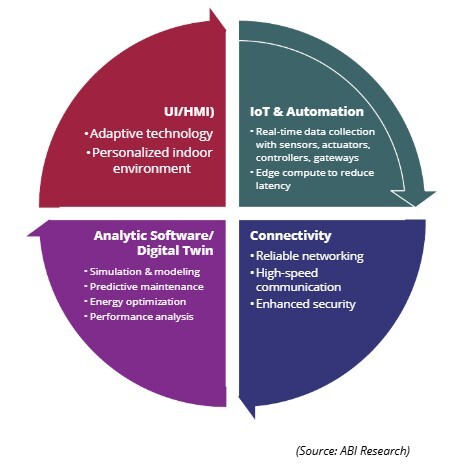
A building automation system consists of four key technology pillars: connected IoT sensors, digital twins, User Interface (UI)/Human-Machine Interface (HMI), and connectivity.
- Connected IoT Sensors: The core elements of building automation. Controllers function as central hubs to receive data from IoT equipment and environment sensors. This ensures the BAS can adjust operations schedules via software, control logic, and preset points.
- Digital Twins: Computer models used to design, operate, and simulate building systems based on historic and real-time data collection. Digital twin construction is the bedrock of data-driven decision-making and climate transparency.
- User Interface (UI)/Human Machine Interface (HMI): Simple, intuitive touch points such as dashboards and multitouch display screens for occupants to interact and control building systems. Mobile applications are included in this technology category.
- Connectivity: Low-frequency wired protocols like MODBUS and BACNET have been the de facto connectivity backbone for one-way or two-way connections within a BAS. Newer systems support short-range wireless connectivity like Wi-Fi, Wi-Fi HaLow, Bluetooth®, DECT 2020, or LoRaWAN, and present a growing opportunity to upgrade/retrofit existing buildings.
Figure 1: Building Automation System Technology Pillars
Benefits of Building Automation
Resource Efficiency
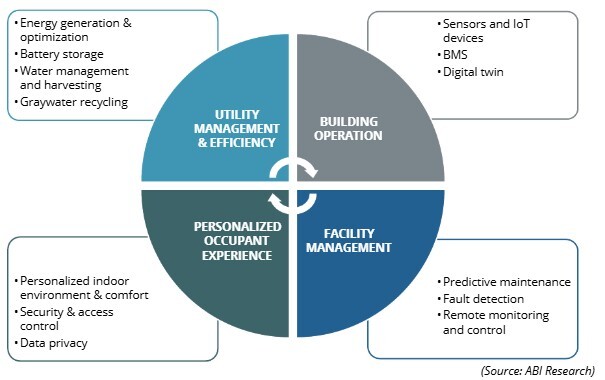
The International Energy Agency (IEA) reports that 30% of global energy consumption comes from building operations, creating an urgent need for better efficiencies. A building automation system makes decisions based on weather patterns, occupancy count, and user preferences. As a result, autonomous buildings optimize resource efficiency across energy usage, battery storage, water management, and recycling.
Real-Time Monitoring
A BAS involves a vast ecosystem of sensors and Building Management System (BMS) tools, each providing essential data for operational decision-making. These data are centralized for real-time monitoring and digital twin construction, which supports accurate forecasting, hotspot detection, and space utilization.
Extended Equipment Life Span
Facility management teams leverage historic and real-time operational data for a variety of efficiency improvements. Notable benefits include Artificial Intelligence (AI)/Machine Learning (ML)-based scenario modeling, fault detection, remote monitoring, forecasting, and predictive maintenance. The BAS empowers users to understand which in-field assets need to be fixed/upgraded, minimizing downtime costs and maximizing the long-term value of equipment.
Personalized Occupant Experience
Autonomous buildings provide a superior occupant/living experience by offering personalized control for temperature, lighting, and air quality. For example, hoteliers and commercial real estate properties can use Schneider Electric’s SpaceLogic controller to consolidate HVAC, lighting, and blinds into a single interface. In addition to advanced room control, building automation tools also typically prioritize security and data privacy.
Figure 2: Building Automation Benefits
Building Automation System Examples
dena, ProptechOS, and ClimaCheck Address Inefficient Compressors
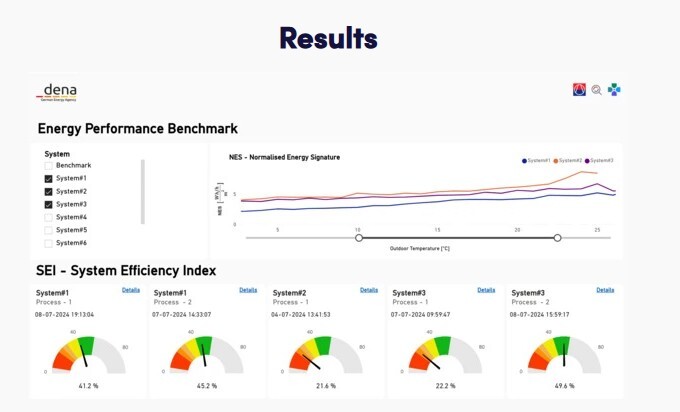
German energy agency dena partnered with ProptechOS and ClimaCheck to conserve energy consumption at multiple properties. With HVAC consuming an estimated 40% of total building electricity, power conservation efforts were top-of-mind.
Challenges like refrigerant mismanagement, lack of variable set points, flow balance, and inefficient fans had been placing a burden on compressors. An Energy Performance platform was created, collating and contextualizing data across building management systems, IoT devices, and similar technologies.
The solution, scaled across 13 sites, allows dena building owners/managers to reduce energy costs by 17%. Deploying the building automation system optimizes compressor cycles, benchmarks system performance, and reduces maintenance costs and downtime.
Figure 3: dena Energy Performance Benchmark and System Efficiency Index
(Source: ProptechOS)
Max Fashion Partnership with 75F Enhances Energy-Efficiency in Retail Stores
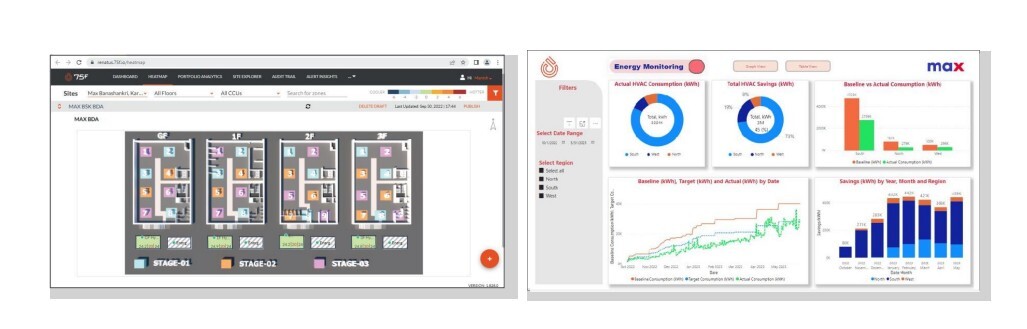
Max Fashion is the premier retail brand for the Dubai-based conglomerate Landmark Group. The company’s facility management team needed a building automation solution to reduce HVAC usage, help meet energy savings goals, and enhance customer comfort. Max partnered with 75F to develop visibility dashboards using data from existing Direct Expansion Cooling Units (DECUs). The team reinstalled the DECUs at each retail site so that 2 to 3 groups were on each floor. A master controller and central command units are used to automate climate control in the Max stores. The deployment of this BAS has scaled across 67 stores, achieving the following results:
- 53% energy savings
- Reduced carbon footprint by 5,893 tons of Carbon Dioxide (CO2)
- Deliverance of customized dashboards for the Max team
Figure 4: 75F Analytics Dashboards for Building Automation
(Source: 75F)
Qatar World Cup Sets a New Standard for Managing Venues
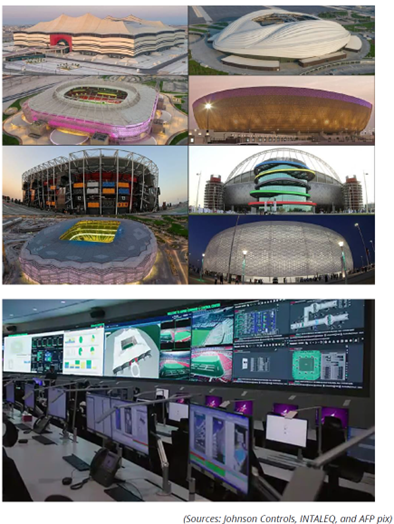
Johnson Controls and its technology partner, INTALEQ, achieved a historic milestone by building a Three-Dimensional (3D) digital twin for each of the eight stadiums used in the 2022 World Cup in Qatar. Built on Johnson Controls’ OpenBlue platform and Microsoft Azure, the BAS unifies data from edge devices and systems so that stadium operators have full operational visibility in a single pane of glass. They can also remotely monitor and control systems for speedy remediation of issues.
Real-time situational awareness is a notable application of this system deployment. For example, the digital twin alerts Qatar stadium operators when a safety concern may affect the spectator experience. Or they can leverage customized AI solutions for predictive analytics and energy management. Having this unified approach is a major upgrade from analyzing data in silos, as was required before deploying OpenBlue. It enables venue operators to respond to incidents more quickly.
Qatar’s deployment of automated tools will not only draw inspiration for the World Cup in North America in 2026, but also for sports & entertainment in general. It demonstrated that a holistic BAS platform can enhance fan experiences, while ensuring security at vulnerable venues. As INTALEQ Chairman Abdulaziz Al Mahmoud states, “We are changing how we manage the security, safety, comfort, and dynamic intelligence of sporting arenas and embracing digital innovation.”
Figure 4: Qatar Soccer Venues and Digital Command Center
Next Steps
Building automation systems are still a relatively new concept. While sustainability has recently been advocated throughout the construction industry, just 15% of commercial buildings globally have deployed automation as of 2024. However, to meet the increasingly strict emissions requirements in many regions such as the European Union (EU) and U.S. States such as California and New York, deploying building automation systems will be the only way to achieve this as human operators are unable to dynamically adapt systems and parameters in real time.
Much education is still required to gain widespread buy-in for BAS software in commercial real estate. Therefore, highlighting success stories like those previously shared will be essential. An emphasis on long-term cost savings will counterbalance the high upfront costs that managers worry about.
Technology vendors must provide quantifiable results, such as energy savings, cost reductions, safety gains, and compliance tracking. Furthermore, mapping building automation use cases to specific pain points felt by facility management teams will foster brand resonance.
Beyond education, BAS technology maturity requires vendors to take the following steps:
- Expedite digital solution development and upgrade legacy hardware.
- Keep tabs on the latest green building regulations to ensure compliance support.
- Build open and interoperable solutions across hardware, software, and systems to prevent data silos.
- Partner with other smart building ecosystem players to complement each other’s capabilities, pilot new technologies, and support the transition to proactive operations & maintenance.
- Provide in-house training to educate facility managers/building operators on the value of new automated solutions, connectivity protocols, and the need for interoperable systems.
- Continue to emphasize the benefits of AI/ML, such as automated control of Air Handling Units (AHUs) based on self-learning algorithms.
Download ABI Research’s Roadmap to Autonomous Building Operations report today for an in-depth study of what is needed to make buildings more automated, example case studies of BAS software in action, and analyst recommendations for technology providers and end users.
This resource is part of the company’s Smart Buildings Research Service.
Frequently Asked Questions
What is a building automation system?
A building automation system is a smart technology that automates various systems and processes within a building. It allows users to control energy, reduce maintenance costs, expand equipment life span, and provide improved experiences for building occupants. Building automation entails connecting to HVAC, lighting, security & fire safety, and other systems.
How does a building automation system work?
A building automation system works by being fed real-time data from IoT devices, sensors, and other connected assets. In turn, these data are displayed and are contextualized on a dashboard. This empowers building managers to identify inefficiencies and safety hazards, while optimizing resources.
What benefits can I expect from building automation?
The top benefits of building automation include resource efficiency, real-time monitoring, extended equipment life span, and personalized occupant experience. A building management system automates the process of tweaking temperature levels based on environmental conditions and predefined parameters. It enables building managers to make data-driven decisions, track the health of technology investments, and adhere to sustainability regulations.
 Paris McKinley