
Authors: Michael Larner, Distinguished Analyst & Paris McKinley, Research Analyst
The global built environment is evolving rapidly, with new trends reshaping how buildings are designed, built, and managed across sectors and regions. From sustainability and energy management to digital innovation supporting improvements for the users of buildings, these developments will influence technology vendors, investors, and strategists over the coming years.
The changing requirements of building owners and those working to manage the buildings day-to-day directly impact smart building technology vendors. Certain building types are expected to experience significant development growth through the rest of the decade, while others are being consolidated into larger facilities. There are also regional variations, making it more challenging to plan the next moves.
ABI Research’s Smart Buildings Metadata reveals several industry trends to help vendors optimize their product roadmaps and pinpoint the areas where marketing resources should be prioritized.
This blog identifies seven key trends and explains how each impacts different business functions (competitive & market intelligence, executive strategy, marketing, and product development).
Table of Contents:
- Data center built area
- Saudi Arabia's construction surge
- Warehouse expansion
- Transport hubs
- India's construction industry outlook
- Leisure and retail
- Office buildings
Larger Data Center Footprints Drive Thermal Management Adoption
Trend: Data centers are being built on a larger scale, especially in the United States and China, to accommodate Artificial Intelligence (AI) workloads. The total built area is expected to grow from 245 million square meters in 2025 to 288 million square meters by 2030. Governments and enterprises alike are working hard to develop adequate energy infrastructure and sustainable construction practices.
Table 1: Built Area of Data Centers by Region, 2025 to 2030
(Source: ABI Research)
|
Region |
Square Meters |
2025 |
2026 |
2027 |
2028 |
2029 |
2030 |
CAGR |
|
North America |
(Millions) |
149.7 |
154.5 |
159.4 |
164.4 |
169.6 |
175.8 |
3.3% |
|
Europe |
(Millions) |
72.8 |
74.8 |
76.8 |
79.0 |
81.2 |
83.4 |
2.8% |
|
Asia-Pacific |
(Millions) |
17.4 |
18.2 |
19.1 |
20.1 |
20.9 |
21.9 |
4.6% |
|
Latin America |
(Millions) |
4.1 |
4.3 |
4.6 |
4.8 |
5.1 |
5.2 |
4.9% |
|
Middle-East & Africa |
(Millions) |
1.1 |
1.2 |
1.3 |
1.5 |
1.6 |
1.8 |
10.7% |
|
Total |
(Millions) |
245.1 |
253.1 |
261.2 |
269.8 |
278.5 |
288.1 |
3.3% |
How technology vendors should respond:
- Competitive & Market Intelligence: Watch competitors in data center cooling as they align offerings with mega-facilities. Vendors that offer future-proof cooling capacities will have an edge.
- Executive Strategy: Prepare for increasing energy challenges by forging partnerships with local utilities, renewable energy providers, and AI server Original Equipment Manufacturers (OEMs). Our metadata provides an outlook for power station and substation construction.
- Marketing: Position data center solutions as essential to efficient, sustainable operations. Marketing campaigns should highlight energy savings and government advocacy. .
- Product Development: Scale cooling technology and automation product roadmaps to meet the needs of hyperscale facilities. Prioritize resilient architecture and modular design to enable scalability and adaptability to overcome climate and regional uncertainties.
Get a free whitepaper: Identify advanced data center cooling solutions
Saudi Arabia’s Surge in Industrial and Data Center Construction
Trend: Saudi Arabia is experiencing the fastest global growth in industrial building and data center construction due to its technical and manufacturing ambitions. With the backing of Western tech juggernauts, the country aims to double its data center footprint to 1 million square meters by 2030.
16.6% CAGR for data center growth in Saudi Arabia
1.3% CAGR for factory development projects
2.8% annual growth in the number of warehouses
How technology vendors should respond:
- Competitive & Market Intelligence: Monitor the influx of global vendors entering Saudi Arabia’s growing technology and manufacturing market. Competitors will move fast to capture the revenue share.
- Executive Strategy: Consider joint ventures and government alliances in Saudi Arabia to gain early support. Articulate your strategy to take advantage of the opportunity to investors/shareholders/team members.
- Marketing: Highlight local success stories and emphasize regional expertise. Cultural alignment will matter in building credibility; presenting product manuals and other marketing materials in Arabic is essential.
- Product Development: Adapt solutions for extreme climates and high-volume data center operations. Showcase regional compliance and sustainability goals.
Expansion of Warehouses for E-Commerce and Logistics
Trend: Warehouses are expanding in both size and number as e-commerce sales grow. According to ABI Research, approximately 14,000 warehouses are expected to be built between 2025 and 2030.
Table 2: Number of Warehouses by Country, 2025 to 2030
(Source: ABI Research)
|
Region |
Sites |
2025 |
2026 |
2027 |
2028 |
2029 |
2030 |
CAGR |
|
North America |
(Actual) |
30,234 |
30,714 |
31,304 |
31,789 |
32,363 |
33,036 |
1.8% |
|
Europe |
(Actual) |
40,602 |
40,901 |
41,223 |
41,543 |
41,858 |
42,172 |
0.8% |
|
Asia-Pacific |
(Actual) |
193,486 |
194,983 |
196,496 |
198,016 |
199,542 |
201,070 |
0.8% |
|
Latin America |
(Actual) |
20,067 |
20,205 |
20,350 |
20,507 |
20,666 |
20,802 |
0.7% |
|
Middle East & Africa |
(Actual) |
15,040 |
15,275 |
15,511 |
15,756 |
16,011 |
16,267 |
1.6% |
|
Total |
(Actual) |
299,429 |
302,078 |
304,884 |
307,611 |
310,440 |
313,347 |
0.9% |
How technology vendors should respond:
- Competitive & Market Intelligence: Track how logistics technology vendors are innovating to enable new companies to integrate new warehouses into their operations and Third-Party Logistics (3PL) providers onboard new clients.
- Executive Strategy: Expand your Go-to-Market (GTM) strategy, focusing on omnichannel supply chains. Partnerships with logistics operators and port authorities will ensure buy-in across the global supply chain
- Marketing: Position smart building and energy-saving tools as consequential to warehouse efficiency and goods security.
- Product Development: Develop integrated solutions that provide warehouses and ports with renewable energy sources, automation, and visibility monitoring.
Security and Energy Priorities at Transport Hubs
Trend: The total built area of transportation hubs is outpacing the number of new hubs being constructed; more specifically, new terminals and expanded footprints, so not necessarily new construction. This means a wider area must be properly secured, new efficiencies need to be achieved, and energy consumption is a bigger focus.
Table 3: Built Area of Transportation Hubs by Category, 2025 to 2030
(Source: ABI Research)
|
Category |
Square Meters |
2025 |
2026 |
2027 |
2028 |
2029 |
2030 |
CAGR |
|
Airports |
(Millions) |
152.5 |
153.1 |
154.0 |
111.3 |
157.4 |
159.0 |
0.8% |
|
Ports |
(Millions) |
167.1 |
167.6 |
167.9 |
145.6 |
170.5 |
172.9 |
0.7% |
|
Terminus Railway Stations |
(Millions) |
27.6 |
27.8 |
27.9 |
25.6 |
28.2 |
28.4 |
0.5% |
|
Total |
(Millions) |
347.3 |
348.5 |
349.8 |
282.4 |
356.0 |
360.3 |
0.7% |
How technology vendors should respond:
- Competitive & Market Intelligence: Evaluate rival vendors investing in AI-driven systems. These will set the pace for innovation.
- Executive Strategy: Seek partnerships with transport hub operators to embed your technologies early and chronicle customer success stories. Invest in platforms that facilitate collaboration and coordination across data, operations, and asset management for real-time insights across transportation networks.
- Marketing: Emphasize safety, climate compliance, and trust in customer-facing campaigns. Cite notable examples of what happens when transport hubs lack the proper solutions (safety risks, stolen goods, government fines).
- Product Development: Focus on integrated sensing and monitoring tools that combine safety with efficiency in high-traffic hubs. Highlight modular tools that streamline modernization and enable safe retrofits without disrupting daily transportation operations.
Upgrades in India’s Transportation and Social Infrastructure
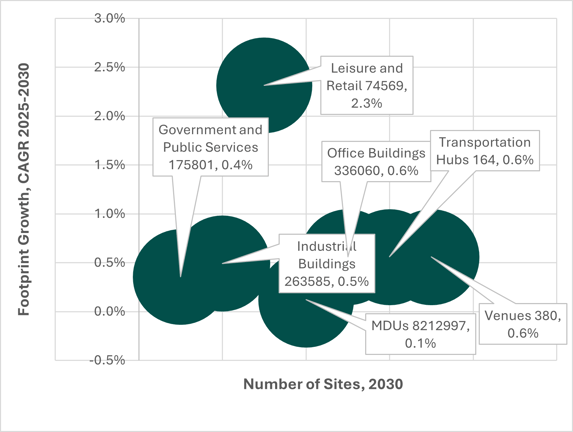
Trend: The built environment in India is expanding rapidly with the construction of new airports, schools, universities, malls, and entertainment facilities with strong government financial backing. Case in point, the number of leisure & retail buildings in India is expected to grow at a 2.3% CAGR between 2025 and 2030. The population has a growing middle class, spiking demand for novel occupant experiences.
Chart 1: Built Environment in India, 2030
(Source: ABI Research)
How technology vendors should respond:
- Competitive & Market Intelligence: Track vendors expanding into education and leisure infrastructure in India and identify areas where your company offers differentiation.
- Executive Strategy: Broaden your play into adjacent verticals like retail, education, and airports, where smart infrastructure demand is increasing. Modular construction is gaining prominence in this emerging market.
- Marketing: Stress your company’s ability to enable never-before possible experiences in the country, notably in the lifestyle space.
- Product Development: Design technology offerings that adapt to rapid construction growth while meeting India’s evolving energy demands and rising middle class (similar to Brazil’s population).
Leisure and Retail Remodeling for Changing Consumer Behavior
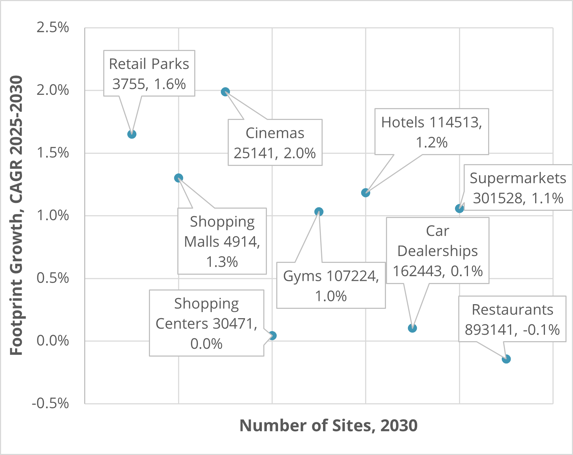
Trend: Retail shopping centers, cinemas, hotels, supermarkets, and gyms are experiencing positive growth rates worldwide for the next 5 years. Building managers are responding to shifting consumer habits by adopting smart building technologies.
Chart 2: Leisure and Retail Built Environment, 2030
(Source: ABI Research)
How technology vendors should respond:
- Competitive & Market Intelligence: Keep tabs on rivals offering specialized retail and leisure solutions. Early movers here will have an advantage going forward.
- Executive Strategy: Position strategically with hotel chains, cinemas, mall operators, supermarkets, gyms, dealerships, restaurants, and other stakeholders that are remodeling their buildings.
- Marketing: Emphasize flexibility and energy efficiency as your core value proposition. Show how your solutions ease redesign and retrofitting.
- Product Development: Enhance modularity of smart lighting, energy management, and sensing technologies for fast-changing layouts. Prioritize customer experience to enhance interactions.
Office Buildings Requiring Technology Transformation
Trend: The construction of office buildings and demand for existing office space in North America and Europe is challenged due to the prevalence of hybrid work. The number of office buildings in Europe remains flat and is declining in the United States and Canada.
Table 3: Number of Office Buildings by Region, 2025 to 2030
(Source: ABI Research)
|
Region |
Sites |
2025 |
2026 |
2027 |
2028 |
2029 |
2030 |
CAGR |
|
North America |
(Millions) |
1.091 |
1.089 |
1.085 |
1.081 |
1.077 |
1.074 |
-0.3% |
|
Europe |
(Millions) |
2.626 |
2.628 |
2.630 |
2.632 |
2.634 |
2.636 |
0.1% |
|
Asia-Pacific |
(Millions) |
3.286 |
3.293 |
3.300 |
3.307 |
3.314 |
3.321 |
0.2% |
|
Latin America |
(Millions) |
0.059 |
0.060 |
0.060 |
0.061 |
0.061 |
0.062 |
1.0% |
|
Middle East & Africa |
(Millions) |
0.174 |
0.176 |
0.177 |
0.178 |
0.179 |
0.181 |
0.7% |
|
Total |
(Millions) |
7.237 |
7.245 |
7.252 |
7.259 |
7.266 |
7.273 |
0.10% |
How technology vendors should respond:
- Competitive & Market Intelligence: Watch competitors accommodating green certifications and developing occupant well-being solutions.
- Executive Strategy: Pivot top-down strategy toward retrofitting and sustainability services rather than new office builds.
- Marketing: Highlight how your solutions make offices more comfortable and sustainable, providing quantifiable energy reduction metrics.
- Product Development: Develop products geared toward accelerating building renovations and achieving energy efficiency. Focus on analyzing space utilization to optimize layouts, booking systems, and occupancy workflows to maximize both workplace and energy efficiency.
ABI Research’s Smart Buildings Metadata reveals all the construction industry trends that technology providers need to know to align their product portfolios with regional demand. Download today.
Meet the Authors

Michael Larner, Distinguished Analyst
Michael Larner, Distinguished Analyst, is part of ABI Research’s End Markets team. His research examines how technologies such as data analytics, robotics, Artificial Intelligence (AI), the Internet of Things (IoT), and connectivity solutions are enabling discrete and process manufacturers, building managers, and facilities managers to address both external and operational challenges.

Paris McKinley, Research Analyst
Paris McKinley, Research Analyst, is a member of ABI Research’s Manufacturing, Energy & Buildings team. Her research focuses on transformational technologies and best practices in the smart buildings market, with a particular emphasis on office buildings, industrial facilities, data centers, and other commercial buildings.
Before joining ABI Research, Paris was a Project Coordinator for Cal Zero Waste Educational and Outreach, where she tracked progress on waste diversion initiatives and implemented circular economy solutions.
 Paris McKinley