
Space technology presents humanity with numerous opportunities to enhance the quality of life and national security. Satellite communications services connect the unconnected and offer ubiquitous global coverage for consumers and organizations alike. This can save lives during natural disasters, improve military capabilities, and enhance enterprise operations in rural or hard-to-reach regions.
ABI Research’s Space Tech team observes the biggest trends in space technology, covering everything from telecommunications integration to data centers in space. In this article, we identify our top seven space technology trends for 2026 and beyond:
- AI in LEO Networks
- Data Centers in Space
- Asia-Pacific’s Space Tech Evolution
- Satellite D2C and NTN
- Software-Defined Networks
- PTN Technology
- PPP-RTK for Global Navigation
Key Takeaways:
- Space is becoming more than a place for satellites. It is quickly turning into a platform for computing, Artificial Intelligence (AI), and new digital services that go far beyond basic connectivity.
- Private companies are now major drivers of space innovation. Their investments are speeding up progress in areas like Low Earth Orbit (LEO) networks, data centers in space, and advanced satellite systems.
- Asia-Pacific is rising as a global space leader. Growing government support and active startup ecosystems are reshaping the balance of power in space technology.
- Industries want space systems that are reliable, flexible, and secure. This is pushing demand for better navigation, stronger cybersecurity, and more resilient connectivity.
- Growing resource and energy needs are inspiring new ideas. New concepts like orbital data centers show how space could help solve long-term computing challenges on Earth.
1. AI in LEO Networks
Low Earth Orbit (LEO) satellite networks are evolving far beyond their original mission of delivering basic Internet access. Bridging the digital divide remains the main prize, but ABI Research believes the true long-term opportunity is using LEO constellations as infrastructure for cloud computing and Artificial Intelligence (AI) services. Space Tech Analyst Andrew Cavalier states that, “With the lower latencies, faster upgrade cycles, and application flexibility unlocked by LEO networks, enabling cloud and AI workloads at the remote edge via satellite will become the flagship offering in LEO.“
Major players like SpaceX, Amazon, and Globalstar are building out massive LEO constellations to tap into new global user bases. These LEO networks connect underserved users, while enabling Direct-to-Device (D2D) and Internet of Things (IoT) applications.
These LEO satellite networks bypass the limitations of terrestrial infrastructure. They can deliver fast, secure connections for cloud service, edge computing, and AI processing at scale.
2. Data Centers in Space
There was a time when the idea of data centers in outer space would have been dismissed as pure science fiction. Today, however, some of the world’s biggest technology companies are championing the concept. In Cavalier’s analysis, he mentions well-known players like Amazon (Blue Origin), SpaceX, NVIDIA, and Google showing interest in developing this technology. Meanwhile, emerging innovators such as Starcloud, Axiom Space, and Lonestar are also exploring orbital data center designs.
In space, an estimated 10X to 40X more energy can be delivered per square meter compared to Earth-based solar-powered systems. Considering the unprecedented power consumption of Generative Artificial Intelligence (Gen AI) workloads, space could offer significant relief for data center operators.
Rather than building massive single-site facilities, these companies are developing smaller, interconnected clusters. AI training will be the top use case for data centers in space, with Sun-Synchronous Orbits (SSOs) offering significant electricity savings. Additional applications include satellite data transfer, collision avoidance, and Quantum Key Distribution (QKD)-based cybersecurity services.
The industry is still at the exploratory stage of data centers in space, as several technical hurdles stand in the way. Notable challenges include thermal management, latency, consistent sunlight exposure, hardware durability, data interconnectivity, and the rapid obsolescence of server racks. Cavalier tells Kratos in a Q&A session that "We anticipate a need for autonomous logistics vehicles—mirroring the model Astrolab is deploying for lunar surface logistics—to robotically swap degraded server components and maintain the constellation."
Vendors that can help the space industry overcome these challenges can expect lucrative revenue opportunities to materialize. For example, AMD, Infineon, and STMicroelectronics will likely see a demand surge for radiation-resistant components, and without a doubt, AI Graphics Processing Unit (GPU) vendors. Similarly, tech vendors that develop atmosphere-independent cooling solutions will find early success in this budding market.
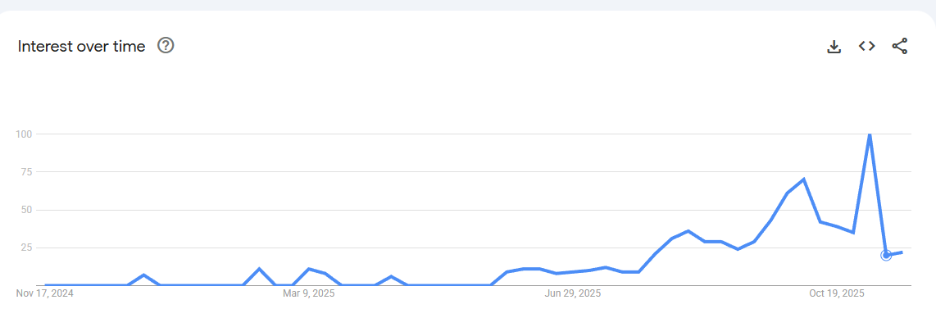
The outlook for space-bound data centers is both optimistic and early. On one hand, the technology has attracted highly influential advocates like Jeff Bezos and Elon Musk. On the other hand, ABI Research forecasts orbital data centers to account for just 1% of edge compute satellites in orbit by 2031. Our Space Tech analyst team will continue to study this embryonic market as it spreads its wings.
Figure 1: Search Interest for the Keywords “Data Centers in Space” over the Past 12 months
(Source: Google Trends)
3. Asia-Pacific’s Space Tech Evolution
Asia-Pacific is quickly becoming a global force in space technology, marked by growing government investments, increasing venture capital activity, and regional satellite innovation.
Countries like Japan, South Korea, Australia, and those across Southeast Asia are scaling national satellite constellations for Earth Observation (EO) and communications. Startups are entering the mix, too, driving new models like Satellite-as-a-Service, Ground Segment-as-a-Service (GSaaS), and satellite data analytics.
Additionally, the physical antenna is multiplying and moving to the edge, while the processing stack is centralizing and moving to the cloud. ABI Research anticipates that the Asia-Pacific region will see near parity with North American Earth station antenna deployments and ground station virtualization by 2032. This expansion is largely fueled by growing demand for LEO networks and much-needed coverage across remote and underserved geographies.
The two space tech juggernauts in the region are China and India. “Within this diverse and fast-evolving landscape, China and India show significant potential as spacefaring nations in terms of scale, long-term vision, technological independence, and strategic models,” says Industry Analyst Rachel Kong.
However, each country takes a different approach toward innovation. While China prioritizes centralized investment and mega constellations, India emphasizes open market access, foreign direct investment, and private-public collaboration.
Table 1: Comparison of China and India’s Space Technology Strategy
(Source: ABI Research)
|
Category |
China |
India |
|
Strategic Vision and Policies |
|
|
|
Satellites Launched |
Mega Constellations:
|
Constellations:
|
|
Market Opportunity and Private Sector |
Market access is highly centralized under the government, and players are largely state-dominated. However, a growing number of commercial players are emerging in the space sector. |
Market access is relatively open to global investors, and the private sector environment encourages startups and technology transfers. |
|
Funding and Investments |
Huge state investments from a few major players (CNSA, CASC, CALT, China Satellite Network, etc.). FDI is tightly restricted, and China is selective about its foreign partnerships. |
Mission-driven and relatively smaller than in China. Major players include ISRO, IN-SPACe, and NewSpace India Ltd (NSIL). FDI is encouraged and up to 100% in some satellite segments. |
As the region matures, Asia-Pacific’s space technology ecosystem is advancing national interests and fostering international partnerships. As a result, analysts expect a spillover into AI, IoT, edge computing, and the broader cloud ecosystem. Kong concludes that “With many emerging space powers across the region, we are witnessing a growing multipolarity in Asia-Pacific’s space landscape. How can Asia-Pacific collaborate on different fronts—policy, commercial, academic, or technical—to ensure that space remains a growth driver with continued technological advancements?”
4. Satellite D2C and NTN
Satellite-enabled D2C and Non-Terrestrial Network (NTN) technologies are moving into large-scale commercialization. According to ABI Research, the number of satellite D2C users is forecast to increase from 585 million in 2024 to 2.6 billion by 2035.
This trend reflects growing global demand for direct satellite connectivity through standard smartphones. D2C advancements are especially prevalent across underserved and disaster-prone areas.
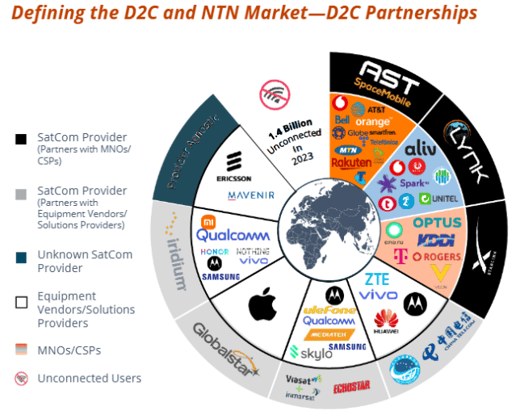
Several major satellite operators, including SpaceX, Iridium, and Globalstar, are developing NTN platforms using both proprietary and The 3rd Generation Partnership Project (3GPP) standards-based architectures. This will give rise to the mass production of commercial off-the-shelf handsets and IoT devices supporting satellite connectivity.
On the device side of things, most major smartphone brands (Apple, Samsung, Google, etc.) support D2C capabilities—at least for free emergency communication, as was the case for the LA wildfires in early 2025.
Telcos and Original Equipment Manufacturers (OEMs) do not want to miss out on new revenue streams. Therefore, we expect the telecoms industry to increasingly partner with satellite operators to build D2C/NTN service portfolios. Through this collaboration, telcos will unlock novel use cases, differentiate 5G offerings, and future-proof infrastructure.
Figure 2: List of Companies Across the D2C and NTN Market
(Source: ABI Research)
5. Software-Defined Networks
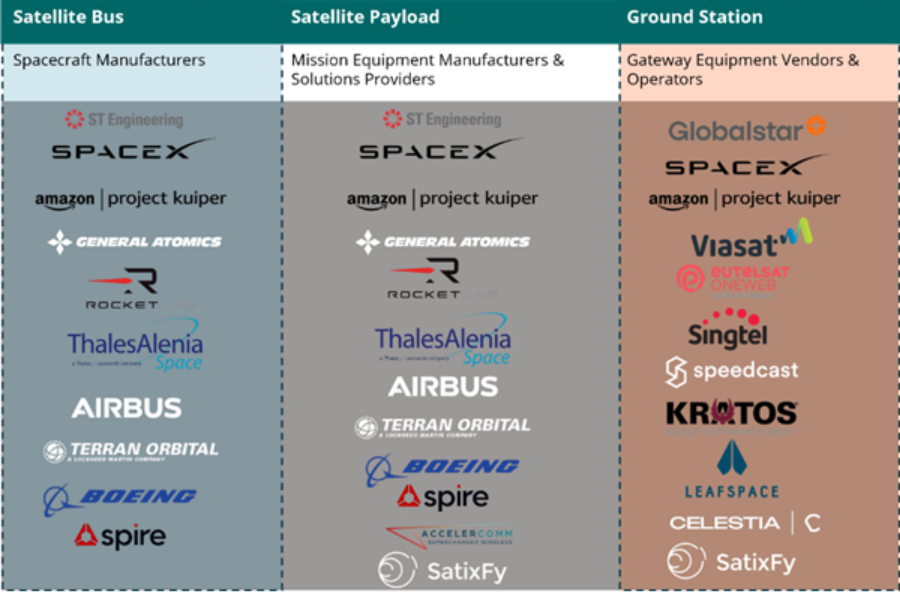
The future of satellite networks is software-defined. Technologies like Software-Defined Satellites (SDSs), Software-Defined Ground Stations (SDGSs), and cloud-native Network Functions (CNFs) are reshaping how space infrastructure is built, operated, and scaled.
Below are notable developments ABI Research is monitoring:
- Satellites are becoming reprogrammable and regenerative. They now use Software-Defined Radios (SDRs), GPUs, and Field Programmable Gate Arrays (FPGAs) to process data in orbit, reducing dependency on specialized ground hardware. This enables faster deployment of new services and more flexibility in mission planning.
- Cloud-native gateways are key to bridging space and terrestrial networks. By centralizing intelligence and separating control and data planes, they allow seamless integration with 3GPP NTNs. These software-defined systems will be vital for the transition to 6G, as they help allocate resources dynamically.
- ABI Research expects software-defined and digital satellite deployments to grow from 234 in 2024 to over 10,000 by 2031. This is driven by cloudification and increased telco-satellite integration. As the satellite communications industry shifts from static to dynamic architectures, service providers will be able to update, scale, and reconfigure networks in real time.
An excerpt from Cavalier from his blog:
“Cloud and SDSs present significant opportunities for satellite and telco operators. ABI Research estimates a US$22 billion revenue potential by 2032 from applications like connected cars, IoT, and Direct-to-Cellular (D2C) services. Cloud-native technologies, including containerization, microservices, and orchestration platforms like Kubernetes, enable rapid NTN-mobile service deployment across a hybrid infrastructure. Hyperscalers such as Amazon Web Services (AWS) can act as neutral brokers, hosting disparate Application Programming Interfaces (APIs) to integrate terrestrial and satellite systems.”
Figure 3: Key Companies and Ecosystems in Space Network Cloudification
(Source: ABI Research)
6. Positioning, Navigation, and Timing (PNT) Technology
Conflicts such as the Russo-Ukrainian war have highlighted the cyber vulnerabilities of traditional GNSS services operating in Medium Earth Orbit (MEO). As a result, space systems will increasingly leverage LEO-based Positioning, Navigation, and Timing (PNT) technologies.
Notable developments include:
- The U.S. Space Force is rolling out GPS III with advanced anti-jamming capabilities.
- Commercial players like SpaceX, Globalstar, and Iridium are stepping in with their own LEO-based PNT services.
- The Federal Communications Commission (FCC) is now exploring both space and terrestrial alternatives through open consultations with industry stakeholders.
These developments point toward a new wave of chipset innovation, with multi-constellation solutions driving PNT shipment growth. LEO-based PNT tech will find significant traction in urban areas, conflict zones, and regions where traditional signals struggle to reach.
7. PPP-RTK Enhances Global Navigation
Precise Point Positioning (PPP) with Real-Time Kinematic Augmentation (RTK) is redefining what’s possible in satellite navigation. It combines the best of both worlds: the wide-area coverage of PPP and the pinpoint accuracy of RTK. This combination enables the delivery of real-time, centimeter-level positioning with fast convergence times.
By blending satellite and Internet broadcast methods, PPP-RTK allows for large-volume correction data to be transmitted efficiently. This hybrid approach supports single-receiver devices without the need for dense infrastructure.
Companies like Trimble and TERIA-EXAGONE are pioneers in PPP-RTK development, offering global and regional services for specific applications (e.g., autonomous driving, robotics, etc.). As location-dependent services become more critical, PPP-RTK will be essential to supporting a new generation of precision technologies.
Let's talk: Stay tuned for more expert guidance on these space technology trends by subscribing to ABI Research’s Space Technologies & Innovation Research Service.
- Why Laser Communication (Lasercom) in Space Is Gaining Traction (Blog)
- Satellite IoT Enters 2026 with New NB-NTN Service Propositions from Viasat, Skylo, and Iridium…Competition Will Ratchet Up (Analyst Insight)
- Are Space-Based Orbital Data Centers the Next AI Compute Frontier? (Analyst Insight)
- The Future of Cyber Resilience in Orbit—and How Operators Can Lead It (Analyst Insight)
Contributing Analysts

Andrew Cavalier, Principal Analyst
Research Focus: Andrew specializes in satellite communications and space technologies. His expertise spans next-generation connectivity, Non-Terrestrial Networks (NTNs), and the integration of satellite and terrestrial systems. With a background in market research, government program management, and software engineering, Andrew provides strategic insights that help industry stakeholders navigate emerging opportunities in space and telecommunications. He regularly contributes to thought leadership through reports, consulting, and industry events, focusing on how space innovation drives digital transformation across global markets.

Rachel Kong, Industry Analyst
Research Focus: Rachel is an Asia-Pacific Advisory team member specializing in Earth observation and remote sensing technologies within the Space Technologies research group. She also supports research across a broader range of space technologies, including Non-Terrestrial Networks (NTNs), Direct-to-Device (D2D) communications, and satellite Internet of Things (IoT), among others. She conducts in-depth research and analysis on geospatial technologies and their applications across diverse industries, focusing on technological innovations, global advancements, and identifying emerging trends to provide actionable insights and support decision-making for businesses and organizations. In addition, Rachel contributes to the Core Forecasting Team, providing research support on immersive technologies such as Augmented Reality (AR) and Virtual Reality (VR).
Frequently Asked Questions
Which space technology trends are shaping the industry today and in the future?
ABI Research analysts identify the following transformative trends:
- Artificial Intelligence (AI) and cloud computing are enabling LEO networks to unlock novel use cases.
- The industry is exploring the viability of installing data centers in outer space to reduce electricity costs and decarbonize Earth.
- Countries across the Asia-Pacific region are quickly catching up to the Western space tech ecosystem, backed by government initiatives and strong investment.
- Direct-to-Cellular (D2C) and Non-Terrestrial Networks (NTNs) are expected to become ubiquitous. These services provide emergency communications and generate new revenue opportunities for telcos.
- Satellite networks are embracing software-defined cloud architecture, accelerating new service provisioning and easing the transition to 6G.
- Governments are increasingly championing Positioning, Navigation, and Timing (PNT) technology to improve military capabilities and circumvent cybersecurity vulnerabilities.
- Precise Point Positioning (PPP) with Real-Time Kinematic Augmentation (RTK) will facilitate centimeter-level accuracy. This will be essential for mission-critical applications like robotics and self-driving cars.
How do these trends impact companies working in the space industry?
These trends create new commercial opportunities for space companies, from LEO-based AI services to orbital data centers and PPP-RTK navigation. They also raise the bar for innovation, pushing vendors to deliver more flexible, secure, and software-defined systems, while addressing complex challenges like power generation, thermal management, and regulatory alignment.
How will these space technologies impact everyday life?
Space technologies will expand connectivity, strengthen emergency communications, improve navigation accuracy, and bring cloud and AI capabilities to underserved regions. As these systems mature, consumers will benefit from more reliable mobile service, faster access to digital tools, and new applications enabled by satellite data, positioning, and space-based computing.
Subscribe to Our Newsletter
Join thousands of other subscribers for the latest technology trends, forecasts, and vendor updates delivered to your email every week.
