

Digital twin software has evolved rapidly in recent years, thanks to innovative technology vendors like Siemens. The next generation of digital twins in manufacturing—comprehensive digital twins—provides benefits far beyond legacy solutions. They support technological capabilities like Agentic Artificial Intelligence (AI), closed-loop feedback, and full-stack software integration. The contextual awareness a comprehensive digital twin provides is unprecedented. It can be used by manufacturers to build more realistic simulation environments, enhance collaboration, and solve specific business challenges across multiple domains.
In this article, we assess the evolution of digital twins, explain how comprehensive digital twins work, and evaluate their multi-persona value.
Download the Whitepaper, The Comprehensive Digital Twin: Not All Are Equal
The Spectrum of Digital Twins
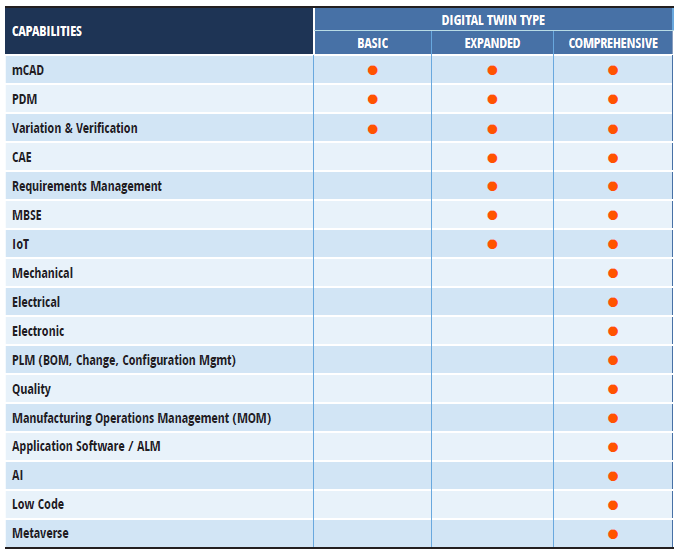
Digital twins have evolved in line with manufacturers’ growing needs. Basic digital twins capture live metadata from connected assets in the field. Some integrate Computer-Aided Design (CAD) and Product Lifecycle Management (PLM) software to virtually represent a product. This type of digital twin is mostly focused on product-based use cases. While it has its uses, basic digital twins lack the robust capabilities that the modern manufacturer requires to scale.
These limitations are why manufacturers increasingly turned to more advanced, “expanded” digital twins. This type of digital twin supports product and process-based use cases, particularly predictive and “what if” scenario analysis. Expanded digital twins incorporate Computer-Aided Engineering (CAE) analysis, support requirements management, and take a systems engineering approach. Despite the advancements, expanded digital twins still fall short of the interconnectedness needed to improve manufacturing performance.
Comprehensive digital twins are designed to overcome this shortcoming. They ingest data across all product domains, including software, mechanical systems, electronics, electronic systems, etc. Live performance data are used for continuous improvement in design and manufacturing. Comprehensive digital twins go a step further by leveraging Agentic AI and low-code capabilities to quickly update data linkages and simplify engineering workflows. Collaboration is also enhanced with this type of digital twin, as photorealistic images can be shared with all key stakeholders across various business functions (e.g., design, engineering, frontline operators, administration, legal).
Table 1: The Different Types of Digital Twins
(Source: ABI Research)
Why the Shift to Comprehensive Digital Twins?
The investment drivers of comprehensive digital twins are two-fold. First, they provide superior contextualization at all stages of a product’s lifecycle. This is due to their all-encompassing nature, leveraging live data from numerous systems, across design, and to production. Context-awareness enables manufacturers to make quicker and better decisions regarding product design, process optimization, or even the layout of an entire smart factory. Additionally, quality managers can take a First Time Right (FTR) approach to production, which reduces waste and rework costs.
Second, the digital twin deployment starts with a problem first. Decision makers no longer prioritize technology, but rather business outcomes. This could be anything from accelerating the design process to enhancing machine health via predictive maintenance. Before evaluating suppliers, manufacturers must identify issues that could be addressed with a single source of data across various domains. From there, a digital twin investment can be mapped to specific use cases.
Technology vendors like Siemens recognize this view, designing digital twin software spanning multiple functional areas. For example, Recreational Vehicle (RV) manufacturer Hymer GmbH & Co. KG uses the Siemens Xcelerator platform to improve flexibility and agility throughout the New Product Introduction (NPI) process. The platform is used for design validation, simulation, and configuration of new RV models. By having a holistic view of data and utilizing VR-based immersive engineering tools, Hymer’s production team solves multi-domain challenges.
Deploying the comprehensive digital twin has provided the following results for Hymer:
- 80% fewer physical mockups and prototypes
- 65% faster time to market
- Alignment of production, marketing, and sales teams
- More seamless data sharing across systems
No Need to Build Your Own Digital Twin Anymore
Sticking with legacy twins carries the risk of data silos, production delays, and dissatisfied customers. The best digital twin software addresses specific business challenges and ingests real-time data across all product realms. Off-the-shelf digital twin solutions have evolved considerably in recent years, diminishing the need to build one in-house. Simpler deployments allow organizations to get up and running faster and create cross-departmental synergies previously unattainable.
When implementing a comprehensive digital twin, ABI Research recommends several best practices to take now through the next 12 months. Grab the full checklist to plan your own digital twin roadmap by downloading the whitepaper, The Comprehensive Digital Twin: Not All Are Equal.
 Ryan Wiggin