
Key Insights
- Executive strategy succeeds when leadership turns market intelligence into clear priorities that every department can act on. Without that translation layer, even strong insights fail to change the business.
- Alignment is often the real execution bottleneck. Product, marketing, sales, and operations may all be moving with urgency, but not always in the same direction.
- The most dangerous strategic gap is poor signal selection. Many leadership teams are flooded with data, yet still miss the competitive shifts and technology changes that matter most.
- M&A works best when it supports a defined growth path. Strong targets need market fit, technology fit, and a realistic path to integration.
- AI tools and analyst input help executives move faster with more confidence. Their value comes from filtering noise, challenging internal assumptions, and surfacing the insights most relevant to board-level decisions.
When executive teams reach out to ABI Research, they typically seek guidance on navigating fast-evolving technology markets and aligning their organizations around a clear strategic direction. Executive leadership has always demanded a blend of bold innovation and careful business planning. In 2026, this strategic mandate has become far more pronounced. Leaders must now navigate a sea of shifting customer demand, emerging regulations, and unexpected competition. The C-Suite must captain the ship, while making high-stakes decisions under tighter deadlines.
Chief Executive Officers (CEOs), Chief Strategy Officers (CSOs), Chief Operating Officers (COOs), and Presidents are responsible for steering organizations through these turbulent waters. Up the corporate ladder, boards now expect leaders to predict market alterations, not just respond to them.
The top senior leaders recognize that extensive market intelligence is a prerequisite for success in their market niche. However, the hard part lies in distilling disparate market signals into clarity. This blog outlines how to build an executive strategy in five key steps to ensure all departments work in lockstep.
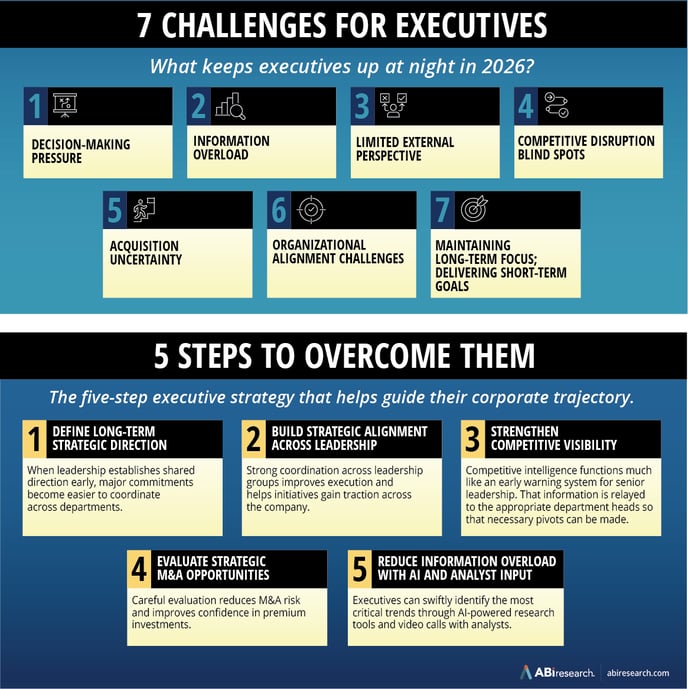

What Is Keeping Executives Up at Night in 2026?
Executives face a dual threat: volatile markets that shift in an instant and a level of strategic complexity that leaves no margin for error. This pressure spans the entire C-Suite, from CEOs and boards to Chief Financial Officers (CFOs) and Chief Technology Officers (CTOs).
Through conversations with ABI Research, some of the most common strategic issues cited by executive teams include:
- Decision-Making Pressure: Leadership teams must make business-critical decisions quickly, while ensuring they are based on accurate market intelligence and realistic assumptions.
- Information Overload: Executives have access to more reports, dashboards, and data sources than ever before. Yet, identifying the insights that truly support executive strategic planning remains difficult.
- Limited External Perspective: Internal teams often operate close to the business, which can make it difficult to challenge assumptions or identify emerging market risks. Such biases must be eradicated in corporate strategy.
- Competitive Disruption Blind Spots: Rapid shifts in technology trends and developments can allow competitors or new entrants to reshape markets before leadership teams have time to respond.
- Acquisition Uncertainty: Evaluating potential acquisition targets requires visibility into competitive positioning, technology interoperability, and future market potential. However, accurate information remains elusive.
- Organizational Alignment Challenges: Ensuring coordination between marketing, product development, operations, and sales is essential for the efficient execution of a sound strategic vision. Be that as it may, many of these teams still work in silos.
- Maintaining Long-Term Focus While Delivering Short-Term Results: Executives are tasked with generating immediate revenue and maximizing operational performance while planning future growth.
To overcome these executive challenges, companies benefit from a clear strategic roadmap that helps guide their corporate trajectory. The five-step executive strategy framework below outlines how to synchronize priorities, track competitive shifts, and evaluate emerging opportunities.
Table 1: Executive Strategy Framework
|
Step |
Strategic Focus |
Key Question for Executives |
Outcome |
|
Step 1 |
Define Strategic Direction |
Where should the company compete and grow? |
Clear long-term priorities |
|
Step 2 |
Leadership Alignment |
Are all departments aligned with the strategy? |
Organizational coordination |
|
Step 3 |
Competitive Visibility |
What market shifts or competitors should we monitor? |
Early disruption awareness |
|
Step 4 |
M&A Opportunities |
Do acquisitions or partnerships strengthen the strategy? |
Smarter investment decisions |
|
Step 5 |
Intelligence & Insight |
Which market insights should guide leadership decisions? |
Faster executive decision-making |
Step 1: Define Long-Term Strategic Direction
Every executive strategy starts with clarity around the company’s future direction. Organizational leaders must determine which markets matter most, which customer segments will drive expansion, and which technological developments will shape the industry in the coming years. This also requires CTOs and Chief Product Officers (CPOs) to gauge whether their current product roadmap is ready to scale.
Senior leaders should regularly examine where the company intends to compete and how it expects to differentiate itself. This includes identifying commercially viable markets, understanding customer demand patterns, and evaluating how emerging technologies may reshape the competitive landscape.
Clear direction also ensures that investments across product portfolios, marketing/advertising, and sales support the same business outcomes established in the boardroom. Without that precision, the organization risks being pulled toward different objectives.
For example, one European chipset supplier partnered with ABI Research to guide its growth strategy. Equipped with our detailed data and consultation, the client crafted the blueprint for entering and disrupting highly competitive segments. Our evidence-based recommendations gave executives a concrete way to communicate their long-term expansion strategy to key stakeholders.
Takeaway: When leadership establishes shared direction early, major commitments become easier to coordinate across departments.
Step 2: Build Strategic Alignment Across Leadership
Once company priorities are defined, the next challenge involves keeping organizational leaders on the same page. A recent survey of 400 global executives by Harvard Business Review showed that just roughly one in seven “strongly agreed” that their company is aligned. What’s more, those few respondents in strong agreement register above-average financial performance.
Different business units naturally focus on different objectives. Product teams emphasize innovation and technical capabilities. Customer engagement and demand generation take precedence for Chief Marketing Officers (CMOs). Meanwhile, sales teams concentrate on near-term revenue opportunities.
If these priorities drift apart, progress stalls.
Senior executives play a central role in maintaining coordination through strategic leadership. CEOs and CSOs must consistently communicate the strategic North Star and ensure that each department understands how its work contributes to the broader plan.
When leadership teams stay coordinated, several benefits follow:
- Product development investments reflect actual market realities.
- Marketing communicates a clear and consistent value proposition.
- Sales efforts reinforce the broader company mission.
- Operational improvements reduce expenses and enhance efficiency and scalability.
Takeaway: Strong coordination across leadership groups improves execution and helps initiatives gain traction across the company.
Step 3: Strengthen Competitive Visibility
Markets rarely remain stable for long. Rivals introduce new products, pursue acquisitions, and expand into adjacent sectors at a steady pace.
Companies that lack visibility into these developments often discover market shifts only after their position has already been compromised.
For this reason, many executive teams build structured processes for tracking industry activity. Synthesizing tech trends and consumer data helps leaders detect the early breadcrumbs of industry disruption.
For instance, ABI Research’s annual technology trends report pinpoints upcoming opportunities and warns executives where demand is fading. Furthermore, competitive assessments reveal the Go-to-Market (GTM) strategies of industry rivals.
This early awareness provides valuable time to adjust product roadmaps, refine marketing initiatives, or explore partnerships that strengthen market positioning.
Table 2: Strategic Intelligence Sources for Executives
|
Intelligence Source |
Strategic Value |
|
Technology trend reports |
Identify emerging opportunities and risks |
|
Competitive rankings |
Reveal market positioning of key players |
|
Market forecasts |
Support long-term planning and investment |
|
Analyst advisory sessions |
Provide external validation and industry insight |
Takeaway: In practice, competitive intelligence functions much like an early warning system for senior leadership. That information is relayed to the appropriate department heads so that they can make the necessary pivots.
Step 4: Evaluate Strategic M&A Opportunities
Mergers and Acquisitions (M&A) remain one of the most effective ways for vendors to expand capabilities and accelerate growth. However, evaluating potential targets can present complexity. What will the change management process look like? How will their tech stacks integrate with your own? Will you have to hire new employees to facilitate services?
To answer these questions, executive leaders must assess market positioning, competitive dynamics, and technology compatibility. CFOs play a critical role at this stage by analyzing valuation models, integration costs, and Return on Investment (ROI) projections. Furthermore, CTOs can provide input on re-architecting underlying technologies to scale.
Corporate strategy teams often struggle to obtain reliable data about how potential M&A fit within the broader industry landscape. An executive strategy framework helps guide these evaluations by placing M&A within the context of multi-year business goals. Leadership teams benefit from examining several factors during this process:
- The target company's competitive position within its market.
- How its technology complements existing product development initiatives.
- The potential impact on revenue growth, customer relationships, and liquidity.
- Risks related to market competition or technology overlap.
Takeaway: Careful evaluation reduces M&A risk and improves confidence in premium investments.
Step 5: Reduce Information Overload with AI and Analyst Input
Modern executive teams operate in an environment where information is abundant. Technology assessments, dashboards, and internal analysis provide continuous updates about performance and market conditions.
However, identifying which insights truly matter for strategic initiatives is not so clear. While executive productivity is improving, most leaders are failing to maximize their time due to excessive busywork (e.g., preparing reports).
Artificial Intelligence (AI) tools and curated technology research can help leadership teams surface relevant insights quickly. An AI-powered research assistant analyzes large datasets and quickly identifies patterns that would be difficult to detect through manual analysis. For example, the Ask ABI tool reduces the time to insight from hours to minutes. This comes in handy when you're short on time and need to prepare for a boardroom meeting.
Beyond AI-based tooling, expert commentary adds much-needed context by interpreting industry patterns within the macro technology landscape. Case in point, an industrial technology leader has been an ABI Research client for several years and regularly engages in structured strategy sessions with our advisors. The client’s executive team appreciates the detailed analysis and strategic input that fuels acquisition strategies and product design.
These analyst calls enable executive teams to get the nitty-gritty details that reports don’t always cover.
Takeaway: Executives don’t always have time to read in-depth reports. They can swiftly identify the most critical trends through AI-powered research tools and video calls with analysts. Moreover, some advisory firms like ABI Research offer snackable, short-form reports/presentations in addition to longer-form analyses.
A Quick Strategic Checkpoint for Executive Leaders
Even experienced leadership teams benefit from periodically reassessing their strategy. A few focused questions can reveal potential gaps in alignment or business intelligence.
For example:
- Are our product development operations aligned with long-term market opportunities?
- Do we have sufficient visibility into competitor activity and emerging technology trends?
- Are marketing, sales, and operations coordinated around shared strategic objectives?
- Do we have the intelligence required to evaluate M&A opportunities effectively?
Addressing these questions helps executive teams identify areas where stronger insight or coordination may improve business outcomes.
Executive Strategy Is a Continuous Process
When building an executive strategy, don't treat it as a one-time planning exercise. It functions best as an ongoing business discipline that helps leadership teams interpret market changes, coordinate organizational priorities, and make confident decisions on the fly. Successful implementation comes from constantly fine-tuning your strategy, syncing your people, and feeding new information into the business plan.
Business executives who adopt a calculated strategy are better positioned to navigate headwinds and educate their organizational stakeholders. When internal wisdom meets external intelligence, the resulting knowledge fusion becomes a powerful tool for evaluating future growth and countering rivals.
Executives looking to strengthen their technology strategy or GTM approach can schedule a strategy session with ABI Research analysts to explore how independent research & advisory translates into better business outcomes.
You can also get to know our own leadership team here.
Let's Talk
Reach out to a member of our team today to discuss what your executive strategy is missing and how ABI Research tech advisors can fill the gap.
Frequently Asked Questions
What is an executive strategy?
An executive strategy is a structured approach that helps leadership teams translate market intelligence into coordinated action across the organization. It ensures that departments like product, marketing, sales, and operations work toward shared long-term goals. This approach allows companies to move away from reactive decisions and toward aligned, forward-looking leadership.
Which steps are required in an executive strategy?
The framework includes five key steps: defining long-term strategic direction, aligning leadership teams, strengthening competitive visibility, evaluating Mergers and Acquisitions (M&A) opportunities, and using intelligence to guide decisions. Each step focuses on improving coordination, anticipating market shifts, and supporting better investment choices. The end goal is faster, more confident executive decision-making.
What are the organizational hurdles to implementing a successful executive strategy?
Executives face challenges such as information overload, limited external perspective, and difficulty aligning departments that often operate in silos. There is also pressure to balance short-term performance with long-term planning while responding to rapid market changes. These hurdles make it harder to maintain a clear, unified strategic direction across the business.
Who helps executives define long-term strategy?
Executives often rely on external market intelligence, AI-powered research tools, and analyst advisory services to shape long-term strategy. Firms like ABI Research provide insights into market trends, competitive dynamics, and emerging technologies that inform strategic decisions. This external perspective helps leadership teams validate assumptions and identify the most relevant opportunities.