
Author: Mark Lydon, Senior Content Marketing Manager
Content marketing is consequential to a tech company’s fate, with 62% of purchases starting with online browsing. Potential customers, especially in the Business-to-Business (B2B) space, want to learn more about a product and compare it with similar solutions before making a final commitment.
Studies show that buyers consume, on average, 13 pieces of content before making a purchasing decision. Tech brands can ensure they are at the top of the buyer’s vendor list by consistently creating high-quality content.
But what should be included in a technology content marketing strategy? This guide identifies the most effective tactics and content types.
Key Takeaways:
- Lead with education, not promotion. Effective tech content marketing focuses on teaching and informing audiences through blogs, whitepapers, and videos. Focus should be on building trust before selling a product.
- Prioritize audience insight and expertise. Understanding your audience’s challenges and featuring subject matter experts makes your content credible, relevant, and aligned with real buyer needs.
- Diversify and repurpose content strategically. Use visual, written, and video formats for different buyer stages. Doing so will help expand reach, improve engagement, and generate higher-quality leads.
Table 1: Comparison of Technology Content Marketing Types
|
Content Type |
Description |
How It Supports Tech Marketing |
Best For |
|
Blog Posts |
Short, educational website articles that drive awareness and organic traffic. |
Improves Search Engine Optimization (SEO) visibility, explains complex concepts simply, and positions your brand as an authoritative voice. |
Brand awareness, SEO traffic, and early-stage lead nurturing. |
|
Whitepapers |
In-depth, research-backed reports providing deep analysis of a specific trend or challenge (often gated). |
Demonstrates subject-matter expertise and captures qualified leads through form submissions. |
Thought leadership and lead generation for mid- to late-stage buyers. |
|
Executive Briefs |
Concise, high-level summaries designed for busy executives (often gated) |
Provides quick, actionable insights without overwhelming detail; aligns with C-suite decision-making. |
Executive engagement and strategic influence. |
|
Visual Content |
Graphics, infographics, charts, and diagrams that visualize data or processes. |
Increases content memorability and shareability on social media, while simplifying technical explanations. |
Social media engagement, visual storytelling, and content repurposing. |
|
Video |
Dynamic, multimedia format combining visuals, narration, and emotion to educate and connect with audiences. |
Enhances trust and humanizes your brand; drives strong engagement and Return on Investment (ROI) across platforms. |
Brand storytelling, product education, and lead conversion. |
|
Case Studies/ Customer Success Stories |
Real-world examples of how your solution solved a customer’s problem. |
Builds credibility and provides social proof with measurable outcomes. |
Sales enablement, proof of value, and bottom-of-funnel conversion. |
What Is Technology Content Marketing?
Technology content marketing is the development and distribution of thought leadership insights aimed at technology users. Well-optimized content educates a target audience and builds trust between brand and customer.
Content marketing teams at tech companies leverage blogs, third-party article placements, whitepapers, webinars, and other assets to demonstrate their expertise. This is a chance for businesses to identify common challenges within an industry and introduce the solution (their product).
Content marketing is not about directly selling technology solutions. Tech brands typically shy away from doing a hard sell within a piece of content. There may be a brief Call to Action (CTA) at the end to connect, but the main focus of technology content should be on answering a user’s question.
Instead, the goal of tech content marketing is to raise brand awareness, generate new leads, and engage with them.
The benefits of technology content marketing include:
- Building credibility
- Generating leads
- Accelerating the sales cycle
- Improving online visibility
- Simplifying complex concepts
- Enhancing customer retention
While most organizations have an in-house marketing department, it’s becoming increasingly common to delegate marketing activities to a third party. According to Marketing Week’s 2025 Career & Salary Survey, 67.5% of B2B brands and 60.2% of Business-to-Consumer (B2C) brands had outsourced work to an agency/third party within the last 12 months.
For example, global technology leaders use ABI Research’s Marketing Services to develop research-backed whitepapers, webinars, blogs, videos, and press releases.
To summarize, technology content marketing turns knowledge into influence. By consistently sharing valuable insights, tech brands can shape industry conversations, strengthen credibility, and build lasting customer relationships.
How Can Tech Companies Achieve Their Content Marketing Goals?
Recent survey results from the Content Marketing Institute highlighted several useful findings. According to the survey, the factors that have the most positive impact on B2B content marketing success are:
- Understanding your audience
- Producing high-quality content
- Possessing industry expertise
- Having high-performing team workers
- Setting goals that align with the organization’s objectives
Technology content marketing success requires companies to first proactively listen to their customers. HubSpot’s 2025 State of Marketing Report found that the biggest change in the marketing industry over the last year is that “‘focusing on the customer and their experience with your brand became more important.” Tech companies must read customer reviews, monitor social sentiment, and ask prospects what their pain points are. By chronicling this information, content teams can build buyer personas, enabling them to develop tailored experiences.
Tech companies must also hire people who can write in-depth, long-form content that readers find value in. Having talented designers is also important, as visual content is a must in a content marketing strategy for tech brands.
To establish authority in a market, tech-centric businesses need to let their Subject Matter Experts (SMEs) share their experiences. Both buyers and search engines are more likely to trust content written by someone with relevant credentials.

What Should Be Included in a Technology Content Marketing Strategy?
A technology content marketing strategy must include a diverse mix of content types, including blog posts, whitepapers, executive briefs, visuals/graphics, video, and case studies. Combined, your content strategy will accommodate every user's content preferences and enable your team to meet them on any digital channel.
Blog Posts
What is it?
Blog posts are pages published to a website aimed at educating a specific audience. Blogs and short articles are typically free to read, not requiring users to sign up for an email list. This type of content marketing excels at driving high-level traffic and brand awareness. Common blog post types include how-to guides, listicles, comparisons, checklists, and Q&A.
How does it support technology content marketing?
According to Demand Gen’s Content Preferences Survey, 65% of B2B buyers find short-form content appealing. Blog posts fit the bill perfectly, as they tend to be brief and straightforward. Tech companies can drive significant traffic with blog posts if they implement an effective SEO or Answer Engine Optimization (AEO) strategy. Leverage keyword research software to align content with the queries that people are typing in on Google, ChatGPT, and other search engines.
Blog posts empower technology brands to explain how their product solves the customer’s challenges, share unique findings, and establish Experience, Expertise, Authoritativeness, and Trustworthiness (EEAT) via expert bylines. This boosts the chances of being cited in Artificial Intelligence (AI) Overviews and AI chat tools.
Tip: Add clear CTAs on high-traffic blog posts to increase your email list size. For best results, personalize the CTA as much as possible to maximize conversions.
Example
Networking technology provider Cisco published a blog on how AI is changing the connectivity landscape. The post informs businesses on what to know about model training, inference, and agentic applications. Cisco’s blog is currently ranked number 1 on Google for the keyword “AI connectivity,” signaling its thought leadership on the topic.
The blog ends with a CTA discussing Cisco’s new Agile Services Networking offering to remind readers that the company has solutions tailored to their interests.
Whitepapers
What is it?
Whitepapers are research-driven documents that provide in-depth analysis of a specific problem, trend, or technology. These pieces of content are typically in PDF format and go beyond what a blog post or executive brief can accomplish in terms of topical coverage.
How does it support technology content marketing?
According to NetLine’s 2025 State of B2B Content Consumption & Demand Report, whitepaper registrants are now 31% more likely to make a purchase decision within 12 months than they were in 2023. Whitepapers are a great opportunity for technology companies to display their field expertise and convey value to buyers. Content marketing teams can take a deeper dive into complex technical concepts without worrying as much about word count.
Whitepapers are usually gated, being used for lead generation. A well-optimized landing page will compel users to share their contact information in exchange for the free resource. Tech companies can increase conversions by displaying interesting stats, cost savings, case study results, and other value-based factoids on the landing page.
Someone who takes the time to share personal information trusts your brand and is likely to be a high-quality lead for sales to target.
Tip: A/B test your whitepaper landing page to measure what works best. Experiment with form fields, headlines, color schemes, and other User Experience (UX) factors.
Example
Adeia is a Research and Development (R&D) company that drives technological innovation across the media, entertainment, and semiconductor industries. To broadcast its expertise in Extended Reality (XR), the company published a 9-page whitepaper discussing compute requirements and key use cases for immersive content and the cloud.
This marketing content is purely educational and does not necessarily promote Adeia itself. However, the paper shares recommendations for companies interested in XR technology development. Decision makers come away with useful insights that help direct them toward their next strategic moves, solidifying Adeia’s thought leadership role within the XR landscape. When it comes to time to evaluate tech partners, readers are more likely to remember Adeia.
Executive Briefs
What is it?
Executive briefs are concise, high-level summaries of larger research studies designed to engage time-constrained executive professionals. They are typically shorter than whitepapers, providing a top-down overview of key findings and strategic considerations.
How does it support technology content marketing?
The 2022 Future Forum Pulse report found that executives have a 20% worse work-life balance than 2 years prior. Executives are time-crunched, spending most of their work schedule in meetings and devising strategic plans. An executive brief is tailored for these business professionals, as it offers snack-sized content and is straight to the point.
Technology companies can use executive briefs to generate high-intent leads with minimal resources and logistics; they require less content creation and coordination than whitepapers, eBooks, and webinars.
Tip: Keep the focus of your executive brief on strategic implications and next steps, as that’s what matters most to the C-Suite. Avoid exhaustive analyses.
Example
Siemens’ marketing team leveraged an executive brief to educate the industrial sector on the merits of a comprehensive digital twin. The paper compares the different types of digital twins and explains why a comprehensive twin is the best choice for manufacturers. The content is packed with actionable insights, while highlighting Siemens’ technology portfolio.
To get access to the brief, users must share some personal information: name, email address, country, and company name. Optional fields include job title and phone number. This gated content is well-positioned to generate high-quality leads for the marketing and sales teams to start nurturing.
Visual Content
What is it?
Visual content refers to marketing assets that visualize technology findings. Common examples include infographics, charts, carousels, diagrams, and graphs. This type of content works well on social media and is inserted within blogs, whitepapers, and other deliverables.
How does it support technology content marketing?
A picture is worth a thousand words. A 2025 study published by Scientific Research Publishing concluded that pictures yield significantly better memorization results than written text.
Moreover, Digital Marketing Expert Boris Untereiner claims that LinkedIn posts receive 2X more comments when they include an image compared to text-only posts. Technology content marketers should use this to their advantage by presenting talking points in visually engaging formats.
Suggestions include:
- A flow diagram showing how your tech product works
- A layered architecture graphic displaying system components
- A comparative infographic contrasting old versus new workflows
- A LinkedIn carousel explaining a complex process step-by-step
- A timeline of the evolution of your technology or industry
- A GIF that teases the content within a whitepaper you’re promoting
Tip: B2B tech buyers prefer to skim content. Make it easy for them to quickly find what they need within a graphic by bolding headers, short text blocks, and other key points.
Example
ABI Research recently published a report on how entitlement servers improve the security of Rich Communications Services (RCS)-enabled technologies. Our design team created a world map indicating the RCS penetration rate in each region.
The visual, as shown below, is easier to digest than a long block of text. Security vendors can quickly identify where opportunities for entitlement server solutions are emerging.
As a plus, the world map graphic can be repurposed on social media and in blog posts.

Video
What is it?
Like other content marketing types, video is used to educate and engage with technology buyers. It combines visuals, narration, and emotion. Video marketing adds a more human element to the marketing mix through narration and expert commentary.
How does it support technology content marketing?
HubSpot’s 2025 State of Marketing Report shows that short-form video delivers the highest ROI for both B2B and B2C brands. Content marketing teams at technology companies can leverage video for product videos, Q&A interviews, customer success stories, livestreams, webinar replays, and other thought leadership content.

Tip: Leverage Generative Artificial Intelligence (Gen AI) tools like ChatGPT to accelerate the script-writing process. Ensure humans are still in the loop to verify accuracy and maintain a consistent brand voice.
Example
The NFC Forum published a video summarizing its global survey results regarding Near Field Communication (NFC)/contactless technology usage. It includes several charts to visualize the results.
Hosted by Andrew Zignani, Senior Research Director at ABI Research, the video walks viewers through the survey methodology and several notable trends:
- Payment method preferences
- Card and digital wallet usage
- Length of use with contactless mobile payments
- Safety and security considerations
- Familiarity with NFC technology
- Other NFC use cases (e.g., ticketing, vehicle access)
This video clocks in at 23 minutes, which is certainly on the longer side. However, long-form video is still a top-five ROI generator for B2B companies. Technology decision makers come away with engaging, data-driven content that helps fuel business growth.
Case Studies and Customer Success Stories
What is it?
Case studies, also referred to as customer success stories, demonstrate how your company has helped a customer solve a problem. While case studies and customer success stories are typically text-based, they can be repurposed for a video format.
Tech companies operating in the B2B space use case studies to walk users through the following:
- Customer background
- The customer’s challenge
- How the problem was solved
- The results
For technology brands targeting consumers, marketing teams often upload user-generated content for customer success stories and testimonials.
How does it support technology content marketing?
Case studies and customer success stories provide valuable social proof for technology brands. Buyers want to see data-backed results of a solution, and this type of content is a suitable place to show that off.
Customer reviews are important, but case studies are more informative and enable prospects to better understand how a tech product is used in the real world. One study cited by TrustRadius found that 78% of buyers look at case studies before making a purchase.
Tip: Categorize case studies on your website based on industry and/or persona to maximize personalization. Customers want to see how your tech product benefits like-minded people.
Example
RFID technology supplier Impinj designed its case studies page ideally. It includes a filter that allows users to select customer success stories within specific industries and solutions (use cases). Impinj offers various types of Radio Frequency Identification (RFID) solutions, so content can also be filtered by product type.
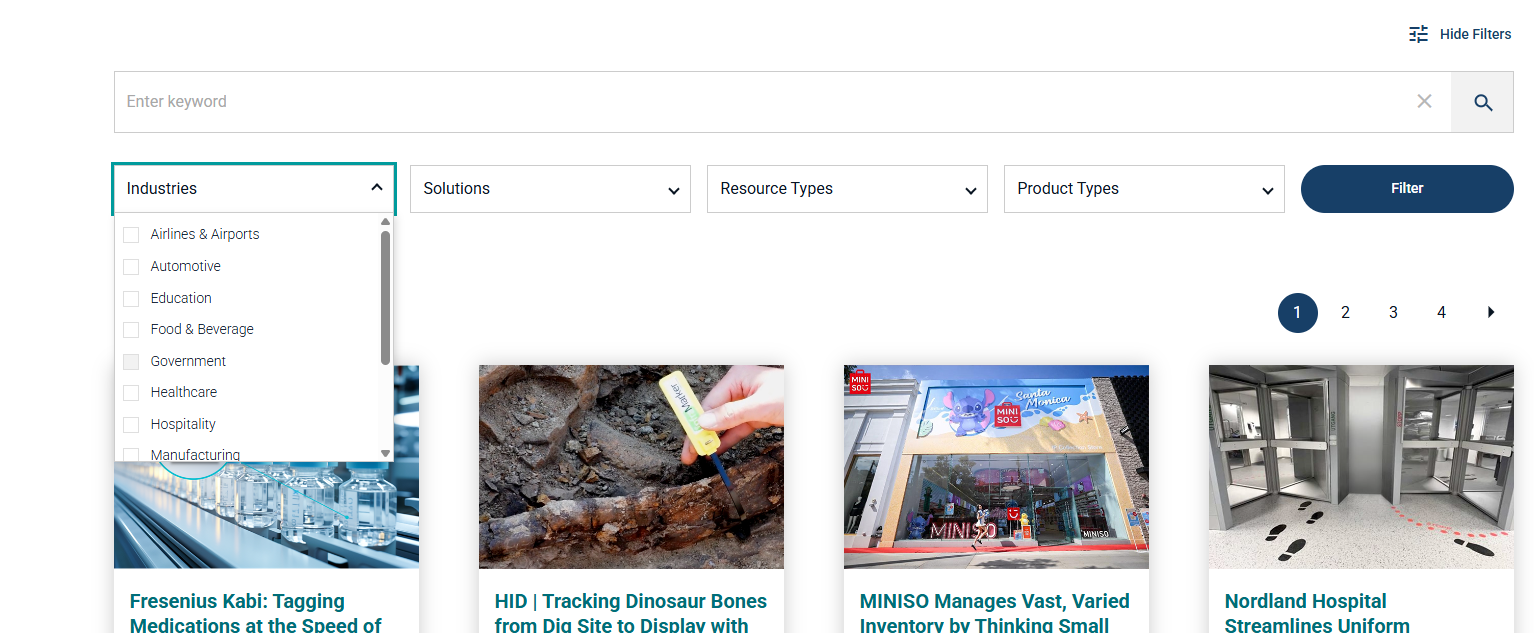
For a specific case study example, let’s look at the company’s work with retailer MINISO. Impinj’s content marketers hit on all the main criteria for an effective case study:
- Customer Background: A Chinese-based retailer that sells kitchenware, toys, jewelry, cosmetics, and other items.
- The Customer’s Challenge: Inventory management difficulties for its 200 U.S. retail stores.
- How the Problem Was Solved: Impinj’s RAIN RFID chip was embedded into Xindeco IoT’s XD-VersaMini M800 tag. MINISO store employees scan shelves with RFID readers to maintain accurate counts and know the location of every item.
- The Results: Improved inventory management processes, ability to tag small items, improved reading of hard-to-read items, and streamlined use of labor.
Conclusion
Without technology content marketing, business growth is nearly impossible. Customers, regardless of industry or persona, use online resources for purchasing decisions more than ever. It’s the job of content marketing teams to reel in leads for their organization. Successful campaigns require a marketing mix that meets buyers on the platforms they visit and in the formats they prefer.
Leading tech marketers leverage the combination of written text, visuals, video, and social proof to meet Key Performance Indicators (KPIs). At the heart of technology content marketing is high-quality content that can be verified by refutable facts. Technology research builds the pillars of high-quality content, providing expert-backed information that audiences trust.
ABI Research’s global analyst team offers tailored content marketing solutions across more than 30 technology topics. We leverage our comprehensive research library to boost engagement, generate leads, and expand brand awareness within respective industries. Learn more about how our custom content programs help tech companies meet their marketing goals.
Frequently Asked Questions
What is technology content marketing?
Technology content marketing is the process of creating and sharing educational content about tech products and trends. It helps companies build trust, attract leads, and show expertise without directly selling.
What are some examples of technology content marketing?
Examples include blogs, whitepapers, executive briefs, videos, visuals, and case studies. These formats explain complex topics, share insights, and show how technology solves real problems.
What are the benefits of technology content marketing?
Tech companies benefit from content marketing by:
- Building credibility
- Improving search engine visibility
- Generating qualified leads
- Keeping their brand top-of-mind
- Simplifying technical ideas
- Sustaining customer relationships
Start with free research
Subscribe to ABI Research's weekly newsletter for access to our latest Analyst Insights, whitepapers, report samples, webinars, and more.

 Dominique Bonte