Competitive & Market Intelligence
Sharpen positioning, deliver actionable insights, and support key stakeholders.
Executive & C-Suite
Drive organizational success, capture growth, and mitigate risks with rapid access to strategic intelligence.
Marketing
Boost engagement, repurpose compelling content, and generate qualified leads with research-driven thought leadership.
Product Strategy
Accelerate product success, secure executive buy-in, gain third-party endorsement, and strengthen positioning.
Startup Leader & Founder
Validate markets, secure funding, raise awareness, and scale confidently.
Users & Implementers
Maximize ROI, streamline adoption, find the best partners, and optimize outcomes with expert guidance.
Hyperscalers
Adapt quickly, stay competitive, and meet customer demands amid AI disruption and shifting geopolitical challenges.
Industrial & Manufacturing
Accelerate digital transformation, secure operations, and turn competitive advantages into measurable revenue.
Industry & Trade Organizations
Boost membership, unify stakeholders, accelerate standards, and strengthen influence to deliver member value.
Semiconductor
Secure operations, advance digital transformation, and maintain market leadership with confidence and clarity.
Supply Chain
Build resilience, reduce risks, and streamline operations while driving digital transformation success.
Telco & Communications
Monetize 5G, capture enterprise opportunities, and accelerate cloud-native transformation for sustainable growth.
All News & Resources
Log In to unlock this content.
This content falls outside of your subscription, but you may view up to five pieces of premium content outside of your subscription each month
You have x unlocks remaining.
NEWSPhysical AI Dominates the Show Floor |
As expected, Physical Artificial Intelligence (AI) was one of the key buzzwords used—at times misused and overextended—across the Mobile World Congress (MWC) 2026 show floor. Companies including HONOR, Lenovo, Samsung Electronics, Nokia, Ericsson, Cisco, Huawei, T-Mobile, Korea Telecom, SK Telecom, SoftBank, China Unicom, BT Group, Xiaomi, Cerebras Systems, NVIDIA, and many others featured Physical AI in their marketing and positioning in various forms.
Across discussions, Physical AI was described as a driver of transformative use cases and as a mechanism to unlock new monetization opportunities from network infrastructure. However, ABI Research’s direct conversations with various industry players confirmed that definitions vary widely. For some, Physical AI refers to embodied on-device intelligence such as humanoids or robocars; or even on smartphone physical AI, for others, it encompasses collaborative wearable ecosystems, coordinated machine vision, or network-integrated AI workloads.
The absence of a shared definition reflects a market still in formation. Physical AI currently operates as a broad umbrella concept, rather than a standardized architectural category.
IMPACTInfrastructure Readiness Defines the Commercial Path |
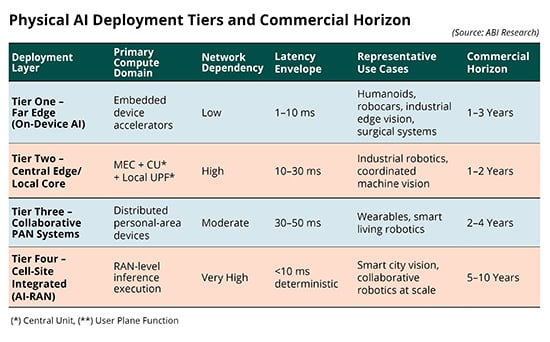
ABI Research structures Physical AI into four deployment tiers, reflecting where intelligence resides, the associated latency profile, and expected commercialization timelines.

The most immediate deployments are concentrated at the far-edge and central-edge tiers, particularly in industrial environments. By contrast, collaborative personal area network deployments remain at earlier stages of ecosystem alignment, while AI embedded directly at the cell site represents a longer-term architectural shift.
CSPs are structurally well positioned to capture Physical AI opportunities due to their access to distributed site infrastructure capable of bringing intelligence closer to end users. This proximity enables the low-latency performance required by many Physical AI deployments. Computing embedded at the edge of the network can also allow battery-constrained Physical AI devices to offload intensive workloads, extending operational time and reducing energy constraints at the device level. In addition, network-enabled coordination can enhance collaboration between multiple Physical AI systems, supporting synchronized operations and overall efficiency gains across fleets of physical AI devices.
However, Physical AI represents a capital-intensive, long-horizon opportunity. Enabling deterministic performance at scale requires substantial investment in edge densification, local breakout capabilities, and distributed compute integration. For large operators, this could imply multi-billion-dollar infrastructure commitments, while monetization pathways may take at least 5 to 10 years to mature. Given the traditionally risk-averse posture of CSPs and competing capital priorities, large-scale upfront investment is unlikely to materialize without clearly-defined vertical demand, validated Return on Investment (ROI) models, and phased deployment strategies that de-risk early adoption.
RECOMMENDATIONSStrategic Implications, Recommendations, and Conclusion |
Physical AI has clearly moved into mainstream industry positioning at MWC 2026, but definitional fragmentation persists. Industrial use cases—particularly coordinated machine vision and robotics—are likely to drive the earliest deployments. Consumer collaborative ecosystems and cell site-integrated AI remain mid- to long-term developments.
For CSPs, monetization will depend less on adopting the terminology and more on enabling deterministic, low-latency network architectures supported by distributed compute capabilities closer to end users. Best-effort connectivity models will not be sufficient to support mission-critical Physical AI use cases.
For infrastructure vendors and device players, hybrid compute architectures—balancing on-device intelligence with edge execution—will shape adoption pathways. Therefore, Physical AI should be understood as a distributed systems evolution that spans device, edge, and network layers.
Day One at MWC 2026 confirms strong narrative acceleration. The next phase will be defined not by terminology, but by architectural execution.