
Artificial Intelligence (AI) is being used in a variety of ways across oil & gas operations, from asset tracking and predictive analytics to data management. Oil & gas operations generate massive amounts of data—up to 2 terabytes daily in some cases. Human analysis can only uncover so much, leaving numerous opportunities in the shadows. By deploying AI software tools, this disparate data can be used to bring new insights to light. These tools identify drilling opportunities, streamline processes, and optimize performance.
AI and Generative Artificial Intelligence (Gen AI) solutions are maturing, with many offerings now being tailored to specific industries. For the oil & gas industry, companies like Canvass AI, AspenTech, PTC, and Imubit showcase the transformative potential of AI.
By adopting targeted strategies and collaborating with innovative solution providers, the oil & gas sector can navigate its digital transformation journey with full confidence and unlock significant value in the years ahead.
AI Use Cases in Oil & Gas
AI in oil and gas operations boosts efficiency, safety, and decision-making across the value chain. Here are some of the most promising use cases:
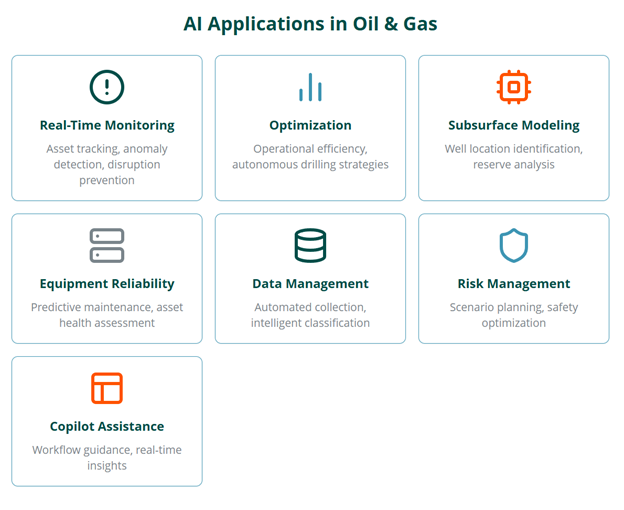
- Real-Time Monitoring: AI applications in oil and gas empower real-time monitoring of assets, pipelines, and facilities. It identifies anomalies, predicts disruptions, and minimizes production downtime. Examples include monitoring flare performance, analyzing seismic data, and measuring pressure or flow rates.
- Optimization Opportunities: By analyzing large datasets, AI can recommend actions to optimize operations, such as adjusting feed rates or enabling autonomous drilling.
- Reservoir and Subsurface Modeling: AI tools can identify optimal well locations and missed reserves, aiding drilling decisions and resource extraction.
- Maintaining Equipment Reliability: Predictive analytics can monitor asset health, schedule maintenance, and reduce unexpected failures.
- Data Management: Automated solutions streamline data collection, classification, and oversight, allowing operators to focus on high-value tasks.
- Risk Management: AI supports scenario planning and risk assessment to improve safety and minimize operational disruptions.
- Copilot Assistance: AI-powered tools can assist operators by delivering insights, streamlining analysis, and guiding complex workflows.
Companies Advancing AI in Oil & Gas
Several companies are developing innovative AI solutions finely-tuned to the unique needs of the oil & gas sector. These technology vendors, highlighted in ABI Research’s Hot Tech Innovators: Oil & Gas Solutions presentation, are leveraging their expertise to help firms optimize operations and improve outcomes.
Here are five technology companies supporting AI for the energy sector.
AspenTech
AspenTech offers AI-powered solutions like Aspen DMC3 and Aspen GDOT, which use Machine Learning (ML) to optimize plant operations. Its Aspen Virtual Advisor (AVA) acts as a digital copilot, assisting operators in decision-making and suggesting actions to improve efficiency. These tools integrate with existing Advanced Process Control (APC) systems, helping companies enhance performance across plants. While APC solutions require significant upfront investments, AspenTech’s AI-powered tools aim to bridge the gap between traditional systems and next-generation optimization.
Canvass AI
Canvass AI equips oil firms leveraging AI with tools that blend into existing workflows. Its MONET platform supports conversational AI, predictive maintenance, anomaly detection, and process optimization. Target use cases of Canvass AI include octane target identification, tower operating pressure minimization, and heat exchanger performance optimization. The company’s partnership with SambaNova Systems enables the delivery of purpose-built Gen AI platforms, leveraging both hardware and software for optimized performance.
PTC
PTC’s ServiceMax supports oil companies adopting AI by enhancing maintenance and asset performance. Features like asset monitoring, repair management, and mobile support are enhanced by the AI-powered ServiceMax Copilot. It offers job clarity, troubleshooting, and access to asset histories. Built on Salesforce, ServiceMax integrates Customer Relationship Management (CRM) and service data into one platform, enabling scalable deployments. While requiring top-level commitment, it simplifies maintenance workflows and improves operational efficiency.
Imubit
Imubit’s Optimizing Brain solution uses Deep Learning (DL) to provide closed-loop optimization for complex processes such as catalytic cracking. The platform integrates with existing APC systems and adjusts operating conditions in real time to maximize efficiency. With over 90 AI applications implemented, Imubit has proven its ability to deliver measurable results, while building trust among operators.
Case Studies
In this section, we look at a few real-world case studies of AI being used to improve oil & gas operations, highlighting the challenge, solution, and results of each deployment.
Reducing Octane Giveaway with Canvass AI
A notable example of AI in oil and gas includes a North American refinery using Canvass AI's Octane Target Optimization solution to tackle octane giveaway losses. The AI tool accurately predicted octane levels, saving the refinery US$10 million yearly. With features like a prediction simulator and Excel integration, Canvass AI streamlined processes and improved decision-making for plant engineers.
Optimizing Fluid Catalytic Cracking with Imubit
A major Canadian oil refiner faced challenges in optimizing a fluid catalytic cracking unit due to nonlinear dynamics and outdated modeling methods. Imubit’s Optimizing Brain provided closed-loop AI optimization, enabling real-time adjustments to improve yields. The AI solution delivered annual savings of US$6 million to US$9 million, while reducing operator intervention and improving process efficiency.
Autonomous Well Optimization with Kelvin and Santos
Santos, one of the top AI-using oil and gas firms in Australia, partnered with Kelvin to optimize its coal seam gas operations with AI. The SmartPCP solution, trained on what Santos’ “best production engineer would do on their best day,” automated well monitoring and control. Utilizing Kelvin’s AI-based solution resulted in a 95% reduction in time spent on manual tasks and improved operational efficiency. By optimizing asset performance, Santos also achieved energy savings of 1% to 2% and enhanced worker safety through reduced site visits.
Conclusion
The uses of AI in oil and gas unlock vast opportunities for operators to optimize performance. Harnessing the power of AI can help overcome some of the top challenges facing the energy sector, such as unplanned downtime, attracting digitally-capable workforces, maintaining high-quality datasets, and mitigating worker safety risks.
While many AI solutions integrate seamlessly with existing systems, oil & gas plants often fall short in their data capabilities. Chiefly, they currently struggle with storing and organizing data in a way that enables the full embrace of AI. Therefore, oil & gas manufacturers must ensure they account for these potential bottlenecks before deploying an AI solution.
For a more comprehensive overview of AI vendors targeting the oil & gas industry and the top use cases to take inspiration from, refer to the following ABI Research reports:
- Hot Tech Innovators: Oil & Gas Solutions
- Best Practices: Managing and Scaling Innovation in Oil & Gas; AI & Data Analytics Case Studies
 Ryan Wiggin
 Ryan Martin