
5G is leaps and bounds ahead of previous network cellular generations, enabling Communication Service Providers (CSPs) to offer brand new types of services, applications, and use cases to consumers and enterprises. Network slicing is one such offering that is expected to define the 5G era. By 2030, ABI Research anticipates roughly US$67.5 billion in 5G slicing revenue and growth at a striking 62% Compound Annual Growth Rate (CAGR) between 2025 and the end of the forecast period.
What to Know About 5G Network Slicing in 2025:
- Network slicing adoption accelerates in 2025. After years of development, 5G network slicing is finally entering the spotlight. Verizon and T-Mobile have launched slicing services in the U.S., with offerings tailored to first responders and enterprise clients. China continues to be ahead of the curve, with consumer slicing packages available for as little as US$2 per month. These moves signal the start of global momentum for consumer network slicing. According to ABI Research, Asia-Pacific accounts for 91% of global spending on slicing solutions. That number will decrease to 73% by 2030 as less mature markets (especially North America and EMEA) catch up.
- Key enablers make network slicing possible now. Several factors have aligned to make network slicing practical: nearly all smartphones shipped after 2022 support 5G Standalone (SA), operators are upgrading to SA and 5G-Advanced, and telcos have gained the necessary enterprise experience from private networks and edge computing. Together, these advances set the stage for slicing to scale.
- Consumer slicing offers the biggest near-term win. The telecom industry has shifted its focus from enterprises to consumers. Consumer network slicing is proving to be the more immediate opportunity, although enterprise customers will drive more total revenue. Subscription plans that prioritize certain apps or guarantee better performance are easy to roll out, appeal to broad audiences, and quickly unlock new revenue streams.
- Enterprise slicing adoption faces major challenges. Manufacturers and other enterprise users are cautious of network slicing. These enterprises prioritize network security and reliability, which creates resistance to using public networks. Additionally, implementing Service Level Agreements (SLAs) and Quality of Service (QoS) guarantees has become more complex. Therefore, ABI Research expects widespread enterprise slicing to take longer to materialize than consumer slicing.
What Is 5G Network Slicing?
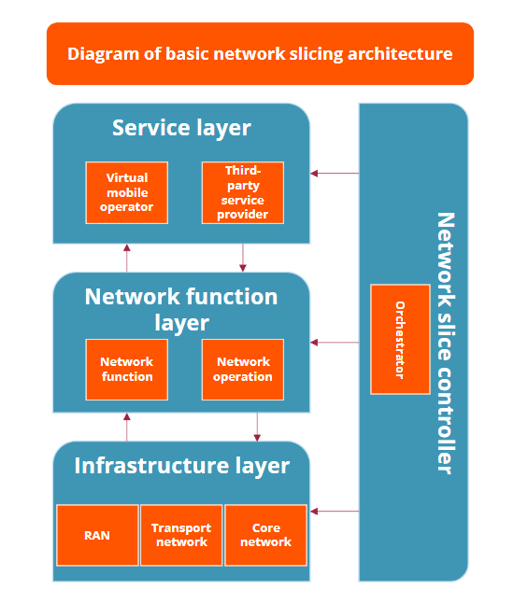
5G network slicing, as the name implies, involves a network configuration in which one domain can be shared and broken up into separate “slices” of that network. With this siloed approach, each independent network slice can be customized for specific use cases. While some companies or consumers need high speeds, others care more about low latency or ultra-reliability. 5G slicing allows operators to allocate the necessary resources for unique customer pain points instead of a one-size-fits-all solution.
Related Content:
Where is the Industry with End-to-End 5G Network Slicing?
Challenges of 5G Network Slicing
Until slicing is fully commercialized in the telecoms industry, there are a handful of challenges that will need to be overcome. One of the biggest challenges that stand out is the increased complexity that comes along with 5G network slicing. Currently, telco networks are being managed with decades-old Operations & Maintenance (O&M) procedures that hinder the ability to smoothly and rapidly bring new services to market. In addition to that, there are some ecosystem limitations, such as an immature market for multi-slice supported terminals, business investment delays due to COVID-19, and a lack of slicing standardization.
CSPs’ competency in creating automated and programmatic slicing capability over the access, transport, and core domains involving deployments with multiple vendors is up in the air at the moment. Consumers and enterprises alike will weigh this concern when deciding to invest in 5G slicing as they seek ease of use and optimal efficiency. Between this shortcoming and the fact that multi-slice concurrency support is lacking for end devices, telcos and their vertical partners must find solutions sooner rather than later.
In terms of strategy, much remains to be seen how exactly telco business models will be modified to reflect new services. A variety of business models have been implemented up to this point in time; however, there is no consensus on what works best. Additionally, it’s not clear how the delivery mode should be designed. In all likelihood, 5G slicing will necessitate four players: the Information and Communications Technology (ICT) vendor, the CSP, the app vendor, and the enterprise vertical.
To learn how to overcome the challenges of 5G network slicing, download ABI Research’s Network Slicing: Technical and Commercial Considerations research report.
Opportunities That 5G Network Slicing Creates for CSPs
For CSPs, 5G network slicing gives them more control and flexibility over their network environment. A network can be sliced using various criteria, some of them being application types, security, mobility, traffic types, and Quality of Service (QoS). The dynamic nature of 5G slicing provides new revenue opportunities for CSPs, notably in the following services:
- Services that require a different functionality
- Services at the edge
- Services with a quick Time to Market (TTM)
- Services that require better isolation
5G network slicing opens the door to more lucrative business models because of the flexibility and control that it gives to operators. Improved flexibility and speed are made possible with Network Slice Selection Function (NSSF), Network Repository Function (NRF), and Single Network Slicing Selection Assistance Information (S-NSSAI). CSPs are no longer constrained by the limitations of 4G and 3G, and can now deliver more personalized experiences for customers. ABI Research expects a willingness on the part of enterprises to pay a premium for 5G network slicing because they are assured of Service-Level Agreements (SLAs), while being empowered to address particular requirements for isolation and security of Internet of Things (IoT) connections.
Given that 5G network slicing also reduces the time and cost of implementing new add-on services, service providers are in a great position to increase their Return on Investment (ROI). The perceived risk and barrier to entry for designing new 5G use cases is reduced significantly and allows telcos to be more aggressive with innovation.
Steps to Success in 5G Network Slicing
The underlying motivations to adopt 5G network slicing are the new revenue streams via new services, low deployment costs due to better resource utilization, and the promise for ecosystem partners to provide new business offerings. Ultimately, the opportunities that slicing presents will only be realized if telecom players are willing to reconsider how to do business. From vendors to CSPs, every company in the telecoms industry must envision slicing with convenience, user experience, and adaptability at the forefront. But it doesn’t end there, the industry needs to work together to ensure vendor interoperability and a steady stream of new services for customers at the same pace as software evolution.
Stay on top of all the latest developments in the world of 5G network slicing by purchasing our 5G Network Slicing Research Spotlight, which is a new service ABI Research is offering. A subscription to a Research Spotlight allows you to only pay for access to our latest research regarding a specific technology topic, as opposed to a broader research area that may be less relevant for your organization's needs.

 Dimitris Mavrakis
 Jake Saunders