
Strategic Takeaways
- New U.S. Tariffs Are Shifting Demand for Certain Software: As manufacturers look to diversify their supply chains in the wake of new U.S. tariffs, the demand for several enterprise software solutions will be affected.
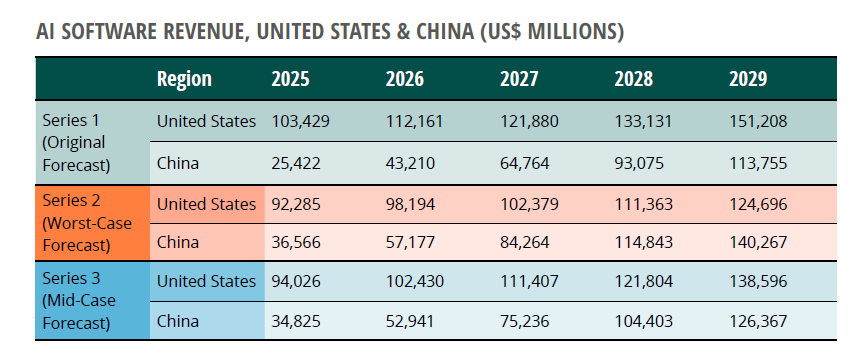
- China May Gain Competitive Ground in the Artificial Intelligence (AI) Race: By offering open-source AI models and competitive accelerators, China could gain market share over the United States as enterprises aim to counterbalance rising costs for AI infrastructure.
- The Need for Resilience Will Drive Software Investment: Solutions that offer cost mitigation and operational efficiencies, such as Quality Management Systems (QMSs), simulation software, and supply chain planning tools, will remain high-priority investments.
Tariffs and the software industry might not seem linked at first glance, but the relationship is more significant than it appears. Software companies often rely on hardware for cloud computing and data centers. With increased hardware costs powering data centers, software companies may raise their prices to maintain margins. Moreover, the potential disruption of the global supply chain is triggering manufacturers across multiple sub-sectors to turn to enterprise software tools for much-needed efficiencies. As a result, ABI Research has adjusted its revenue outlook for several software solutions. From cloud infrastructure and AI to quality control and supply chain planning platforms, the tariff-induced ramifications for the software industry will be profound in some ways and negligible in others.
Note: This is a fluid situation, as a Federal court has blocked the tariffs and is under appeal.
Companies May Turn to Chinese-Made AI Software to Offset Higher Infrastructure Costs
One of the most immediate impacts of tariffs on the software industry will be the increased cost of AI infrastructure, especially for cloud and data center providers. These Capital Expenditure (CAPEX) hikes are unlikely to be fully absorbed by service providers, meaning U.S.-based Independent Software Vendors (ISVs) will shoulder much of the burden. As these costs trickle down to the customer, enterprises will have to pay more for AI software and services.
Chinese software providers stand to be big winners from this shift. With enterprises facing elevated operational costs for using AI platforms, many will look to reduce their software Operational Expenditure (OPEX) by turning to more affordable Chinese alternatives. This trend is amplified by the availability of competitive open-source AI models and accelerators emerging from China, positioning software made in the country as cost-effective solutions in a tightening global market.
QMS Software Should Remain Resilient Amid Tariff-Driven Constraints
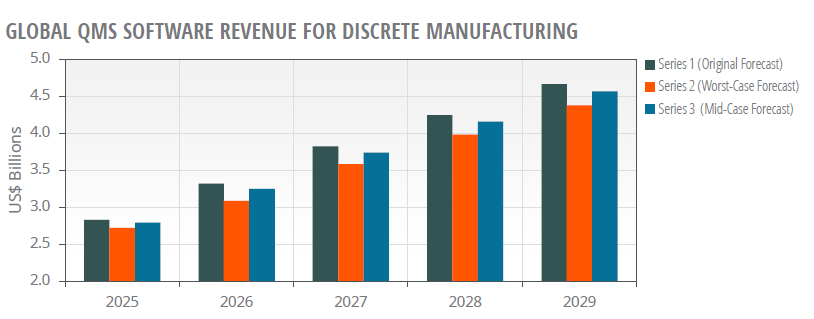
Despite broader market constraints, U.S. tariffs will have a minimal effect on Quality Management System (QMS) software. Rising input costs due to tariffs are narrowing profit margins, making every dollar count. QMS software, which helps manufacturers reduce scrap rates, becomes even more critical in this volatile climate.
According to ABI Research’s The State of Technology in the Manufacturing Industry, 54% of manufacturers ranked QMS software among their top five investment priorities to improve quality levels. While overall adoption may slow slightly due to conservative spending behaviors among U.S. manufacturers, the core value proposition of QMS software—cost savings through quality improvements—will protect it from major investment downturns.
Product Simulation Software Will Get a Small Boost in Spending
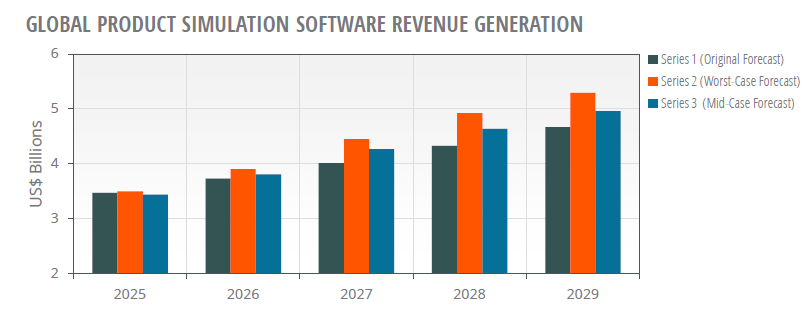
Unlike other technology categories that may face spending slowdowns, ABI Research believes that product simulation software is likely to experience a slight boost. Faced with higher costs for raw materials and components, manufacturers are increasingly turning to software tools that help streamline design and production processes.
US$3.5 billion
ABI Research forecasts global spending on product simulation software to reach US$3.5 billion in 2025 in a worst-case forecast for tariff impact, compared to our original US$3.46 billion estimate.
Product simulation software allows for virtual prototyping, enabling companies to minimize material use without compromising product integrity. In turn, manufacturers can reduce the overall cost of making things. This approach aligns with a broader drive to maintain operational efficiency and reduce CAPEX. Simulation tools are becoming essential in navigating the cost pressures brought about by tariffs.
Supply Chain Planning Software Emerges as a Must-Have Tool
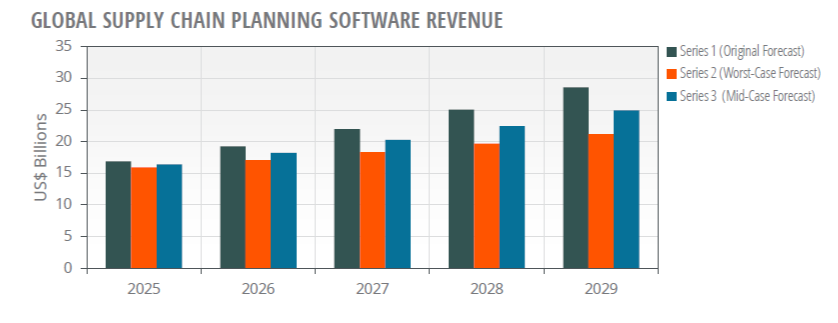
Tariffs are accelerating the digital transformation of supply chains. Planning software, which incorporates features like AI-driven scenario modeling and real-time analytics, is emerging as a critical tool for maintaining supply chain resilience. These platforms offer a strategic advantage by helping enterprises understand the potential effect of new trade policies on their logistics operation. Additionally, they support companies in adjusting sourcing strategies, optimizing inventory stock, and managing input cost volatility.
7%
Even in a worst-case forecast, ABI Research expects an over 7% growth globally for supply chain planning solutions through 2029.
Cloud-native and collaborative by design, supply chain planning software facilitates multi-stakeholder engagement across diverse geographies. Above all, these digital tools help enterprises adapt swiftly and efficiently to any new tariffs affecting global trade.
ABI Research just published its Tariff Forecasts & Fallout whitepaper to look at how software and other technology areas will potentially be affected by the new U.S. trade policies. In the paper, our analysts share their original forecasts for each technology, as well as a mid-case and worst-case forecast to visualize the impact on solutions. Download the free whitepaper today for these analyses and expected strategic pivots from businesses operating in each industry.
 Ryan Wiggin
 Ryan Martin