

Senior Research Analyst Aisling Dawson answers five key questions about NHIs to pinpoint commercial avenues, AI impacts, and the competitive landscape in this early but soaring market.
Non-Human Identities (NHIs) are reimagining the cyber battlefield. More connected machines, Artificial Intelligence (AI) agents, and cloud software workloads pose new identity risks with limited human oversight. Although the market is still immature, ABI Research expects NHIs to become a major cybersecurity spending category over the next 3 years. In the five questions below, I examine the trends, use cases, risks, and platform providers shaping NHIs based on my discussions with digital security leaders.
Table of Contents
What Are Non-Human Identities?
Which Trends Are Shaping NHIs?
What Are the Top NHI Use Cases?
Why Does Agentic AI Create New NHI Security Risks? How Is This Being Addressed?
Who Are the Leading NHI Security Platform Providers?
What Are Non-Human Identities?
Non-Human Identities (NHIs) are digital identities assigned to machines, software workloads, and Artificial Intelligence (AI) agents interacting with enterprise systems. Examples include OAuth tokens, Application Programming Interface (API) keys, and digital certificates. ABI Research views machine identities as one subset of NHIs, while autonomous AI agents represent another with distinct security requirements.
Which Trends Are Shaping NHIs?
ABI Research identifies four overarching trends influencing the direction of NHIs:
- Vendor Consolidation: Established Identity and Access Management (IAM), Privileged Access Management (PAM), and Public Key Infrastructure (PKI) providers are acquiring startups to close NHI capability gaps. Cisco (Astrix) and Cyera (Oasis) are notable recent examples.
- Platform Convergence: The lines between IAM, PAM, and cryptographic services are blurring because enterprises prefer unified visibility and control across human and non-human identities.
- Quantum Readiness: Quantum-safe assurances are a competitive requirement as certificate lifetimes shrink, machine identity volumes increase, and customers demand more agile certificate management.
- AI-Enhanced Security: Vendors are fighting fire with fire, using AI to identify hard-coded secrets, automate remediation, and flag suspicious agent behavior.
What Are the Top NHI Use Cases?
Six NHI use cases offer commercial opportunities for cybersecurity vendors. Some address immediate enterprise needs, while others present longer-term growth potential.
Table 1: NHI Use Cases Time Frame, Commercial Value, and Opportunities
|
NHI Use Case |
Time Frame |
Commercial Value |
Key Opportunity |
|
Secrets Vaulting |
Near Term |
High |
Secure existing credentials and support HashiCorp Vault migrations. |
|
Firewalls |
Medium Term |
Medium |
Address shorter certificate lifetimes through existing network security infrastructure. |
|
Service Account Management |
Medium Term |
High |
Meet established security needs and upsell advanced NHI capabilities. |
|
CLM/TLS Support |
Medium Term |
High |
Automate certificate management as TLS certificate lifetimes shorten. |
|
Code Signing & AI Coding Agents |
Long Term |
High |
Protect DevOps workflows and code integrity as AI agents gain autonomy. |
|
Cloud-Native Environments |
Near Term |
Medium |
Improve identity discovery and governance, with future opportunities in quantum readiness. |
(Source: ABI Research)
1. Secrets Vaulting—Near Term, High Value
A high-value, near-term opportunity driven by demand to secure existing credentials. The widespread uptake of HashiCorp Vault has been a primary catalyst for migration support, but this won’t last forever. The inevitable shift to ephemeral credentials and the demise of hard-coded secrets will reduce reliance on traditional vaulting over time.
2. Firewalls—Medium Term, Medium Value
A medium-term opportunity as shorter certificate lifetimes exert pressure on network security infrastructure. Established firewall markets offer NHI vendors a viable entry point through existing enterprise relationships.
3. Service Account Management—Medium Term, High Value
A historically persistent enterprise security requirement with strong medium-term commercial potential. Vendors can use service account management to establish customer bases before upselling them on advanced NHI capabilities.
4. CLM/TLS Support—Medium Term, High Value
Growing demand for automated Certificate Lifecycle Management (CLM)/Transport Layer Security (TLS) creates medium-term opportunities for NHI security vendors. Recent changes made by the CA/Browser Forum help stimulate demand here. PKI providers are in the best commercial position among all identity security players given a reputable track record in CLM.
5. Code Signing and AI Coding Agents—Long Term, High Value
A longer-term, yet lucrative, opportunity as AI becomes more embedded in software development. In parallel, these agents are being given more autonomy. Therefore, it is commercially critical for NHI security providers to demonstrate they can protect DevOps workflows and code integrity.
6. Cloud-Native Environments—Near Term, Medium Value
An immediate opportunity spanning identity discovery, governance, and compliance. Longer-term differentiation will come down to integrating cryptographic visibility with PQC readiness in cloud environments.
Why Does Agentic AI Create New NHI Security Risks? How Is This Being Addressed?
AI agents introduce new security risks because they can adapt their behavior and make decisions with minimal direct human supervision. Having this free rein to conduct autonomous activities undermines the effectiveness of conventional identity controls. The rogue agents that infiltrated Hugging Face’s production databases in the summer serve as a cautionary tale (learn more in this ABI Insight, “License to Kill: Can the Agentic AI Trust and Security Crisis Be Combatted by AI Kill Switches?”).
An agent might possess legitimate credentials, yet perform actions that overstep its intended guardrails. In this case, traditional authentication systems may validate the agent’s credentials without detecting the underlying security risk.
The Response
The agentic threat has given rise to AI agent registries (especially for PKI/Certificate Authorities (CAs)) and new authentication protocols. Google’s Agent2Agent (A2A) protocol, IETF’s Agent Name Service (ANS) proposal, and the draft Aauth proposal are the most championed examples currently. However, these are not guaranteed to prevail, considering vendor lock-in concerns for the former and viable alternatives for the latter.
On the solution side, there is a need for continuous verification and behavioral monitoring in NHI security schemes. ABI Research expects human and non-human identity management tactics to join forces. We see leading innovators addressing the agentic threat through solutions such as:
- Temporary credentials
- Runtime authorization
- Kill switches
- Credential injection
- Improved AI-powered anomaly detection capabilities
Commercial success depends on these solutions being able to control agent behavior without disrupting legitimate enterprise workflows.
Who Are the Leading NHI Security Platform Providers?
The NHI security market includes specialist providers and long-established cybersecurity juggernauts expanding into machine/agent identity management. In one camp, we have NHI, IAM, and PAM platform providers. In the other, we have PKI and cryptographic service providers.
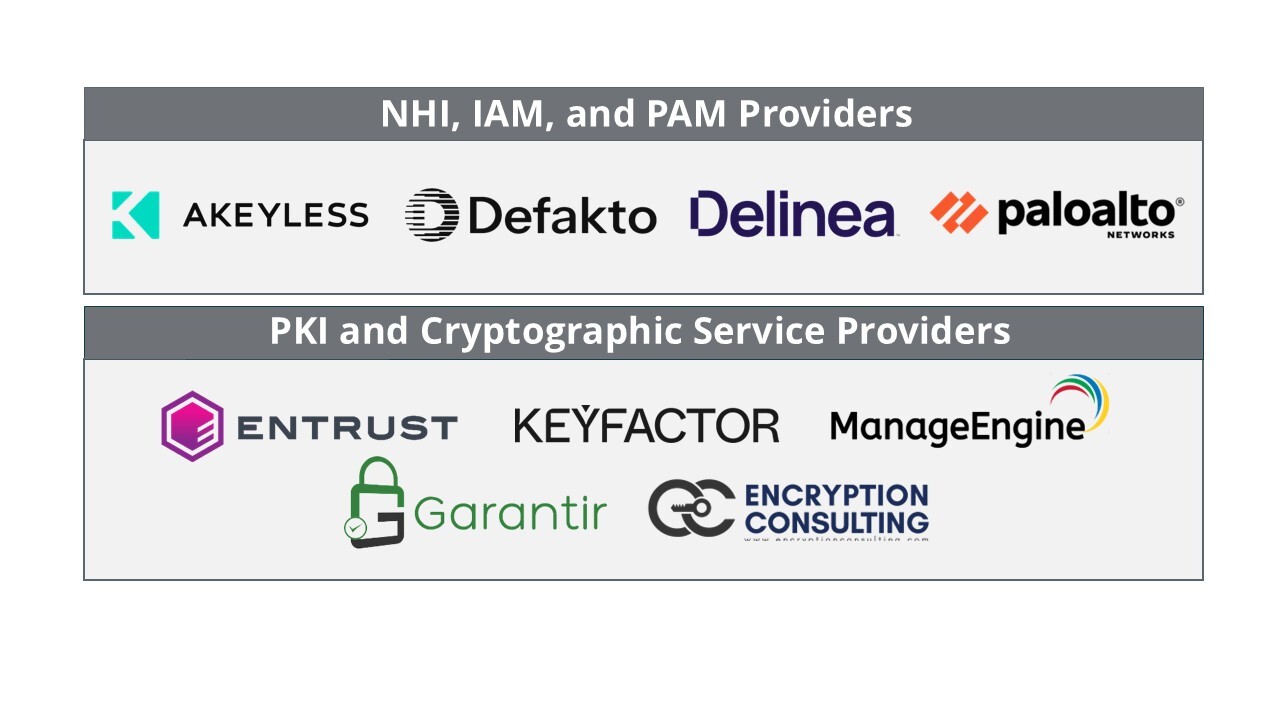
NHI, IAM, and PAM Providers
- Akeyless: Provides identity security for humans, machines, and AI agents. Its Agentic Runtime Authority monitors agent behavior and enforces runtime policies. SecretlessAI replaces hard-coded credentials with temporary access.
- Defakto: Offers an NHI-focused IAM platform built on open standards such as SPIFFE. Notable capabilities include automated credential rotation and multi-hop delegation, which allows agents to act on behalf of users.
- Delinea: Combines human and NHI security within a cloud-native platform. Delinea’s portfolio emphasizes privileged access and dynamic authorization. Delinea Iris AI adds automated security administration and behavioral analytics.
- Palo Alto Networks (PAN): Converges PAM, PKI, and AI security expertise, enabling PAN to offer broad NHI coverage. Key differentiators include Just-in-Time (JIT) access, multi-hop delegation, and secrets management orchestration. PAN's extensive integration portfolio creates new revenue opportunities for CyberArk's (which Palo Alto acquired in February 2026) Idira platform.
PKI and Cryptographic Service Providers
- Entrust: Focuses on cryptographic trust and hardware-backed identity verification. The U.S.-based vendor’s Agentic AI Trust Accelerator integrates with existing identity security tools. Entrust's expertise in hardware Roots of Trust (RoTs) and workload attestation is particularly relevant to heavily regulated industries (e.g., financial services).
- Keyfactor: Extends its PKI and CLM expertise into NHI security. Its acquisition of Cofide adds agent-to-agent authentication and workload identity capabilities beyond its traditional IoT security expertise (learn why Keyfactor was named Overall Leader in ABI Research’s Enterprise PKI Infrastructure Vendors competitive ranking.
- ManageEngine: Manages human and non-human identities through PAM360. Through an integrated approach, ManageEngine spans identity management and Information Technology (IT) operations. Competitive pricing is another differentiator, particularly for mid-market customers.
- Garantir: Introduced Agentic Security as the fifth pillar of its GaraTrust platform in July 2026. A key-access gate model keeps cryptographic keys and credentials out of AI agents’ control. Access is authorized through JIT permissions, Multi-Factor Authentication (MFA), or quorum-based approval. Furthermore, operations are executed in customer-controlled Hardware Security Modules (HSMs) or cloud Key Management Systems (KMSs).
- Encryption Consulting: An innovator in digital trust and cryptographic attestation, catering to a range of NHI use cases including agent-to-agent trust, signing of agent actions, mediating secure access to enterprise resources, accommodating multi-agent ecosystems, and AI agent attestation. Centralized discovery and inventory tooling, end-to-end-automation, and natural language capabilities ease management of certificates, PKI operations, and machine identities via CertSecureManager MCP Server.
Preparing for the Next Generation of Non-Human Security Threats
NHIs are rapidly becoming a C-suite cybersecurity priority as machine identities, sovereign cloud workloads, and AI agents outgrow the limits of legacy security controls. How do businesses prevent an AI agent from making an unauthorized transaction? What happens if a resuable API key is compromised in the cloud? And what about an agent used for reconnaissance, state espionage, or target identification and delivery of lethal force during both peacetime or an armed conflict context? The ramifications range from financial losses and Intellectual Property (IP) theft to a full-blown national security nightmare.
Vendor consolidation, quantum resistance, and AI-based threats and opportunities personify the NHI market. For cybersecurity vendors, maximizing commercial prospects will depend on several factors:
- Prioritize short-term NHI use cases such as service account management and cloud-native environments.
- Align product marketing with NHI-related standardization—WIMSE, SPICE, SPIFFE/SPIRE, OpenID Connect, etc.
- Balance AI-driven innovation with practical enterprise needs, rather than overbuilding for future demand.
- Build NHI security portfolios around continuous verification, attestation, crypto-agility, and automated certificate management to address both agentic risk and quantum readiness.
The NHI market is ripe with opportunity, but cybersecurity vendors would be wise to avoid chasing every shiny new AI capability. The better bet is to build on what they already do well, and address security problems enterprises are willing to pay to solve.
If your organization needs timely advisory to seize the NHI opportunity, contact ABI Research to discuss how our cybersecurity research can support your Go-to-Market (GTM) strategy.
Related Research:
- Non-Human Identity (NHI): Securing Machine Identities
- NHI: Use Cases and Applications
- Non-Human Identities (NHIs) and Artificial Intelligence (AI): Opportunities and Challenges