
Authors: Malik Saadi, Chief Research Officer; Michela Menting, VP
Trust was the word of Cisco's EMEA Analyst Summit this October. Cisco wants it to be the reason customers consolidate networking, security, and observability on one platform as Artificial Intelligence (AI) agents enter the enterprise. The ambition is right, but the definition needs to be strengthened.
What Cisco means by trust
Cisco presents trust as something engineered into its stack, from the silicon to the AI agent. Its executives rightly called trust "the currency of AI" and "the new catalyst," and paired it with a telling line: "control is the new moat." The evidence on stage was concrete: hardware trust anchors, security built into switches, Post-Quantum Cryptography (PQC)-ready equipment on by default, tracing of model lineage, guardrails for agents, and Splunk as the record of everything AI touches. Cisco also turned trust into a contract. It offers critical infrastructure customers across multiple verticals legal guarantees of no backdoor, air-gapped operation and continuity under embargo, for a fee. Cisco is, therefore, selling trust three ways: as technology, as a legal commitment, and as a reason to hand it more of the estate.
Where Cisco is right, and areas that need improvement
The opportunity is real. Secure-by-design is an old principle that few vendors applied in full: its Return on Investment (ROI) was hard to prove, and outside compliance barely mandated it. That is changing. Regulation now makes companies pay for trust: European Union (EU) cybersecurity laws (NIS2, DORA), the EU AI Act, and deadlines to adopt quantum-safe encryption all carry legal obligations. AI agents makes the case more urgent: it can cut the time from finding a vulnerability to exploiting it from months to hours, so manual defense can no longer keep up. The same AI can now operate inside the enterprise as autonomous agents with privileged access, which makes it a new kind of insider threat. Trust can no longer be added after the fact. It must be designed in, and Cisco is early to that market.
Yet Cisco described trust almost entirely from the infrastructure up, and that leaves three gaps:
- Safety Is Treated as Part of Security: An AI agent can cause harm without ever being attacked, for example, by acting on bad data or overstepping its task.
- Models Are Traced, but Content Is Not: Cisco tracks where models come from, but not the content and data they consume and produce. The EU AI Act now requires AI-generated content to be labeled.
- Trust Is Asserted, Not Proven: Cisco published no figures showing how well its controls work, no independent auditor has confirmed its claims, and few customers were named as running them in production. Buyers who must prove compliance to regulators need evidence they can show, and Cisco has yet to provide it. Nor did Cisco map which trust mechanisms (Public Key Infrastructure (PKI), Identity and Access Management (IAM), zero trust, secure execution environments, secure memory, tamper resistance) it applies to which products.
Four challenges stand between Cisco’s trust vision and the market:
- Revenue: The trust pitch is not yet turning into sales. Security revenue grew only 2% last fiscal year, against 22% for networking, so customers still buy Cisco for its networks rather than for trust.
- Multi-Vendor Coverage: Most customers run equipment from several vendors, but Cisco’s protections still cover mostly Cisco gear. Its firewall management now supports third-party firewalls, but only as a first step, and firewalls deliver security, not trust. A trust provider must make the whole estate trustworthy: its own non-security equipment, such as gateways and load balancers, and every other vendor’s gear.
- Lock-in: The more a customer standardizes on Cisco’s platform, the more it depends on one vendor and the less control it keeps. Yet Cisco sells control as its main advantage.
- Trust in Cisco Itself: Cisco’s sovereignty guarantee promises European customers that their equipment keeps running if a U.S. export restriction cuts them off. But the security patches stop, so the equipment becomes more exposed every month the restriction lasts.
Trust is an ecosystem, and governance is the key
ABI Research defines trust as reliability (including resilience) plus security plus safety; in other words, a system that works as intended and keeps working under stress or attack, minimizes and defends its attack surface, and does no harm whether it works or fails. Measured against that definition, Cisco is uneven across the three. Security is its center of gravity: most of what it announced at the summit, from AI defense to post-quantum encryption, is about stopping attacks. Reliability is a strength it brings from decades of building resilient networks, with the redundancy to keep running even under attack. Safety is its frontier: making sure an AI agent does no harm, even when nobody is attacking it, is the area where Cisco has the least to show. An AI agent with legitimate access is an unintended insider threat and needs security policies as strict as those applied to any employee, starting with least privilege. This imbalance matters because the three pillars of trust, namely reliability, security, and safety are no longer separate. Once AI agents act on the network, a security breach becomes a safety incident: a hijacked agent can shut down a production line or move money. Equally, a model that is secure but unreliable is still a risk, because a wrong answer acted on automatically causes damage without any attack at all. A vendor that is strong on one leg of trust and weak on another cannot deliver trust as a whole.
Trust is an ecosystem, not a product. It must hold at every node of the supply chain: content and data, models and agents, the identities of humans and machines, cryptography, and infrastructure. Weakness at any node undermines the rest. Cisco covers the lower nodes strongly and the upper nodes partially, so it cannot hold the stack alone. It needs partners in content provenance, model assurance, and identity to make the upper layers as robust as its own.
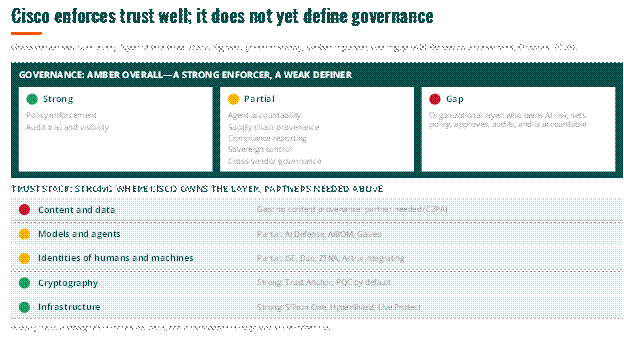
That makes governance the binding layer of trust: who sets the policy, who is accountable, and who audits, across every node and every vendor. Infrastructure can enforce governance; it cannot define it.
Cisco has the strongest infrastructure-led security proposition in the market, but not yet a trust proposition across all its equipment. To lead in the agentic era, it must move from delivering security to integrating trust throughout the stack, through open standards, published evidence, and safety treated as seriously as security. The vendors that orchestrate trust across the ecosystem, rather than enclose it, will capture the value.
 Aisling Dawson