

Key Insights
- CLM automation is becoming essential as certificate volumes rise, life spans shrink, and security teams struggle to manage PKI manually.
- The biggest operational risk is lack of visibility. Undocumented or poorly tracked certificates can trigger outages, compliance issues, and new security exposure.
- AI is making CLM more scalable by improving certificate discovery, renewal planning, and risk prioritization. Human oversight still matters, especially for revocation and audit readiness.
- Enterprises need to move quickly on crypto agility, ACME native infrastructure, and modular automation tools if they want CLM programs that can scale into the post-quantum era.
The 2026 enterprise security landscape has morphed into an operational hydra: exploding Public Key Infrastructure (PKI) certificate volumes meet imploding life spans, leaving security teams buried under a self-multiplying mountain of deadlines. This is repositioning Certificate Lifecycle Management (CLM) automation from an optional capability to an enterprise necessity.
The rise in machine identities is expanding the enterprise attack surface. Concurrently, quantum-safe PKI is climbing the C-suite priority list, which creates further complexity in issuing and managing new certificates.
CLM automation can simplify enterprise security processes by reducing the operational overhead needed to successfully safeguard networks and assets. Converged with Artificial Intelligence (AI), enterprises can automate certificate discovery, issuance, provisioning, renewal, and revocation.
Here are the key drivers of CLM automation, why enterprises benefit, and how to ensure a smooth transition.
Why Certificate Lifecycle Management Is More Difficult than Ever
All connected systems must be anchored in certificate-based trust. However, as more machine identities are introduced, potential network entry points quickly multiply. Enterprise security teams must adapt or risk a greater prevalence of breaches.
Organizations cite struggles in tracking certificate ownership, expiration timelines, renewal requirements, and cryptographic dependencies. A single faulty certificate could trigger a ripple effect, disrupting essential customer services and introducing non-compliance risks.
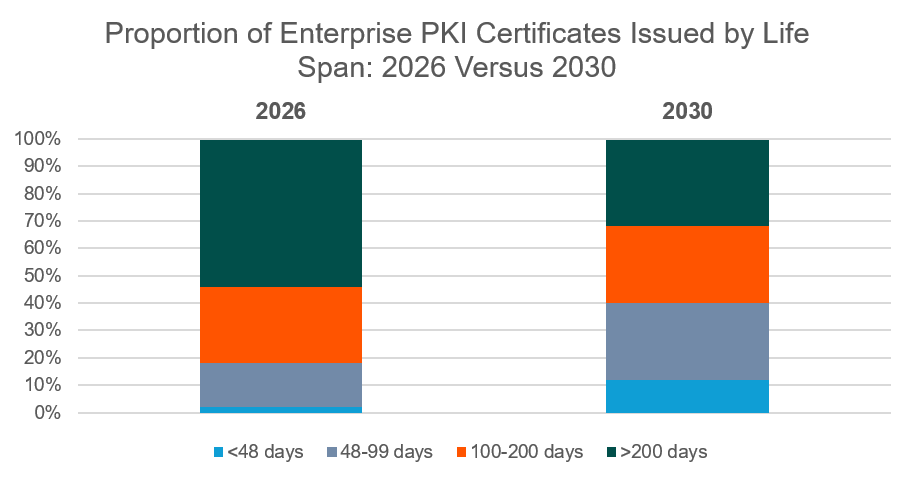
CLM is becoming even more challenging as certificate life spans continue to compress. ABI Research forecasts that 54% of enterprise PKI certificates issued in 2026 will have a life span of more than 200 days. By 2030, that proportion will drop to 32%.
In that same time span, PKI certificates with a life span of less than 100 days will increase from 18% to 40%. This trend is being driven by the push toward crypto-agility as part of the quantum transition. Habits borne out of new public trust requirements are expected to spill over into private trust. The CA/Browser Forum’s push for CLM automation is the primary accelerant for publicly trusted certificates—yet, what applies in the public trust space will influence CLM practice within the enterprise PKI space.
As a result, Information Technology (IT)/Operational Technology (OT) security teams must increasingly revoke digital certificates while managing numerous connected technologies. Without certificate lifecycle automation, this is an insurmountable task.
Chart 1: Proportion of Enterprise PKI Certificates Issued by Life Span
World Markets: 2026 Versus 2030
(Source: ABI Research)
Automated Certificate Discovery and Renewal
Speed and efficiency of certificate discovery and renewal are hallmark benefits of CLM automation. Many enterprises still lack end-to-end visibility into certificates deployed across their cloud and on-premises environments. Security teams must also manage certificates at greater scale and frequency.
Hidden in the shadows of operational workflows, undocumented or rogue certificates can be exposed by threat actors. These blind spots are extremely vulnerable to outages as they evade the routine tracking that prevents unexpected expiry. As a result, enterprises could lose access to applications and services, disrupting workflows and contributing to an increased risk of data loss or attack from a malicious actor.
To address these risks, leading cybersecurity vendors now support CLM automation using agent-based and agentless approaches.
With these capabilities, enterprises can now possess centralized visibility across their entire certificate fleet. Modern CLM automation solutions automatically send alerts regarding certificate expiration, compliance, and other critical information.
AI in CLM Automation
AI and Machine Learning (ML) increasingly support CLM automation by helping teams:
- Discover undocumented certificates or shadow cryptographic assets
- Predict and coordinate renewal timelines
- Detect anomalous certificate behavior
- Prioritize high-risk certificates
- Reduce alert fatigue through rules-based frameworks
Enterprise security teams continue to face skills shortages. They also have large PKI certificate fleets to manage, something that is challenging to do manually. AI/ML-enhanced certificate automation is a game-changer, as these tools help alleviate the impact of cybersecurity talent gaps.
Despite the advantages of AI-enhanced CLM automation, it does not come without adversity. False positives and negatives are a key reason why AI still isn’t used for certificate revocation. Moreover, there is still no consensus on auditor attitudes toward embedding AI into PKI and CLM workflows. For these reasons, certificate issuers and enterprises alike must champion rules-based certificate automation and showcase explainable/responsible AI usage to auditors.
How to Facilitate CLM Automation
The challenge for enterprise security teams is no longer deciding whether CLM automation is necessary. Rampant skills shortages, larger certificate fleets, and shrinking certificate life spans make that clear. Instead, the real question is how quickly CLM automation strategies can be operationalized. ABI Research believes the following actions are essential to accelerating deployments:
- Test AI-enabled CLM automation early and often. Early and consistent experimentation with AI tooling ensures a smoother transition to full-scale CLM automation.
- Find favor with cybersecurity auditors. So far, auditors have not revealed their cards regarding AI-enhanced solutions in the PKI and CLM markets. Auditor buy-in depends on demonstrating compliance and risk mitigation.
- Prepare for the post-quantum shift with crypto-agile solutions. The transition to Post-Quantum Cryptography (PQC)-supported PKI necessitates algorithm flexibility. Integrating crypto-agility into CLM enables enterprises to future-proof solutions in preparation for the migration to quantum resilience, especially by integrating mechanisms that allow systems to quickly swap in new standardized PQC algorithms.
- Evaluate Automatic Certificate Management Environment (ACME)-native CLM infrastructure. Legacy systems, restricted hosting environments, and limited support for ACME clients continue to hinder certificate lifecycle automation given the critical role of the ACME protocol in enterprise CLM. However, growing adoption of ACME-native system designs is expected to reduce compatibility barriers and increase long-term scalability for CLM deployments.
- Adopt lightweight, modular CLM automation tools. Small and Medium Businesses (SMBs) have limited budgets and CLM expertise. Therefore, Generative Artificial Intelligence (Gen AI) and Natural Language Processing (NLP) tools, which simplify CLM workflows, are gaining traction for staff training. Cybersecurity teams should prioritize modular and cost-effective AI models that can be deployed in small increments.
The era of manually managing digital certificates is nearing its end. AI-enabled CLM automation is not replacing cybersecurity professionals, but helping organizations fill persistent skills shortages, while freeing security teams to focus on higher-value network protection tasks. Enterprises that fail to modernize CLM workflows risk greater operational disruption, expanding security exposure, and slower readiness for the post-quantum future.
If you're navigating the transition to automated security technologies as an IT/OT professional or a solution provider, reach out to ABI Research to discuss how our forward-looking advisory services can help you meet your strategic goals.