

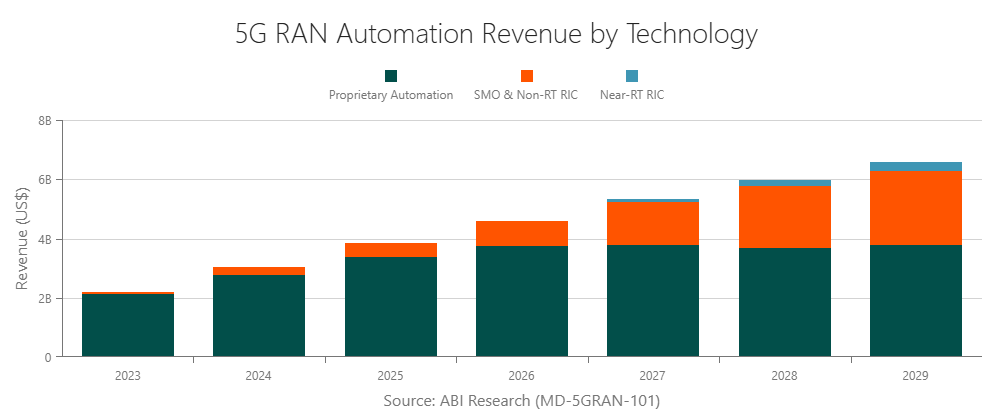
5G Radio Access Network (RAN) automation is rapidly transforming how Mobile Network Operators (MNOs) manage, deploy, and monetize their infrastructure. As network complexity increases and operators seek energy reductions and new revenue streams, RAN automation offers a pathway to intelligent, scalable, and highly autonomous networks. ABI Research forecasts that annual spending on 5G RAN automation will triple by 2029, reaching US$6.6 billion. In this post, we cover the latest developments in RAN automation, including adoption drivers, key use cases, innovations, and the pivotal role of Artificial Intelligence (AI) in making 5G networks more autonomous.
Recent Research on 5G RAN Automation
5G RAN Automation Platforms: Commercial Strategies
✅ Develop long-term 5G Radio Access Network (RAN) automation strategy.
✅ Understand the market dynamics and motivations for growing RAN automation demand.
✅ Evaluate the differing commercial strategies adopted by Open RAN vendors
5G RAN Automation Platforms: Use Cases for Network Operations
✅Forecast of Open RAN automation annual revenue split into two categories: SMO & non-Real Time (RT) RIC, and near-RT RIC.
✅Breakdown of 5G RAN automation categories and example use cases.
✅Assessment of the different latency requirements for various use cases.
5G RAN Automation Platforms: Technologies
✅Evaluate the development of Agentic Artificial Intelligence (AI) and foundational AI models for Radio Access Network (RAN) automation.
✅Understand how RAN automation platforms play a role within the AI-RAN architecture.
✅Evaluate the development of Open RAN automation platforms.
5G RAN Automation Market Data Overview: 1Q 2025
✅In which regions will Service Management and Orchestration (SMO) and RAN Intelligent Controller (RIC) technologies hold the biggest revenue opportunity?
✅What is the size of the 5G RAN automation market?
✅Where will proprietary automation technologies remain dominant?
Why Are Telcos Investing in RAN Automation?
Several dynamics are propelling the telecom industry to adopt AI-enhanced RAN automation technologies:
- Energy Efficiency: The power demands of 5G network densification have eroded operator margins, making energy optimization critical.
- Service Monetization: As cellular networks shift toward delivering differentiated services, automation becomes essential to meet evolving Service Level Agreement (SLA) and Quality of Experience (QoE) expectations.
- Network Evolution: Efficient deployment and upgrade of 5G cell sites require intelligent planning and orchestration.
- Resiliency Requirements: AI-based network automation tools are needed to detect, predict, and resolve outages proactively, enhancing uptime.
Table 1: Short-Term Strategies for RAN Vendors
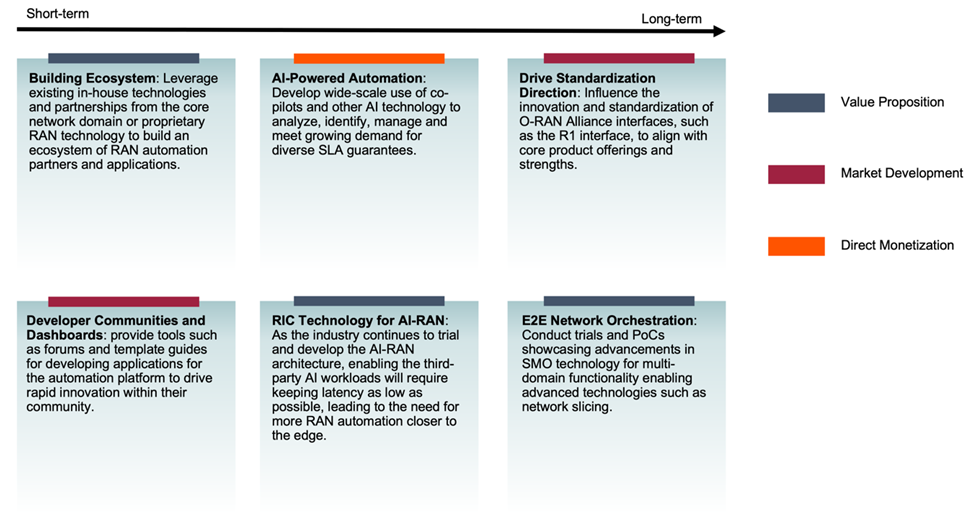 (Source: ABI Research)
Top Use Cases for 5G RAN Automation
ABI Research categorizes 5G RAN automation use cases across four domains: network optimization & efficiency, monetization, deployment, and healing.
Network Optimization & Efficiency
5G RAN automation platforms help address increased power consumption by dynamically managing network resource usage based on traffic patterns.
- Anomaly Detection: Automatically identifies cell performance issues to prevent degradation.
- Spatial Multiplexing: Improves spectrum capacity through advanced channel calculations.
- Traffic Steering: Enhances resource utilization with near-real-time traffic distribution.
- Energy Efficiency: Monitors and optimizes the energy performance of individual cell sites.
Network Monetization
RAN automation is critical for enabling End-to-End (E2E) slice orchestration and enforcing SLAs.
- Automatic SLA Management: Dynamically adjusts SLA metrics.
- QoE Monitoring & Optimization: Uses predictive models to refine service delivery.
- RAN Slice SLA Assurance: Fast-loop optimization to meet SLAs.
- Slice-Aware Admission Control: Prioritizes access for different user types.
Network Deployment
Automation accelerates deployment by leveraging analytics and AI to inform site decisions and ensure configuration consistency.
- Configuration Consistency Analysis: Detects and resolves setup discrepancies.
- Cell Identity Detection: Resolves Physical Cell Identity (PCI) collisions and confusions.
- RAN Insights: AI-generated location recommendations for capacity enhancement.
- Lifecycle Orchestration: Automates full RAN operations lifecycle.
Network Healing
Resilience through automation includes predictive maintenance and early anomaly detection.
- Cell Outage Detection: Identifies and alerts on service degradation.
- Anomaly Detection with AI: Uses Key Performance Indicators (KPIs) and AI models to predict faults.
Proprietary Versus Open RAN Automation
Although Open RAN automation is gaining ground, proprietary platforms continue to lead in terms of deployment prevalence. This is due to established vendor relationships and a technologically mature ecosystem for proprietary solutions.
With that said, ABI Research projects Open RAN automation to account for 42% of the US$6.6 billion global RAN automation market by 2029. This is up from less than 5% of the market in 2023.
- Proprietary Platforms: Provide end-to-end integration, but limit multi-vendor flexibility.
- Open RAN Platforms: Promote interoperability, but face challenges in interface standardization and integration maturity.
Most brownfield operators prefer single-vendor Open RAN solutions initially to reduce integration risk. Their approach mirrors AT&T's adoption of the Ericsson Intelligent Automation Platform (EIAP).
The Growing Role of Telco AI in RAN Automation
AI is set to reshape telco business models, augmenting everything from sales & marketing to network management. On the network side of things, industry attention has shifted decisively from traditional Self-Organizing Networks (SONs) to more advanced, AI-native automation platforms. This evolution is driven by the need for MNOs to reach Level 4 (L4) autonomous networks as defined by the TM Forum, which requires comprehensive AI integration across the RAN stack. Foundational AI models and Agentic AI are at the forefront of this transformation.
Legacy SON platforms, while beneficial in early Long-Term Evolution (LTE) deployments, fall short of what complex 5G networks demand. In response, vendors are now creating vertically integrated Large Language Models (LLMs) trained on telco-specific data to orchestrate and automate across core, RAN, and service layers. These models support the development of AI agents capable of contextual decision-making and task execution. Some real-world examples of telcos leveraging AI agents include:
- Huawei: At the Global Mobile Broadband Forum 2024 (MBBF 2024), Huawei introduced its Telecom Foundation Model, embedded in its IntelligentRAN suite. This suite enables closed-loop fault resolution via network agents, and includes live deployments such as the FME Mate application co-developed with China Mobile Hangzhou.
- ZTE: Released its Nebula Telecom Large Model and uSmartNet platform in July 2024. Built on internal data and proprietary Graphics Processing Units (GPUs), this platform offers an End-to-End (E2E) AI framework aimed at highly autonomous operations.
- SoftBank: Announced the Large Telecom Model (LTM) built on NVIDIA DGX SuperPOD. This model, integrated into a full-stack AI RAN platform, supports dynamic resource orchestration and is part of the AITRAS reference architecture.
- Google Cloud & Deutsche Telekom: Developed the RAN Guardian AI agent using Gemini 2.0 on Vertex AI. This agent provides real-time RAN monitoring, issue classification, and optimization through services like CloudRun, BigQuery, and Firestore.
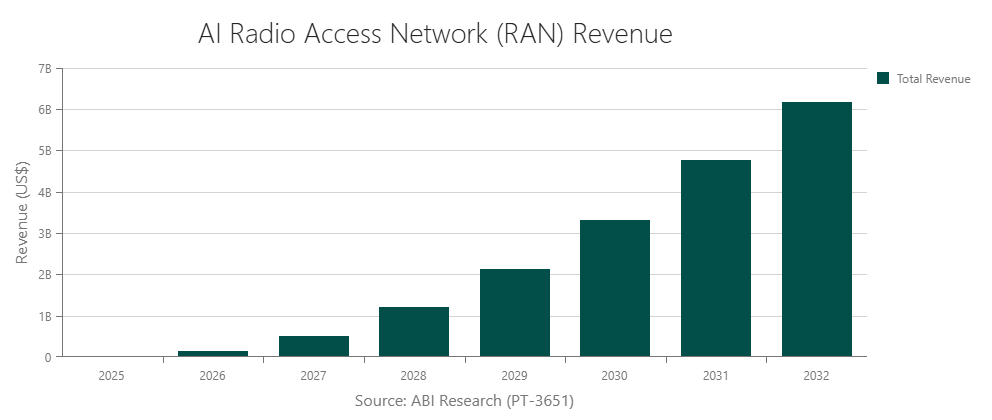
AI RAN is still very much in the early stages of adoption, with ABI Research expecting a ramp up in deployments to occur in 2029. By 2032, our analysts forecast US$6.2 billion in AI RAN revenue, up from just US$133.5 million in 2026.
To support broader adoption of AI in RAN automation, the telecommunications industry must:
- Standardize interfaces for multi-agent orchestration.
- Develop more transparent and explainable LLMs.
- Partner with hyperscalers like Amazon Web Services (AWS) and Google Cloud to accelerate AI integration.
- Mature data strategies to enable higher granularity and context awareness.
Conclusion
5G RAN automation is rapidly evolving from a competitive advantage to a necessity for further monetization in telecommunications. As operators contend with rising energy costs, complex SLAs, and shifting architectures, AI-enhanced automation tools are a must-have for managing next-generation cellular networks. ABI Research sees a clear trajectory toward intelligent, autonomous systems that not only optimize network performance, but also unlock new revenue and innovation opportunities across the global telecom landscape.
For a more in-depth study of how RAN automation and AI are reshaping telecom, refer to the following reports from ABI Research’s 5G, 6G & Open RAN Research Service analyst team:
Recent Research on 5G RAN Automation
5G RAN Automation Platforms: Commercial Strategies
✅ Develop long-term 5G Radio Access Network (RAN) automation strategy.
✅ Understand the market dynamics and motivations for growing RAN automation demand.
✅ Evaluate the differing commercial strategies adopted by Open RAN vendors
5G RAN Automation Platforms: Use Cases for Network Operations
✅Forecast of Open RAN automation annual revenue split into two categories: SMO & non-Real Time (RT) RIC, and near-RT RIC.
✅Breakdown of 5G RAN automation categories and example use cases.
✅Assessment of the different latency requirements for various use cases.
5G RAN Automation Platforms: Technologies
✅Evaluate the development of Agentic Artificial Intelligence (AI) and foundational AI models for Radio Access Network (RAN) automation.
✅Understand how RAN automation platforms play a role within the AI-RAN architecture.
✅Evaluate the development of Open RAN automation platforms.
5G RAN Automation Market Data Overview: 1Q 2025
✅In which regions will Service Management and Orchestration (SMO) and RAN Intelligent Controller (RIC) technologies hold the biggest revenue opportunity?
✅What is the size of the 5G RAN automation market?
✅Where will proprietary automation technologies remain dominant?
 Dimitris Mavrakis
 Sam Bowling