

Key Insights:
- AI is the primary engine of data center capacity growth. Across all regions, AI workloads are driving most next-generation data center builds. By the early 2030s, ABI Research forecasts AI to account for a larger share of active Information Technology (IT) load than legacy workloads.
- Hyperscalers remain dominant, but the market is fragmenting. U.S.-based hyperscalers continue to lead capacity additions. At the same time, neocloud and sovereign providers are scaling faster in regions where pricing transparency, Graphics Processing Unit (GPU) access, and data control matter more.
- Geographic expansion is becoming more balanced. North America, Europe, and China anchor global AI data center infrastructure today. However, there are numerous projects underway in Asia-Pacific, the Middle East, and urban areas in Africa.
- Sovereign AI is reshaping where data centers are built. Data residency and regulatory pressure are pushing governments to invest in domestic AI infrastructure. This trend is especially visible in China, Europe, South Korea, Africa, and the Middle East.
- Energy access and power density are now strategic constraints. AI data centers demand massive, reliable power. Regions with grid capacity, renewable access, and favorable climates are emerging as preferred locations for deployment.
We are officially in the age of the Artificial Intelligence (AI) data center. Improved accessibility and growing geopolitical competition will make enterprise investment in Generative AI (Gen AI) solutions an operational necessity. The impact on data center operators couldn’t be clearer: infrastructure needs to be optimized for next-generation AI workloads, if it isn't already.
ABI Research recently undertook a unique study, forecasting active AI-dedicated data center capacity on a country and regional level. Our analysis tells the story of where AI data center demand growth is being driven globally and why.
Table of Contents:
Table 1: Active AI Data Center Capacity Growth by Region
World Markets: 2026 to 2031
(Source: ABI Research)
|
Country/Region |
Number of Live Data Centers (2026) |
Active AI-Dedicated Capacity (2026) |
Number of Live Data Centers (2031) |
Active AI-Dedicated Capacity (2031) |
|
United States |
2,528 |
8.2 GW |
3,226 |
26.4 GW |
|
China |
483 |
3.1 GW |
541 |
10.3 GW |
|
Europe |
1,879 |
3.5 GW |
2,303 |
9.7 GW |
|
Japan |
210 |
1 GW |
259 |
2.6 GW |
|
South Korea |
75 |
599 MW |
86 |
2.5 GW |
|
Rest of Asia-Pacific |
1,203 |
2.3 GW |
1,472 |
8.9 GW |
|
Latin America |
514 |
443 MW |
627 |
1.6 GW |
|
Middle East |
309 |
223 MW |
402 |
1.4 GW |
|
Canada |
249 |
540 MW |
320 |
1 GW |
|
Africa |
116 |
188 MW |
179 |
856 MW |
United States
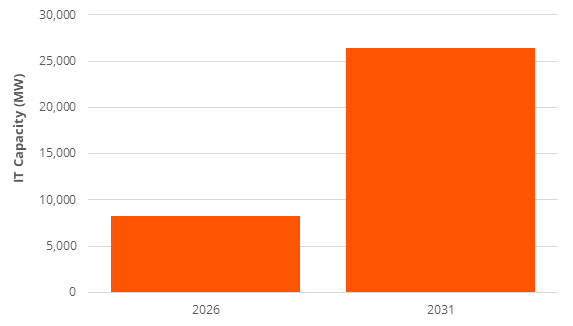
8.2 GW of AI-dedicated active data center capacity in 2026 (40% of total installed capacity)
1.9 GW of new capacity will be added in 2026
26.4 GW of AI-driven capacity by 2031 (54% of total installed capacity)
Key Growth Drivers:
- Strong hyperscaler presence, such as Amazon Web Services (AWS), Microsoft Azure, Meta, and Google Cloud Platform (GCP). Each of these companies is shifting greater focus toward AI-ready infrastructure and High-Performance Computing (HPC). Learn more in our blog, Top 25 Largest Data Center Companies in the U.S. by Active IT Capacity (2025 Edition).
- Enterprise AI is more mature here than in other regions. These compute-intensive applications require significant data center resources, necessitating cloud solutions that cater to AI workloads.
- The US$500 billion Stargate Project (OpenAI, Microsoft, Oracle, SoftBank) aims for 10 GW of power capacity and the use of next-generation AI chips
- North America dominates neocloud demand on the global stage. Neoclouds are AI specialists, offering more transparent pricing models than hyperscalers/colocation operators and supporting specific AI use cases.
Chart 1: Active AI Data Center Capacity Growth
United States: 2026 versus 2031
(Source: ABI Research)
China
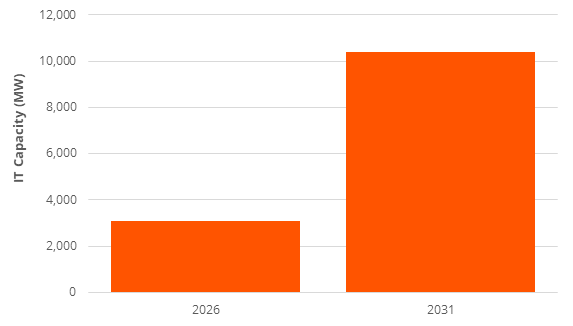
3.1 GW of active AI-dedicated data center capacity in 2026 (44% of total installed capacity)
741 MW of new capacity will be added in 2026
10.3 GW of AI-driven capacity by 2031 (67% of total installed capacity)
Key Growth Drivers:
- A growing middle class and industrial sector will drive significant demand for AI tools. Hyperscalers (including Alibaba Cloud) and Huawei operate numerous data centers and “SuperClusters” in China.
- Significant investments in AI-centric workloads, such as the Eastern Data, Western Computing (EDWC) national strategy.
- The 10 million square foot China Telecom-Inner Mongolia Information Park is widely considered the world’s largest AI data center. It will be key to enabling cloud AI applications in the country.
- Baidu’s 5-year roadmap includes new Kunlun AI chipsets in 2026, 2027, and 2029. The company’s cloud AI infrastructure plans align with the “Made in China” policy, countering U.S. hardware dominance.
- Sovereign AI projects are concentrated the highest in China, as the government enforces strict data protection policies. According to our latest cloud capacity forecasts, sovereign AI capacity will nearly triple from 1.3 GW in 2026 to 3.1 GW by 2031.
Chart 2: Active AI Data Center Capacity Growth
China: 2026 versus 2031
(Source: ABI Research)
Europe
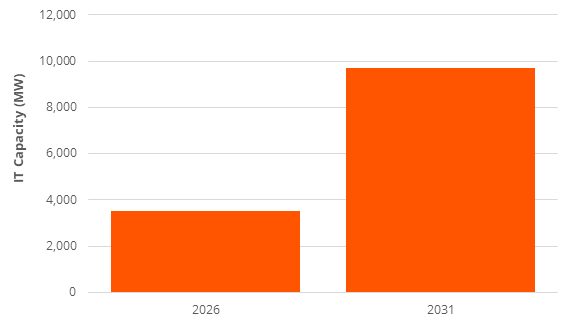
3.5 GW of active AI-dedicated data center capacity in 2026 (37% of total installed capacity)
686 MW of new capacity will be added in 2026
9.7 GW of AI-driven capacity by 2031 (46% of total installed capacity)
Key Growth Drivers:
- Hyperscaler-led AI data center investment is accelerating across Europe. Major commitments include Microsoft’s US$10 billion AI hub in Portugal, Google’s US$6.4 billion expansion across Germany, and large-scale projects in the United Kingdom and Italy designed to support high-density AI and sovereign cloud workloads.
- Private capital is scaling AI infrastructure at unprecedented levels. Brookfield and Data4 plan to invest more than US$20.7 billion across France and Northern Europe, including a significant expansion of the Strängnäs, Sweden campus to support large-scale AI training capacity.
- European lawmakers have adopted strict sovereign AI policies, such as the General Data Protection Regulation (GDPR), the NIS2 Directive, and the European Union (EU) Data Act. ABI Research forecasts sovereign cloud capacity in the region to increase from 672 MW in 2026 to 1.6 GW by 2031.
Chart 3: Active AI Data Center Capacity Growth
Europe: 2026 versus 2031
(Source: ABI Research)
Japan
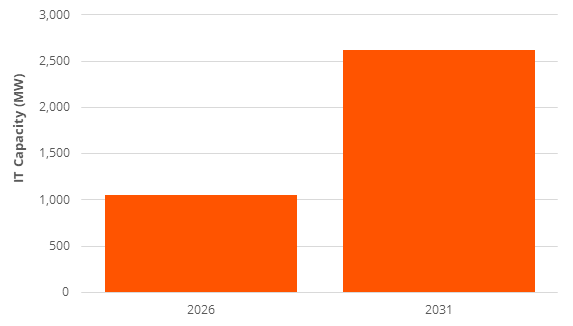
1 GW of active AI-dedicated data center capacity in 2026 (42% of total installed capacity)
197 MW of new capacity will be added in 2026
2.6 GW of AI-driven capacity by 2031 (51% of total installed capacity)
Key Growth Drivers:
- Leveraging NVIDIA Blackwell GPUs, SoftBank plans to develop Japan’s most powerful AI supercomputer. These GPUs will be essential computing tools for a new AI data center being constructed in Hokkadio Tomakomai that will run on 100% renewable energy.
- Similar to China, the Japanese government is working on AI projects that will see data center infrastructure move from dense urban environments to cooler, rural areas.
- Announced in April 2024, Microsoft pledged a US$2.9 billion investment in Japan to expand cloud infrastructure. Domestic manufacturers like Hitachi, Honda, and Mitsubishi are notable Microsoft AI customers. Companies across financial services, healthcare, food service, and IT services are also using Microsoft’s cloud AI solutions.
- Other plans in the country include the AI retrofit of large hyperscale campuses in Chiba, the development of a government-supported sovereign AI cloud, and AWS’s multi-year expansion to create a resilient dual-hub AI architecture spanning Tokyo and Osaka.
Chart 4: Active AI Data Center Capacity Growth
Japan: 2026 versus 2031
(Source: ABI Research)
South Korea
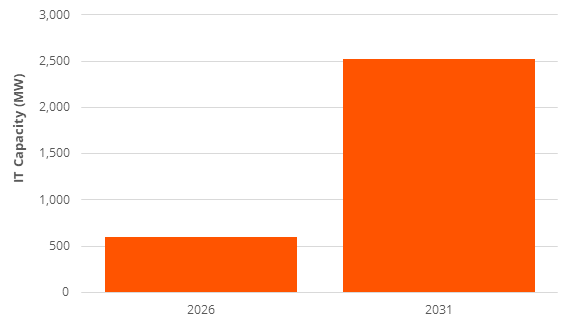
599 MW of active AI-dedicated data center capacity in 2026 (43% of total installed capacity)
185 MW of new capacity will be added in 2026
2.5 GW of AI-driven capacity by 2031 (64% of total installed capacity)
Key Growth Drivers:
- AWS and SK Group plan to construct a US$5.1 billion AI data center in Ulsan. The facility is scheduled to be operational by 2027 and generate tens of thousands of new jobs.
- A groundbreaking 3 GW data center is slated for a 2028 project completion in Jeollanam-do, South Korea. This US$35 billion project, being built by Fir Hills Inc, will be one of the world’s largest AI data centers and critical to accelerating AI innovation in the country.
- The Korean government is working with NVIDIA and Hyundai to build an AI factory that will accelerate model training. The factories will help support mobility applications such as in-vehicle AI, autonomous driving, and robotics.
- South Korea stands out for its intensifying sovereign AI efforts. ABI Research Senior Research Director Dimitris Mavrakis recently mentioned in a report, “South Korea is by far the most advanced and innovative market for sovereign AI cloud, especially if we consider a normalized metric, in this case, sovereign data center capacity per capita. This translates to South Korea having the largest appetite to innovate for its citizens and protect its computing borders.”
Chart 5: Active AI Data Center Capacity Growth
South Korea: 2026 versus 2031
(Source: ABI Research)
Rest of Asia-Pacific (Southeast Asia, India, Australia, etc.)
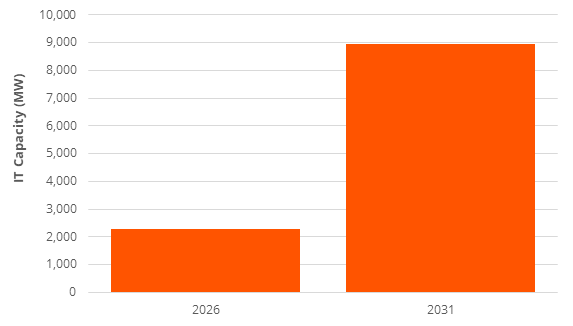
2.3 GW of active AI-dedicated data center capacity in 2026 (31% of total installed capacity)
677 MW of new capacity will be added in 2026
8.9 GW of AI-driven capacity by 2031 (50% of total installed capacity)
Key Growth Drivers:
- Cloud strategies are increasingly becoming AI-specific. Enterprises in Southeast Asia are moving beyond general cloud adoption and designing infrastructure around AI training, inference, and latency-sensitive workloads.
- Reliance on hyperscalers is being rebalanced. Rising costs, GPU availability issues, and sovereignty concerns are pushing enterprises toward multi-cloud and hybrid models.
- Regulation and vertical demand are accelerating local build-out. Data residency rules, sector-specific AI use cases, and telco cloud initiatives are increasing demand for in-country AI data center capacity.
- Hyperscalers continue to unlock new data center regions in places like Singapore, Thailand, the Philippines, Taiwan, Malaysia, etc. They are key partners for unlocking the enterprise AI applications that growing economic sectors require.
-
Chart 6: Active AI Data Center Capacity Growth
-
Rest of Asia-Pacific: 2026 versus 2031
-
(Source: ABI Research)
-
Latin America
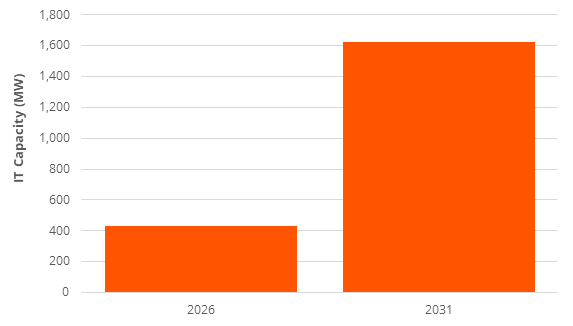
443 MW of active AI-dedicated data center capacity in 2026 (30% of total installed capacity)
108 MW of new capacity will be added in 2026
1.6 GW of AI-driven capacity by 2031 (46% of total installed capacity)
Key Growth Drivers:
- The Rio AI City is designed to be one of Latin America’s largest data centers dedicated to AI workloads. This Goldman Sachs-backed project will reportedly use waterless cooling systems for sustainability and reach a peak power capacity of 3.2 MW.
- A 300 MW facility from ODAT is under development in Querétaro, Mexico, making it the largest data center campus in the country.
- TECfusions and Baeza Group are building a Gen AI-ready data center in Puente Alto, Chile. While initial IT capacity will be 10 MW, the plan is to expand to 100 MW.
- Over the course of 15 years, AWS will invest US$15 billion in transforming Mexico’s cloud computing infrastructure. The newly available zone makes advanced AI and Machine Learning (ML) technologies more accessible to businesses and consumers.
Chart 7: Active AI Data Center Capacity Growth
Latin America: 2026 versus 2031
(Source: ABI Research)
Middle East
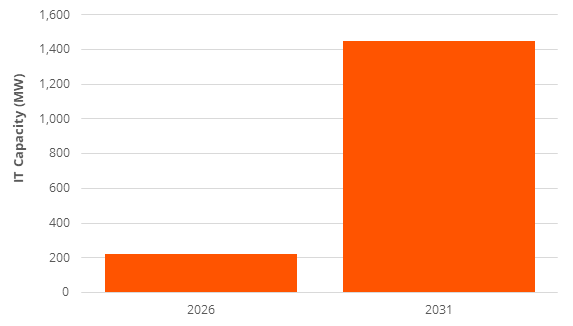
223 MW of active AI-dedicated data center capacity in 2026 (24% of total installed capacity)
79 MW of new capacity will be added in 2026
1.4 GW of AI-driven capacity by 2031 (42% of total installed capacity)
Key Growth Drivers:
- The United Arab Emirates (UAE) is scaling AI-ready data center capacity through sovereign partnerships. Microsoft and G42 plan to add 200 MW of capacity via Khazna Data Centers. Deployment will begin before the end of 2026, strengthening local, secure, and AI-optimized cloud infrastructure.
- Sovereign cloud and responsible AI are core design principles in the Middle East. The Microsoft–G42 partnership emphasizes cybersecurity, data protection, and ethical AI. Initiatives such as the Responsible AI Future Foundation and national AI governance frameworks are emblematic of this trend.
- Google Cloud and Accenture are building a major region in Saudi Arabia, Kuwait is developing a dedicated AI and cloud zone, and Qatar is expanding AI-focused sites to support industrial and energy workloads.
- AI infrastructure is reshaping national development strategies. From Liquefied Natural Gas (LNG) optimization in Qatar to potential repurposing of Saudi Arabia’s Neom projects as AI data center hubs, governments are prioritizing AI compute as critical economic infrastructure.
Chart 8: Active AI Data Center Capacity Growth
Middle East: 2026 versus 2031
(Source: ABI Research)
Canada
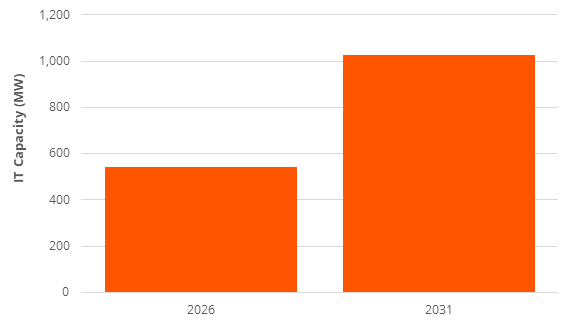
540 MW of active AI-dedicated data center capacity in 2026 (35% of total installed capacity)
66 MW of new capacity will be added in 2026
1 GW of AI-driven capacity by 2031 (42% of total installed capacity)
Key Growth Drivers:
- One of the most ambitious plans globally is Beacon AI Centers’ roadmap in Canada. It aims to install up to 4.5 GW of data center power capacity in the country. Full operations likely won’t commence until the 2027-2030 time frame.
- By late 2026, a new 90 MW AI data center is expected to be launched by eStruxure Data Centers in Alberta (Alberta has rich natural resources, a cool biome, and strong grid capacity).
- Google and AWS, like Microsoft, have also announced plans to expand data center capacity in Canada as AI demand surges. AWS’s US$18.3 billion investment in Canada by 2037 will be a key catalyst for AI data center growth.
- In December 2025, Microsoft made it known that it will invest a further 7.5 billion CAD over the next 2 years to support Canada’s sovereign cloud and AI innovation efforts. The hyperscaler says new data center capacity will be added in 2H 2026.
Chart 9: Active AI Data Center Capacity Growth
Canada: 2026 versus 2031
(Source: ABI Research)
Africa
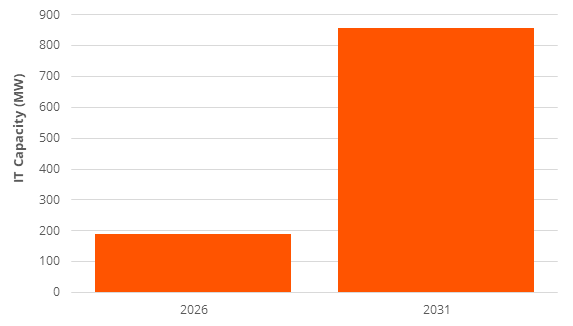
188 MW of active AI-dedicated data center capacity in 2026 (25% of total installed capacity)
54 MW of new capacity will be added in 2026
856 MW of AI-driven capacity by 2031 (45% of total installed capacity)
Key Growth Drivers:
- Microsoft announced in May 2024 that it is teaming up with G42 and the Kenyan government on a US$1 billion “state-of-the-art green data center.” The initiative entails developing local-language AI models, training in AI skills, investing in connectivity, and providing secure cloud services.
- In November 2025, colocation data center operator Equinix proclaimed a US$100 million investment in Africa to expand cloud infrastructure. Notably, the company plans to build a US$22 million facility in Lagos, Nigeria.
- A 40 MW data center is currently being built by Digital Reality-owned Teraco in Johannesburg, South Africa. The facility will be part of the Isando campus, which consists of three data centers presently. Expected to be operational in 2026, the fourth facility will increase capacity to 70 MW.
- Morocco is an AI leader in Africa, reportedly accounting for 35% of total data center capacity on the continent. Recently, the Moroccan government declared that it plans to launch a next-generation data center with 500 MW of power capacity in Dakhla. Furthermore, the Jazari Institute of Artificial Intelligence is being tasked with AI research and training across the energy sector.
- South Africa, Kenya, Egypt, and other countries are pushing for sovereign AI to keep data within their own borders.
- Cassava Technologies President and group chief executive Hardy Pemhiwa said in 2025 that the company plans to deploy 12,000 NVIDIA GPUs to power Africa’s AI data centers by 2030.
Chart 10: Active AI Data Center Capacity Growth
Africa: 2026 versus 2031
(Source: ABI Research)
Conclusion
AI data center demand is soaring rapidly across all regions. Hyperscalers are committed to several multi-billion-dollar projects to expand their AI infrastructure globally. Additionally, governments are increasingly embarking on sovereign cloud initiatives that will generate interest for AI specialists, such as neoclouds.
For these reasons, ABI Research projects that more than 50% of total data center capacity will be dedicated to AI workloads by the early 2030s.
The choice of where to build a next-generation data center typically hinges on climate conditions, resource availability, grid capacity, and regional AI demand. The successful expansion of AI data centers necessitates not just close synergies between operators and technology vendors (for server cooling, connectivity, etc.), but also with policymakers and the domestic enterprise sector.
Through its AI & Machine Learning, Cloud, and Smart Buildings Research Services, ABI Research delivers insight into AI data center growth, power capacity forecasts, emerging trends, and design innovations that improve build speed and energy efficiency. In addition to reports and market data, we offer technology consulting, custom research, and content marketing services. Contact a member of our team today to learn more.
Frequently Asked Questions
What is the growth outlook for AI data centers?
According to ABI Research, active data center capacity dedicated to AI workloads will expand from 11.5 GW in 2026 to 43.6 GW in 2031. By then, AI workloads will overtake legacy workloads in terms of active power capacity in data centers.
What is the impact of AI on data center capacity planning?
AI increases data center power density, cooling demand, and infrastructure scaling requirements, making power and cooling readiness the top capacity-planning priorities. As AI workloads overtake legacy workloads by 2031, operators must prioritize power availability, rack-level cooling efficiency, and electrical infrastructure readiness to support accelerator-heavy environments.
Which region/country holds the most AI data center capacity?
The United States. It is forecast to increase AI data center capacity from 8.2 GW in 2026 to 21.4 GW by 2031. This is more than twice the active power capacity of runner-up China (10 GW by 2031).
Start with free research
Subscribe to ABI Research's weekly newsletter for access to our latest Analyst Insights, whitepapers, report samples, webinars and events, blog posts, and more.
