Key Insights:
- 6G commercialization will begin as a measured extension of 5G-Advanced rather than a clean break from today’s networks. Early growth will come from upgrades to existing RAN infrastructure, not wholesale replacement.
- Asia Pacific is set to lead the first wave of 6G because it combines strong infrastructure, better spectrum positioning, and tighter coordination between governments and telecom operators.
- The market will develop in clear stages from groundwork and standards to selective rollouts and broader expansion. That makes timing and regional readiness more important than broad 6G hype.
- ISAC is losing momentum as a headline 6G value driver. It now looks more likely to serve niche use cases than to justify large-scale network investment on its own.
- For operators and vendors, near-term success will depend on extracting more value from 5G Advanced, advancing AI-native RAN capabilities, and targeting early 6G deployments where ROI is easiest to prove.
6G remains in the testing phase in 2026, largely driven by standardization requirements and spectrum challenges. According to ABI Research’s 6G Timeline and the Vision for 6G Networks report, 6G commercialization will commence in 2029.
However, Asia-Pacific alone accounts for 54% of global 6G radio deployments (see the forecast). Other regions face telecom infrastructure limitations and take a more practical approach toward adopting transformative technologies.
ABI Research offers a pragmatic outlook for 6G commercialization.
6G As an Evolutionary Successor to 5G-Advanced
Unlike its predecessors, 6G will build on existing cellular foundations rather than replacing them entirely. 5G services monetization has not lived up to initial expectations, leaving operators to look inward at current network capabilities to drive revenue. Technical standardization and spectrum accessibility are further roadblocks to 6G commercialization.
As a result, operators are gradually converging 5G-Advanced features with the hallmarks of future 6G infrastructure. This means a pronounced focus on the following:
- Maximizing value from existing cellular investments
- Implementing software-based network upgrades
- Improving network efficiency
Much of the near-term innovation in cellular networks will occur within the Radio Access Network (RAN), rather than the 6G core network. Here, the telecom industry will push for new and improved spectrums and broader Artificial Intelligence (AI) support.
Multi-layer spectrum architecture (low, mid, upper-mid, mmWave) addresses historical network challenges such as coverage, capacity, and cost. Meanwhile, AI will increasingly be used to optimize RAN deployments, predict mobile traffic, detect network bottlenecks, and reduce power consumption. Once these technical capabilities mature, the bridge from 5G-Advanced to 6G will become more secure.
The Four Phases of 6G Commercialization
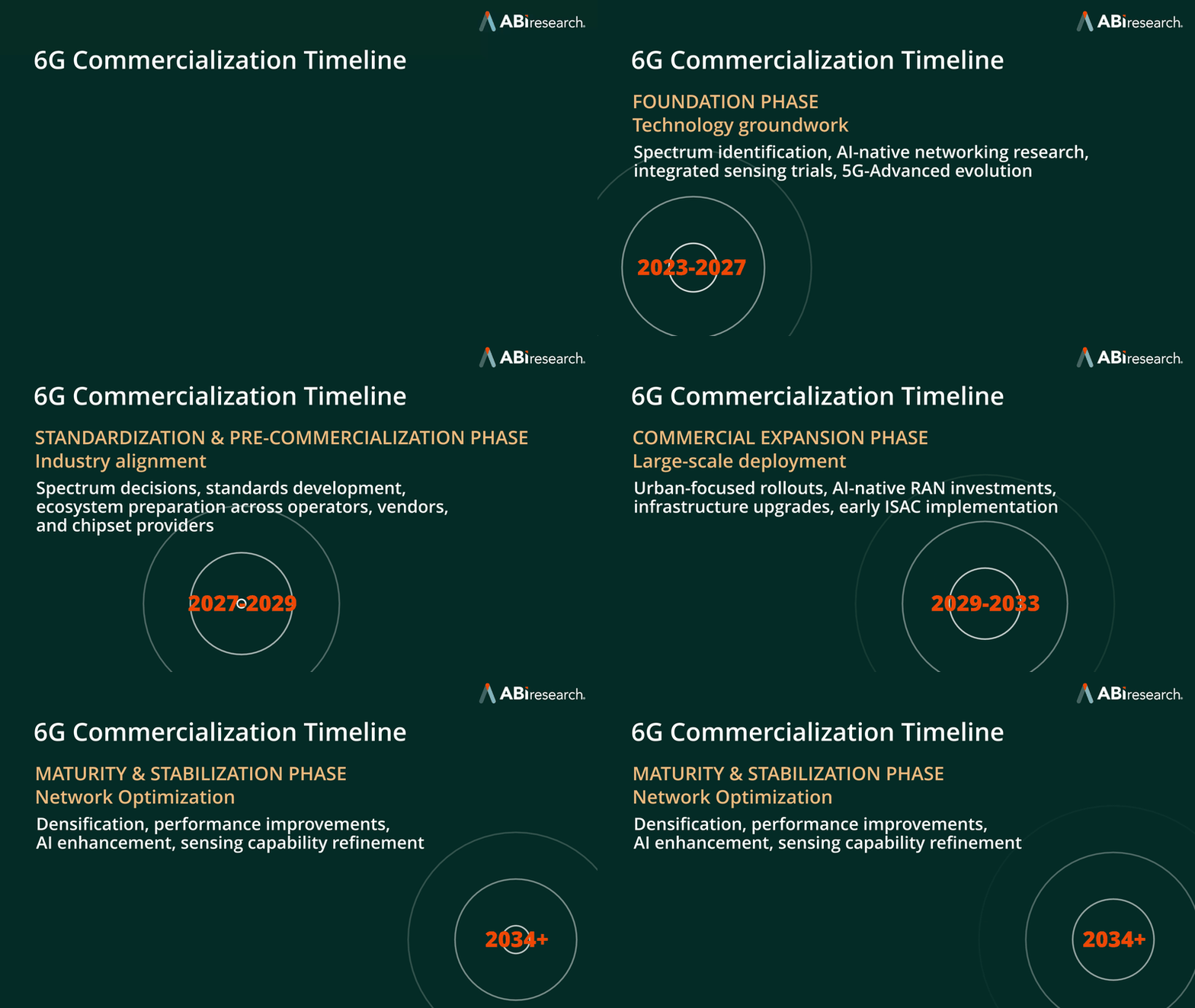
ABI Research envisions a four-phase sequence to emerge across the 6G development timeline: foundation (partially complete), standardization and pre-commercialization, commercial expansion, and market maturity/stabilization.
- 2023–2027: Laying the Foundation. Industry stakeholders identified key 6G spectrum bands, value-driving 5G-Advanced capabilities, and began early technology trials focused on AI-native networking and integrated sensing.
- 2027–2029: Standards and Pre-Commercialization Take Shape. Global spectrum decisions and emerging 6G specifications create a clearer roadmap for operators, infrastructure vendors, device makers, and chipset providers.
- 2029–2033: Commercial Deployment Accelerates. Operators begin large-scale 6G rollouts, initially targeting urban and high-value markets. Investment in infrastructure, AI-native capabilities, and Integrated Sensing and Communications (ISAC) increases significantly.
- 2034 and Beyond: Maturity and Stabilization. As deployments mature, the focus shifts from network buildouts to performance improvements, densification, and continued enhancement of AI-driven and sensing capabilities, and market maturity/stabilization.
ISAC Monetization Challenges
ISAC was originally seen as an integral part of the 6G era. The appeal of sensing capabilities would transform industries such as health, public safety, and physical autonomy (learn more in Senior Research Director Dimitris Mavrakis’ 2024 article, Assessing ISAC: How Sensing Will Meet Communication in 6G Networks).
Almost two years later, ISAC is still stuck in standardization limbo. The 3rd Generation Partnership Project (3GPP) continues developing technical standards, now focused on foundational enablers rather than deployable services.
Adding to the commercialization challenge, ISAC is compute-intensive, which drives up costs for a feature with no clear monetization path. Finally, the ISAC ecosystem has limited ecosystem openness and requires hard-to-come-by spectrum.
The consensus is that ISAC will be limited to several niche use cases:
- Drone detection and tracking
- Industrial collision avoidance (Automated Guided Vehicles (AGVs))
- Infrastructure and perimeter monitoring
- Limited environmental awareness
Key Takeaway: Once viewed as a key catalyst for network upgrades, ISAC is now expected to play a more complementary role in 6G deployments.
The Companies Shaping the 6G Discussion
ABI Research identifies the following seven technology leaders as the pioneers in 6G network development:
- Huawei: Huawei is advancing pre-standard 6G development through ISAC, upper mid-band trials, and tightly integrated end-to-end network experimentation. Huawei is a key driver behind China’s dominance in the global 6G market.
- Ericsson: Ericsson is positioning 6G as a natural extension of 5G-Advanced, focusing on AI-driven network optimization, cloud-native RANs, and operational efficiency.
- Nokia: Nokia is prioritizing real-world 6G validation through operator trials, while emphasizing AI-native networking, integrated sensing, and energy-efficient network evolution.
- Samsung: Samsung is helping shape the future 6G ecosystem through research into new spectrum bands, antenna technologies, and end-to-end device and network architectures.
- Qualcomm: Qualcomm is bridging standards development and commercial deployment by advancing AI-enabled modem technologies, dynamic spectrum utilization, and next-generation chipset capabilities.
- Intel: Intel is supporting 6G through cloud-native infrastructure, edge computing, and software-defined networking technologies designed to enable highly distributed network architectures.
- NVIDIA: NVIDIA is bringing AI-native computing to telecommunications, providing the Graphics Processing Unit (GPU) and software platforms needed to power real-time network intelligence and automation.
Conclusion
According to ABI Research, 6G radio revenue will increase from US$8.1 billion in 2029 to roughly US$67 billion by 2034. Revenue will primarily derive from upgrades to existing 5G-Advanced RANs.
Thanks to aggressive national strategies and investment programs, Asia-Pacific is expected to emerge as the leading region for 6G deployments. For example, China reportedly holds 40% of the total 6G patent filings worldwide. The country also has the most robust telecom infrastructure, easing the transition from 5G to 6G.
In other regions, early 6G deployments will be much more selective to start out. Telcos will focus on high-value urban and enterprise use cases with a clear Return on Investment (ROI). As early pilot programs mature and the installed base of 6G-capable devices grows, broader market adoption is expected to accelerate from 2032 onward.
For ABI Research’s full outlook for 6G commercialization, download the 6G Timeline and the Vision for 6G Networks report.