

I will be heading to Network X in Vienna from October 13 to 15 to witness how the telecoms industry is adapting to Artificial Intelligence (AI) and how mobile and fixed network operators are progressing with their AI-native strategies. Over the past few years, the industry has been focusing on 5G, 5G-Advanced, Passive Optical Network (PON) and Fiber to the x (FTTx), discussing how to monetize existing networks and looking forward to new network generations and technologies.
The discussion in 2026 is completely different from the past. For example, ZTE is now positioning its overall strategy towards “connectivity and computing”, when 35% of its revenues are driven by computing and data centers. It is a similar story for other infrastructure vendors, all aiming to diversify, some more than others.
I expect to have many discussions on telco AI, 6G, data center connectivity, and network monetization. At Network X I will be looking closely at how telco vendors are aiming to help telco operators transform their operations, network, and services.
What Is the Status of 5G-Advanced and Sentiment Toward 6G?
I expect to hear a lot about 5G-Advanced and 5G Standalone (SA) at the show, highlighting how the two technologies are now a robust foundation for mobile operators to start offering new types of services to consumer and enterprise clients. Some operators have already started to do so (e.g., AIS in Thailand with its 5G VIP Ultra packages) and many more will follow now that the transition to SA is in advanced stages. I will be discussing this with telco operators to understand their sentiment and willingness to create new types of products and services.
On the 6G front, we hear that many telco operator board members are starting to ask, “how and when,” when they were previously asking “why” for the new generation. Some are even starting to discuss their deployment plans to ensure a competitive edge against other operators because the requirements and specifications of the new generation will be frozen in March 2027 (Stage-1 freeze). I look forward to discussions with mobile operators at the show to understand what they expect from the new generation and how they aim to deploy it.
I will be chairing the Future Networks session on the afternoon of October 13, so please attend the session if you are interested in hearing more about these topics or conversing with me.
Can Telco Vendors Survive Infrastructure Stagnation, and Will AI Create a New Opportunity for Telcos?
Telco network infrastructure revenue is steady and even expected to decline over the next few years, as revenue from 5G, 5G-Advanced, and 5G SA deployments stagnate due to mainstream deployments largely being mature. Large infrastructure vendors like Ericsson, Huawei, Nokia, Samsung, and ZTE may face top-line pressure as infrastructure investments stagnate. According to ABI Research estimates and vendor financials, the following diagram illustrates the future of vendor diversification and how data centers and computing products are helping them survive the market.
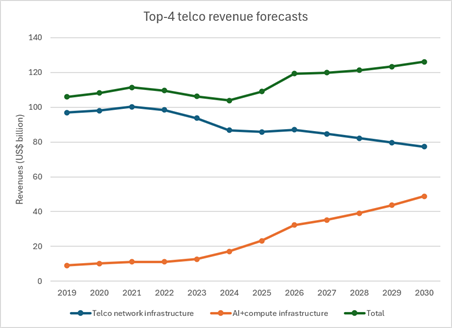
Sources: ABI Research; vendor financials (includes Ericsson, Huawei, Nokia, and ZTE)
Nevertheless, their clients, telco operators, are very well positioned to play a pivotal role in the AI supercycle, offering sovereign AI capabilities, a trusted last mile to consumers and enterprises, and even bundling tokens and AI applications with connectivity.
I will be looking out for diversified vendor strategies at the show, and how telco operators are expected to transform toward becoming AI enablers rather than connectivity providers.
What Data Center Interconnect Opportunities Await Telcos?
Telco operator dark fiber assets are now becoming a prized commodity for Data Center Interconnect (DCI), which is a bottleneck for the expansion of AI training and inference. In fact, the next wave of AI data center deployments will see distributed processing in smaller data centers to take advantage of different power grids, rather than relying on data centers with multiple Gigawatts (GW) of capacity in one location.
In China, this is already taking place but not for the lack of energy; it is the lack of processing capabilities that local accelerators have in comparison with NVIDIA chipsets, leading to requiring more data centers (for example, the Huawei Ascend 960 supernode has roughly 11X the processing capability of NVIDIA’s GB300 NVL72 but at 57X the silicon footprint). This has forced the deployment of more data centers in China, which, in turn, require more DCI.
At the show, I am keen to learn where telco operator opportunities are emerging in this space and how European operators expect to monetize their existing fiber and passive assets. I will be presenting on the scale-across opportunity on the afternoon of October 14, so please join me to discuss further.
Are Telcos Ready for Deep Satellite and NTN Integration?
The satellite andNon-Terrestrial Network (NTN) discussion is becoming a hot topic for telco operators, which are now facing potential competition from Starlink. Satellite operators are rushing to launch massive Low Earth Orbit (LEO) constellations, yet The 3rd Generation Partnership Project (3GPP) 6G NTN standards won't be fully frozen until early 2029. This may create a disconnect between the telecoms and satellite markets.
There is also overwhelming industry hype around satellite stepping in when terrestrial networks are out of coverage. Yet, some mobile operators have already noted that usage and monetization for these initial satellite features remain quite low. If basic messaging/SOS has not yet proven its financial worth today, why should the market sign off on even more expensive 6G architecture designed to deeply integrate space and ground?
Engineers in the room know that making a standard smartphone connect to a LEO satellite requires massive compromise on battery life, antenna design, and link reliability. Which of those three is going to break first when we talk about mainstream 6G integration?
I look forward to addressing these questions with an excellent panel I will be moderating on the afternoon of October 13.
Let’s Connect
If you’re attending Network X 2026 in Vienna, I welcome the opportunity to connect. I would like to hear how your organization is modernizing its mobile network across Europe through AI integration, full fiber, space technology, data center networks, and more. Schedule a meeting.
 Larbi Belkhit