
Authors: Malik Saadi, Chief Research Officer; Leo Gergs, Research Director
The goal
At Cisco's EMEA Analyst Summit on October 14 to 15, 2026, the ABI Research team learned how Cisco sets itself a mission to turn its networking position into a broader role: the supplier enterprises trust to run Artificial Intelligence (AI) where failure is not an option—in power grids, banks, hospitals, factories, and governments.
The logic is sound. AI is moving from training in hyperscale data centers to inference everywhere, and that AI needs a network that is fast, secure, reliable, observable, safe, and under the customer's control.
Cisco wraps this in one word, trust, and starts from strength. It owns the foundations of the trust stack (silicon, cryptography, and network security), while content provenance and the governance of AI risk still need partners. Cisco is not diversifying; it is deepening, using AI to win a bigger share of what customers spend on infrastructure across the same four segments.
The numbers show the shift is underway, and Cisco has the potential to lead if it executes.
The numbers: a real transition, not an exit from networking
Cisco revenue, FY 2015 to FY 2026
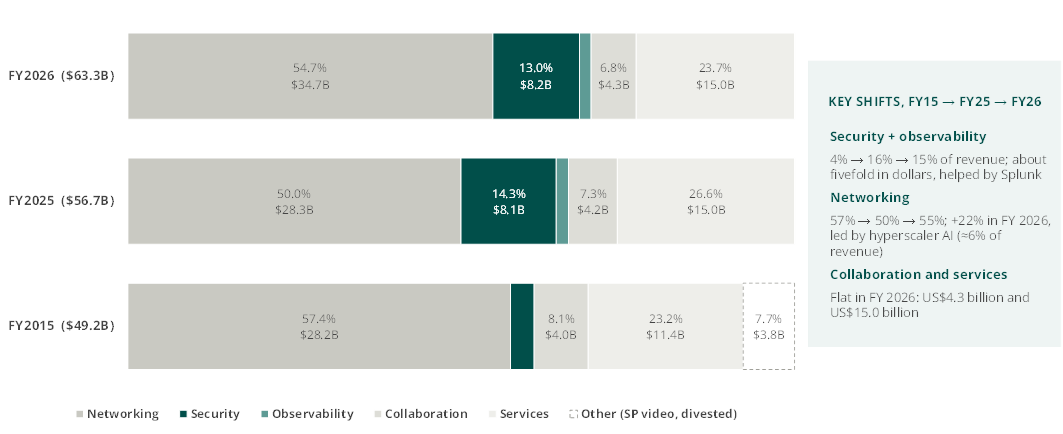
(Source: ABI Research using Cisco financial results. FY 2015 networking=switching + NGN + routing + wireless + data center.)
In Fiscal Year (FY) 2026 (ended July 25, 2026), networking grew 22%, driven by hyperscaler AI infrastructure: about 6% of revenue, up from under 2%, on US$9.3 billion of orders. Security and observability grew only 2% to 4% after a decade of acquisition-led growth, and services were flat. Software reached US$23.2 billion, about 37% of revenue, across these categories.
AI runs through all four product segments. Networking already monetizes it at scale; the other three hold the next wave:
- Networking monetizes AI as hardware. Silicon One, optics, and AI PODs for hyperscalers earned about US$4 billion, the only AI revenue Cisco discloses, and AI readiness drives campus refreshes. The next step is charging for performance and selling AI-driven operations as subscriptions.
- Security and observability bundle AI into subscriptions. AI Defense, agent identity, and Splunk and Galileo agent monitoring sit inside existing contracts. Splunk also gives Cisco a rare position in data: not only is Cisco one of the only players to have created commercial traction around a data fabric, but that data fabric is also a commercial vehicle for Cisco, bringing more telemetry, and more of the portfolio, into each deal. Agent governance, AI telemetry, and compliance evidence could become guaranteed trust, priced per agent or per outcome and reported as its own line.
- Collaboration gains a smarter product. Webex AI Assistant is largely bundled in; the contact-center AI Agent sells as an add-on. Pricing per resolved interaction rather than per seat would turn AI into growth.
- Services can be reinvented. Outcome-based managed AI operations, built on telemetry and support history no rival can match, are the prize; the cost is cannibalizing high-margin support contracts and bringing partners along.
How Cisco is making the shift
Cisco is making four moves. First, it is applying its expertise in chips, optical links, and networking to the networks that connect AI processors (Graphics Processing Units (GPUs)) in data centers. This is important, because a slow network leaves expensive GPUs idle, waiting for data. Cisco now also sells its own networking chips, Silicon One, directly to the largest cloud providers.
Second, it is broadening delivery with NVIDIA and Supermicro rack-scale systems alongside UCS, AI PODs and Unified Edge.
Third, it is linking security, telemetry, and management through the Cisco Data Fabric (powered by Splunk), Cloud Control, and Cisco IQ, while acquisitions such as Robust Intelligence, Isovalent, Galileo and Astrix extend that control to AI models and agents. Cisco is one of very few vendors, alongside Amazon Web Services (AWS), to make a data fabric work commercially; it now leads sales conversations across the portfolio.
Fourth, it is changing how it sells: enterprise agreements and the Cisco 360 partner model aim to turn one-off equipment purchases into a continuing operating relationship. Integration is staged; turning portfolio breadth into a unified customer experience is the work ahead.
Cisco’s data center strategy is distinctive in where it chooses to play. Beyond selling Silicon One to hyperscalers, it particularly targets edge and on-premises data centers, where enterprises want AI close to their data and under their own control, and distributed inference, where models run across many sites and the network connecting them determines performance and cost.
The Supermicro partnership, announced in August 2026 with sales starting in October, extends this reach to neoclouds, particularly in Europe, the Middle East, and Africa (EMEA). It adds Supermicro’s liquid- and air-cooled rack-scale systems (NVIDIA NVL72, HGX, and MGX) to Cisco’s Secure AI Factory with NVIDIA in an NVIDIA Cloud Partner (NCP)-compliant architecture: Silicon One switches for the front-end network and NVIDIA Spectrum-X for the back end, unified through Nexus One.
Cisco says it is the only NVIDIA partner to use its own switches and network operating system in an NCP-compliant design, and it front-ends support and validation for the whole stack.
These moves rest on five technology building blocks:
|
Pillar |
Key Technologies |
Role in Mission-Critical AI |
|
AI networking and optics |
Silicon One G300 and P200, Ethernet switching and routing, 800G optics |
Connect GPUs, storage, and sites with high utilization and efficiency |
|
Compute from core to edge |
UCS, AI PODs, NVIDIA and Supermicro systems, Unified Edge |
Run inference where latency and data control require it |
|
Security and sovereignty |
AI Defense, HyperShield, Hybrid Mesh Firewall, post-quantum encryption, sovereign portfolio |
Protect infrastructure and agents; customer-operated options |
|
Data and observability |
Cisco Data Fabric (powered by Splunk), ThousandEyes, Galileo |
Join network, application, security, and agent telemetry |
|
Unified operations |
Cloud Control, Cisco IQ, Intersight |
Coordinate policy, lifecycle, and support |
The first pillar earns the revenue today. The other four make Cisco mission-critical rather than merely fast, and together form its trust offer: strong at enforcing policy, with governance and proof of outcomes as the next frontier.
Deepening, not diversifying: why the strategy is solid
Cisco's strategy is a bet that one integrated platform, augmented by AI across all four segments, beats best-of-breed rivals in each. It is the right bet: its past diversifications (Linksys, the Flip camera, set-top boxes) were exited, while its successes (UCS, security, Splunk) stayed close to the network.
The strategy also reaches further than the four segments suggest. The same products now win new customers (hyperscalers, a class Cisco barely sold to 5 years ago), new budgets (grids, factories, and sovereign programs), and a new kind of spending (subscriptions and managed operations). With AI, Cisco is tapping new Capital Expenditure (CAPEX) opportunities rather than competing only for a share of existing budgets.
The test is competitive: rivals are deepening the same way, so AI features alone will become table stakes. Cisco wins where integration across the four segments delivers outcomes no single-category rival can match. The next step is a new business model, not a new market or more technology: selling guaranteed outcomes and trust, which would lift the ceiling that customers’ infrastructure budgets set today.
Opportunities, challenges, and what Cisco must prove
The opportunities are well timed:
- Distributed AI: Enterprise inference is starting to move to campuses, branches, and factories, making the network an input to application performance and operating economics.
- Regulation and Agent Governance: European rules on cybersecurity, AI, and quantum-safe encryption turn trust into a budget line, and every AI agent needs an identity, limits, and an audit trail. Cisco is early to both.
- Neoclouds: Supermicro opens a route to neoclouds, especially in EMEA, where sovereign AI demand is growing. NCP compliance matches the reference architecture neoclouds already build to, and a single point of support and validation removes multi-vendor risk. GPU specialists, full-stack AI clouds, sovereign providers, and telco AI factories each stress different security strengths, but security for models, agents, and their data is still maturing across all of them. That is where AI Defense, HyperShield, and Splunk add the most value.
The challenges are real:
- Security Growth Has Yet to Follow: The platform story is compelling; converting it into sales is the priority.
- Concentration and Economics: AI revenue depends on a handful of hyperscalers, and rack-scale growth adds exposure to hardware mix and supply constraints. Enterprises may also hold back on AI deployments until they see a clear return on their investment.
- The Edge Bet: Cisco is strongest on-premises and at the edge. If enterprises keep AI inference in public clouds for longer than Cisco expects, its enterprise AI opportunity will arrive later.
- Integration and Dependence: Fragmented management, costly telemetry, or restrictive licensing would undermine the platform promise. NVIDIA is both a partner and a competitor; Arista and HPE, now with Juniper, attack the data center and campus.
- Neocloud Go-to-Market and Timing: CoreWeave’s debt-driven slide and Nscale’s loss of Microsoft as U.K. anchor tenant call for a careful go-to-market strategy that qualifies neoclouds on financial strength, not just capacity. But Cisco cannot wait: neoclouds are choosing suppliers now, and the survivors will be those that move beyond hyperscaler anchors to enterprise and sovereign customers who demand stronger security.
- Sovereignty with Limits: Sovereign configurations restrict cloud-delivered functions and depend on external maintenance; as a U.S. company, Cisco cannot fully insulate customers from U.S. export decisions.
To move from ambition to leadership, Cisco needs to show proof, not promises: production results on cost per AI task, time to go live, reliability, and operating effort, plus clarity on which features work in which countries, how much control customers keep, and how well Cisco works with other vendors. Customers should upgrade where the network is holding AI back, not everywhere at once.
The bottom line: after a decade of near-flat revenue, Cisco is growing again, up 12% in FY 2026, but mostly on networking sold to a few hyperscalers, a demand cycle it does not control. Leadership in mission-critical enterprise AI needs a second engine in security, observability, and common management, and that engine has not yet started. Three measures will tell whether Cisco becomes a trusted AI infrastructure provider: enterprise production deployments, adoption across product lines, and security.