

Key Insights
- AI is a bedrock for supply chain resilience. ABI Research’s survey of 490 supply chain management professionals indicates that 65% of respondents agree that AI/Gen AI capabilities are important or very important for technology purchase decisions. AI is proving to be the foundation for agility-enabling solutions such as control towers and Fleet Management Systems (FMSs).
- Robotics and automation are now core to supply chain stability. Mobile and fixed robotic solutions are no longer nice-to-haves. They are evolving into essential solutions to address supply chain disruptions, notably labor shortages.
- Growing regulation requires adapting to new technological truths. Government policymaking increasingly centers around fleet safety. Enterprises need robust driver monitoring tools to prevent vehicular accidents, financial penalties, and reputational damage.
- Key priorities for scaling AI-driven supply chains. Supply chain leaders should focus on unifying data across systems to make control towers more actionable. At the same time, building trust in AI requires clear governance, defined processes, and the right partners, such as system integrators, to support smooth deployment. Starting with targeted pilot programs allows organizations to validate results early and scale automation with confidence.
The global supply chain has arrived at a tumultuous period. Military conflicts are closing vital trade routes, component scarcity is hindering production, labor shortages are causing downtime, and new government regulations are driving mandatory investments.
Failure to technologically adapt increases the risk of being outperformed by digitally transformed competitors.
Artificial Intelligence (AI) and robotics automation are now crucial pillars for supply chain resilience. These technological pillars deliver agility across the entire logistics value chain: from the loading dock and supply routes to connected fleets and the boardroom.
The New Reality: Four Structural Disruptions Reshaping Global Supply Chains
Supply chain disruptions originate in four key areas: geopolitics, component inaccessibility, labor shortages, and regulatory compliance. These disturbances have always been a thorn in the side, but recent events have exacerbated their operational impact.
Geopolitical Volatility and Trade Route Instability
The conflict in Iran is weighing heavily on the minds of global supply chain leaders. More than a third of global crude oil travels through the currently closed Strait of Hormuz. And a third of global fertilizer exports pass through these same waters. This is on top of tit-for-tat tariff policies and the supply cuts induced by the Russo-Ukrainian war. These events are closing off vital trade routes, leading to downstream effects such as higher gas prices and food shortages.
Semiconductor and Component Shortages
The memory shortage was one of the biggest talking points at technology conferences such as CES 2026 and MWC26 Barcelona. Semiconductor memory suppliers are increasingly prioritizing the AI data center market. As a result, higher-grade Random Access Memory (RAM) takes precedence over commodity memory products. This creates a situation in which access to mainstream memory solutions is limited, disrupting supply chain operations for consumer device manufacturers (smartphones, PCs, etc.).
Workforce Attrition and Labor Shortages
The ongoing retirement of Baby Boomers remains a key challenge for supply chains. Highly skilled workers are retiring at a rapid rate, leaving up to 600,000 job vacancies across U.S. supply chains and manufacturing. At the same time, younger workers are less inclined to work in these industries. High turnover among logistics workers further compounds the disruption. Sustaining business continuity will require greater adoption of automation and robotics.
Rising Safety and Compliance Pressures
Regulation has emerged as another hurdle for supply chain leaders to tackle in 2026. Driver fatalities involving large commercial vehicle collisions now exceed pre-pandemic levels. Government policies such as the European Union’s (EU) General Safety Regulation (GSR) require enterprises to integrate enhanced driver assistance features in trucks and buses. Concurrently, organizations exporting to EU countries must plan for enhanced supply chain traceability through the use of Digital Product Passports (DPPs). Governments aim to ensure that products use eco-friendly designs and minimize counterfeits.
These disruptions highlight historical limitations in end-to-end supply chain visibility and automation capabilities.
The Technological Pillars to Build Supply Chain Resilience in 2026
AI-Powered Supply Chain Control Towers
Control towers are centralized, cloud-based digital hubs that track supply chain activities from suppliers to final shipments. AI integration enables alerts to logistical shocks such as port congestion, rate spikes, and supplier shortages. These “Cognitive Control Towers” have gained traction in recent years as the COVID-19 pandemic exposed crippling supply chain bottlenecks.
Control towers collect data from numerous domains: carriers, ports, suppliers, risk feeds, Enterprise Resource Planning (ERP) systems, Transportation Management Systems (TMSs), and other sources. These data are interpreted into actionable next steps.
This aligns with a broader industry shift seen by ABI Research at MODEX 2026, where simulation and digital twin technologies are increasingly used to validate decisions before deployment and reduce implementation risk.
With a control tower, organizations benefit from a single, unified source of truth across global supply chain operations. This consistency is essential to successful decision-making in a fluid environment. It also provides the traceability needed to meet DPP regulations in the EU, where 16% of global goods are imported.
In 2026, control tower deployment is becoming a non-negotiable to avoid global disruptions. AI-powered control towers help support prescriptive analytics use cases:
- “Next-best” action recommendations
- Scenario planning
- Stress test routes or sourcing strategies
These use cases empower supply chain managers to re-architect their entire network before implementing changes. Given the Strait of Hormuz closure and memory shortages, this capability is especially valuable. Alternative suppliers can be evaluated and less congested ports can be identified in real time.
Spearheaded by tech vendors like Blue Yonder and FourKites, the next evolutionary phase of supply chain control towers involves agentic capabilities. AI agents can automatically execute decisions and take corrective measures based on current conditions. This frees up limited manpower, while ensuring that the most optimal supply chain pivots are made.
What do supply chain leaders think about AI agents?
Supply chain executives are showing growing interest in AI agents, but full buy-in for autonomous decision-making will take time. ABI Research’s survey findings demonstrate that strategy and show that digital transformation leaders are the most supportive of agent-based “digital workers.”
By contrast, C-level executives tend to view AI agents as tools for automating or assisting tactical decisions, rather than guiding strategic ones. This gap highlights the need for vendors to strengthen trust, transparency, and control mechanisms in their solutions.
Supply chain executives who agreed or strongly agreed that AI agents (digital workers) could support operations
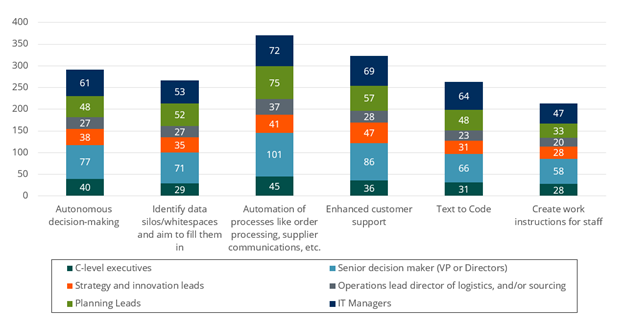
*490 respondents
Robotics and Material Handling Automation
ABI Research’s survey results show that 77% of supply chains are considering, are in the Proof-of-Concept (PoC) stage, or beginning their implementation of mobile automation. This includes Autonomous Mobile Robots (AMRs), Automated Guided Vehicles (AGVs), and similar technologies.
Enthusiasm for fixed automation (e.g., Automated Storage and Retrieval Systems (ASRSs), robotic picking arms, etc.) is equally evident. Our findings reflect the urgent need to overcome persistent labor shortages across the supply chain & logistics sector.
Warehouse automation has historically been concentrated among large enterprises with the financial capacity to support it. However, technology vendors have worked hard toward democratizing their solutions. Modularity and scalability have given way to more affordable automation technologies.
Principal Analyst Ryan Wiggin noted that vendors at MODEX 2026 showed clear prioritization of specialized, well-defined solutions over broad platforms. This buyer demand is “we need technologies that deliver clear operational value—not vague promises.”
While large-scale automation has previously been confined to the industry giants, more modular, cost-effective, and scalable solutions have opened warehouse automation to more of the middle market (500-9,999 employees).
Ryan Wiggin, Principal Analyst ABI Research

Retailers, distributors, and Third-Party Logistics (3PL) providers that adopt robotics and material handling automation solutions can alleviate skills gaps through forward-looking use cases:
Mobile robots
- Moving goods between storage areas, picking zones, and packing stations
- Replenishing inventory by bringing stock from the backroom or reserve storage to the frontline workers
- Supporting sortation by carrying items to the correct outbound area
- Reducing manual travel time in warehouses and fulfillment centers
- Handling repetitive internal transport tasks in manufacturing sites
Robot picking arms
- Picking individual items for e-commerce and order fulfillment
- Sorting products by size, type, destination, or order
- Placing items into bins, totes, cartons, or pallets
Material handling automation System Integrators (SIs) tell ABI Research they are experiencing 10% to 20% annual revenue growth. The biggest customers come from retail, food & beverage, and 3PL. Automation projects are scaling rapidly despite industry turbulence (tariffs, economic uncertainty, etc.). That’s how disruptive workforce shortcomings are for supply chain leaders right now.
This trend was also evident at MODEX 2026, where buyers showed a clear shift from experimentation to active deployment. Throughout the show, there was a growing focus on practical, high-throughput automation systems, rather than conceptual solutions.
Further value is being achieved with Machine Vision (MV)-enabled cameras. While adoption is still very much in the early stages, the potential is clear: the ability to automatically log Stock Keeping Units (SKUs) and barcodes with little to no human intervention. Fifty-five percent of supply chain leaders tell ABI Research they plan to invest US$100,000 or more in MV over the next 2 years.
Zebra is a key innovator in the MV-enabled supply chain space, as covered in Wiggin’s Insight, Specialization, Not Spectacle, Drives Warehouse Automation Momentum at MODEX 2026. The company’s Aurora Vision Studio leverages MV capabilities to automate palletization, which has been a persistent challenge for logistics teams.
Similar use cases will continue to accelerate in 2026 and beyond as supply chain labor shortages impact bottom lines.
AI-Enabled Video Solutions
The third technology pillar for building supply chain resilience is AI-powered dashcams and telematics. According to Verizon Connect’s 2025 Fleet Technology Trends Report, 43% of enterprises say increased regulation is their biggest challenge, up from 5% the previous year.
Unsafe driving can result in downtime, lawsuits, and serious risks to human life. Regulatory requirements are only tightening, necessitating intelligent solutions that enable supply chains to take a proactive approach toward driver safety.
Enterprises should consider adopting AI-powered video systems that fuse computer vision, Machine Learning (ML), and multi-sensor data in one system. Supply chains can achieve the following business outcomes:
- Real-Time Behavioral Detection: Identification of fatigue, distraction, tailgating, and unsafe maneuvers.
- In-Cab Alerts and Coaching: Immediate feedback loops that correct behavior before incidents occur.
- Multimodal Data Fusion: Integration of video, telematics, and GPS data for contextual awareness.
- Extended Visibility: Dual-facing and near-360° camera systems that improve situational awareness.
- Regulatory Compliance: Ensure adherence to Hours-of-Service (HoS) requirements.
- Incident Exoneration: Near real-time video feeds can prove if a driver was not at fault in an accident, reducing financial penalties (e.g., increased insurance premiums).
To illustrate how AI-powered dashcams work in the real world, consider this example: a delivery driver is momentarily distracted by a handheld scanner and begins to drift off the road in a densely populated neighborhood. The dashcam detects the driver’s gaze shift and immediately triggers an audible in-cab alert, helping prevent a collision with a pedestrian.
This split-second correction can avoid a potentially multi-million dollar “nuclear verdict.” It also prevents a fleet vehicle from going out of commission for repairs. In this way, supply chain leaders should not view AI-powered video solutions as solely a compliance tool, but as a means to reduce costs and improve overall safety.
The old way of tackling fleet safety: standalone dashcams used for post-incident review.
The new way: continuous, real-time monitoring of driver behaviors before an incident occurs.
How Enterprises Can Maximize ROI on Their Supply Chain Technology Investments
Building supply chain resilience does not end at technology adoption. Organizational leadership must account for change management and equip downstream teams with working frameworks.
AI and robotics automation come with a lot of red tape. Workers are worried about job security and Information Technology (IT) teams express concerns around data security. Gaps in internal expertise also limit organizations’ ability to fully harness the value of transformative technologies.
ABI Research identifies the following strategic priorities for supply chain decision makers:
- Prioritize data unification to unlock control tower value. In most organizations, data across planning, logistics, and procurement still sits in silos. Unifying that data is what makes a control tower more actionable. Supply chains need to stitch together a digital thread to consolidate disparate data into a single dashboard for easy access, contextualization, and automation.
- Establish governance frameworks early to build trust in AI decisions. Define clear AI guardrails, escalation paths, and human-in-the-loop processes from the outset. Without clear guardrails, teams will hesitate to trust AI recommendations, especially in volatile conditions.
- Partner with SIs for smooth automation rollouts. ABI Research projects that organizations will spend US$137 billion annually on SIs for material handling automation by 2032. SIs offer specialist expertise in designing, programming, and installing robotics across the logistics sector. Look for innovative SIs that offer customized solutions with easy-to-use interfaces.
- Start with targeted video AI pilot programs before scaling. Begin with a representative subset of drivers to test impact, validate system integrations, and measure improvements in safety and operations. Early results make it easier to justify a broader rollout and secure internal support.
Global supply chains are inherently vulnerable to outside forces. Despite global disruptions in 2026, customers still expect their goods to be delivered on time. Some surveys even indicate that customer expectations are becoming higher. Maintaining profitability and a trusted brand image will require continuous cross-departmental coordination of digital transformation programs. Contact an ABI Research representative today to discuss how our latest supply chain advisory services can support this technological transition.