Industry leaders, cybersecurity experts, and innovators in digital security will converge again at RSAC, the world’s largest cybersecurity conference, at the end of April. With over 600 exhibitors attending and more than 550 sessions planned, ABI Research has picked out 5 of the top digital security trends to watch out for at RSAC 2025.
Five Digital Security Trends to Look Out for at RSAC 2025
Apr 8, 2025 9:17:39 AM / by Aisling Dawson posted in OT Cybersecurity, Quantum Safe Technologies
6 Game-Changing Highlights from NVIDIA GTC 2025: The Future of AI Computing Unveiled
Apr 4, 2025 3:24:02 PM / by Admin posted in AI & Machine Learning
NVIDIA’s GPU Technology Conference (GTC) 2025 wasn’t just another tech event—it was a bold declaration of where Artificial Intelligence (AI) is headed. With 25,000 in-person attendees and a buzzing virtual crowd of 300,000, there was immense energy and excitement in the air. Jensen Huang’s keynote set the stage, unveiling a vision that swaps traditional computing standards for a new era of AI computational efficiency driven by token generation. ABI Research’s April 2025 recap whitepaper dives deep into these shifts, and we’ve distilled six key highlights that every business leader and tech strategist needs to know.
Building a Cloud Security Strategy: ABI Research's Best Practices
Apr 3, 2025 12:00:00 AM / by Michela Menting posted in Quantum Safe Technologies
Cloud computing is a staple in today’s business environment, enabling companies to leverage Large Language Models (LLMs), store customer data, and scale their tech stack. Developing a robust cloud security strategy has emerged as a key concern. Most enterprises are still sluggish to make the shift to cloud-based ecosystems.
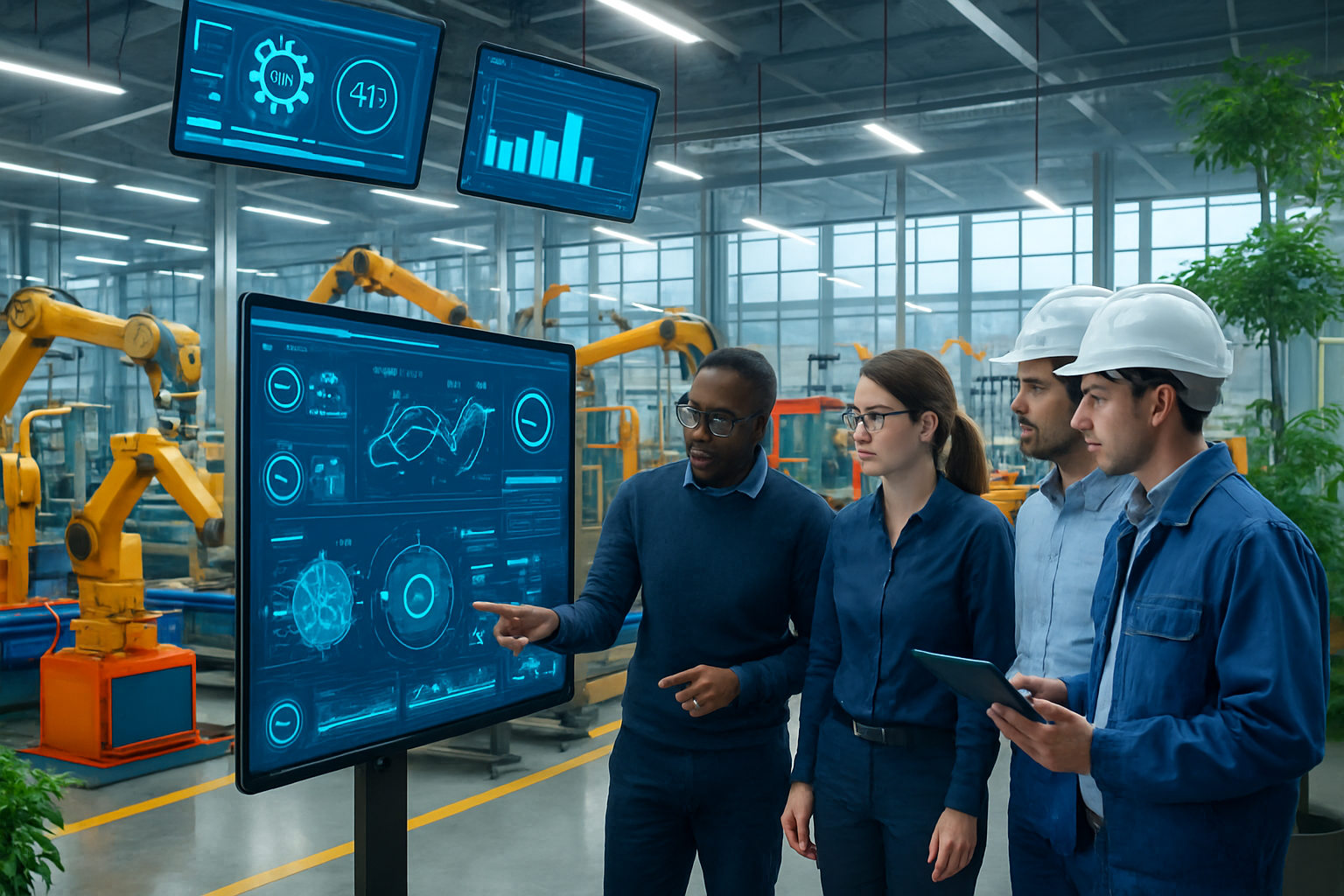
Digitalization in Manufacturing: 6 Revelations from ABI Research’s Latest Survey
Apr 1, 2025 12:00:00 AM / by Admin posted in Industrial & Manufacturing Technologies, Industrial & Manufacturing Markets
Digitalization in manufacturing is redefining operational efficiency and resilience, yet it’s not always so clear how digitally transformed manufacturers are. To get a better understanding of how technologically advanced manufacturers are, to date, ABI Research conducted the second edition of its Manufacturers’ Technology Adoption & Attitudes Survey, published in March 2025. It draws insights from 458 decision-makers across the United States, Germany, and Malaysia. The six revelations shared in this blog highlight key trends and challenges shaping manufacturing digitalization, offering strategic guidance for industry leaders and technology vendors.
Top 7 Most Innovative Data Center Cooling Companies from ABI Research’s Latest Study
Mar 27, 2025 7:49:10 AM / by Rithika Thomas posted in Hybrid Cloud & 5G Markets, Smart Buildings, Cloud, Data Centers
Data centers are the backbone of our digital age, but increasing compute demands from Artificial Intelligence (AI) and high-density racks make cooling a critical challenge. For example, data centers are forecast to double their annual energy consumption by 2030. ABI Research’s latest study ranks the top data center cooling companies, identifying leaders in delivering the best cooling systems with innovative thermal management solutions. From liquid cooling to digital oversight, these firms have demonstrated superior heat mitigation capabilities for data center operators around the world.
Table 1: Comparing the Top Data Center Cooling Companies
| Company Name |
Score (out of 100) |
Standout Features |
Strengths |
Best For (Who Would Be Interested?) |
| Vertiv |
81.1 |
Liebert range with free cooling, Vertiv 360AI, digital twin BMS integration, CoolTera acquisition, circular economy strategy |
Broad cooling portfolio (air + liquid), AI-ready with NVIDIA/Intel, ESG leadership, localized supply chain, strong onboarding, robust diagnostics and service |
Hyperscalers and colocation providers seeking full-stack, AI-optimized, sustainable cooling and integrated monitoring |
| Johnson Controls |
79.8 |
YORK chillers, Silent-Aire hyperscale cooling, OpenBlue software, Global DC Solutions org |
Long HVAC legacy, integrated services from design to maintenance, emission reduction ahead of target, strong retrofit and flexibility offerings |
Operators seeking mature, scalable solutions for multi-site operations with a focus on energy efficiency and lifecycle value |
| Schneider Electric |
74.1 |
EcoStruxure + DCIM 3.0, Motivair acquisition, modular builds, NVIDIA + NTT partnerships |
Cooling-agnostic and modular, liquid cooling for HPC, strong global footprint, software integration, strong edge and AI partnerships |
Enterprises or edge facilities prioritizing flexible deployment, global support, and AI-readiness |
| Daikin |
73.3 |
CRAH units, AHRI-standard chillers, Daikin on Site monitoring, L∞P circular economy program |
Strong air cooling, real-time monitoring, reclaimed refrigerant leadership, U.S. manufacturing expansion |
Data centers favoring standard-compliant air cooling with strong monitoring and circular economy capabilities |
| Trane |
71.1 |
TRACE®, myPLV®, myCO2e™ software tools, LiquidStack immersion cooling, Autodesk partnership |
High-efficiency HVAC, predictive software tools, circular service program, design-optimized solutions for engineers |
Facility managers and engineers focused on simulation-led design, performance optimization, and circular maintenance |
| Danfoss |
68.3 |
End-to-end cooling incl. direct-to-chip, Leanheat software, heat reuse, Net Zero Innovation Hub partnerships |
Proven PUE improvements, long-standing liquid cooling R&D, strong in North America + EU, small footprint modular products, IBM/HPE/Siemens collaborations |
Operators seeking liquid cooling innovations, heat reuse, and small-footprint efficiency |
Recent Research on Data Center Cooling
AI Meets Robotics: Why Closed-Loop Frameworks Are Key to Next-Gen Automation
Mar 25, 2025 12:44:56 PM / by Ryan Martin posted in Industrial & Manufacturing Technologies, AI & Machine Learning, Collaborative & Commercial Robotics
Robotics has become a staple of the manufacturing sector, essential for maximizing productivity, ensuring quality, and reducing labor costs. As valuable as robotics are, many solutions fall short of the time-to-impact metric that manufacturers seek. Enter Artificial Intelligence (AI)-based, closed-loop automation.
Mobile World Congress 2025 (MWC25): Four Ways the Telco Value Chain Is Supporting Compute-Driven Applications
Mar 21, 2025 12:55:29 PM / by Admin posted in 5G and Tech, Hybrid Cloud & 5G Markets, 5G, Southeast Asia Digital Transformation, 5G Devices, IoT Hardware, AI & Machine Learning
The telecoms industry has hit an inflection point, with a newfound focus on computing-centric applications. This marks the era where communications alone is no longer enough for telcos to drive the revenue growth they seek. At Mobile World Congress 2025 (MWC25), ABI Research analysts observed this transformation unfolding across the exhibition floor. As the event highlighted Artificial Intelligence (AI), edge computing, and data-driven solutions over conventional hardware, the telco value chain emerged as a key area of change. Here are five compelling examples from MWC25, each revealing a piece of this industry-wide pivot.
Cloud AI Chipset Market Overview 2025: Size, Trends, and Forecasts
Mar 20, 2025 10:15:42 AM / by Paul Schell posted in AI & Machine Learning
Key Takeaways:
- Cloud AI chipset revenue is surging. The market will grow 65% in 2025 to reach $63.6 billion and is expected to hit $137 billion by 2031, nearly quadrupling in size from 2024.
- Generative AI is the main growth driver. The rise of Gen AI, cloud computing, and AI-optimized silicon is fueling record demand for powerful chipsets that can train and run large AI models.
- GPUs lead the market. Graphics Processing Units remain the top choice for cloud AI workloads, while ASICs are gaining traction and CPUs are growing more slowly.
- Energy use and scalability are key challenges. Power constraints and data center bottlenecks are pushing the industry toward greener designs, hybrid setups, and edge computing.
- Hybrid and multi-cloud strategies are essential. Businesses should invest in flexible cloud infrastructures and monitor fast-moving AI chipset innovations to stay competitive.
According to the latest forecast from ABI Research, the cloud AI chipset market size is set to grow 65% in 2025, reaching US$63.6 billion. Growing at a 21% Compound Annual Growth Rate (CAGR) between 2024 and 2031, the market is projected to reach US$137 billion by 2031. This translates to a nearly quadrupling of the market size compared to 2024,
The market is expanding rapidly, driven by advancements in Generative Artificial Intelligence (Gen AI), cloud computing, and AI-optimized silicon chipsets. Businesses and organizations are increasingly leveraging cloud AI to train complex Large Language Models (LLMs), run new applications, and integrate Machine Learning (ML) capabilities into their operations.
Top Industries/Applications Driving 5G Market Growth from 2025 to 2030
Mar 18, 2025 4:00:00 AM / by Shadine Taufik
The 5G market is poised for significant expansion, presenting telco operators with clear opportunities for revenue growth. Enterprises within industries like manufacturing and healthcare are seeing private 5G deployments rapidly catch up to 4G/Long Term Evolution (LTE) deployments as they require advanced cellular capabilities to facilitate mission- and safety-critical applications. Developments such as these will increase the Total Addressable Market (TAM) for 5G services from US$2.7 billion in 2025 to US$29 billion by 2030, representing a Compound Annual Growth Rate (CAGR) of 61%. That is according to ABI Research’s Private Cellular Network Forecasts, which was published in 1Q 2025.
RF Energy Harvesting in the IoT: Comparing Powercast, Wiliot, and Ossia
Mar 13, 2025 11:57:21 AM / by Jonathan Budd posted in IoT Hardware
Wireless energy harvesting is rapidly gaining traction in the Internet of Things (IoT) industry as companies look for alternatives to traditional batteries and wired power. While there are several ways to enable energy harvesting, Radio Frequency (RF) harvesting has emerged as a transformative method.