
AI takes center stage as a deployable platform, rather than a future promise, with practical implementations emerging across automotive, robotics, consumer devices, and connectivity. CES 2026 highlighted how intelligence, autonomy, and reliable wireless infrastructure are converging to enable real-world scale.
ABI Research analysts were on the ground at the Consumer Electronics Show (CES) 2026 in Las Vegas, where Artificial Intelligence (AI) dominated product launches, keynotes, and conversations across the show floor. From autonomous driving to humanoid robotics, from personal AI agents to industrial Internet of Things (IoT), the event made it clear that AI is now central to product strategy and platform differentiation.
This recap features insights from ABI Research analysts who attended CES 2026. Their standout observations shed light on how AI is being implemented, tested, and scaled across multiple technology domains.
Key Takeaways:
- AI has moved from concept to execution across industries. CES 2026 showed that AI is no longer experimental. Vendors are actively deploying AI in vehicles, robots, devices, and infrastructure with clear commercial intent.
- Agentic AI is becoming core to the in-vehicle experience. Automotive demos focused on practical use cases like navigation, digital cockpits, and infotainment. In these applications, transparency and contextual reasoning improve real-world usability.
- Robotics and Physical AI are accelerating rapidly. Humanoid robots, especially from Chinese vendors, demonstrated higher autonomy and maturity. New edge-focused AI chipsets from major semiconductor players are playing a key role.
- Personal AI is reshaping consumer ecosystems. Device vendors are converging data from PCs, wearables, and smart devices into unified AI agents, with Neural Processing Unit (NPU) performance emerging as a key differentiator.
- Connectivity is a critical enabler of AI performance. Advances in Wi-Fi, Ultra-Wideband (UWB), sub-GHz, and Extended Reality (XR) connectivity underscore that reliable, low-latency networks are essential for scaling AI-driven experiences.

Agentic AI in Automotive: From Concept to Execution
Jennie Baker, Research Analyst, highlighted that automotive AI was no longer about novel ideas, but about practical deployment. “The automotive content felt cohesive, with many of the dominant themes closely aligning with topics already shaping industry discourse. There was significant overlap across briefings and demos around Agentic AI, spatial awareness, and contextual understanding.”
According to Baker, “Navigation and digital cockpit experiences stood out as the most mature and intuitive applications of Agentic AI, particularly where systems could reason through multi-constraint requests involving arrival time, charging, and user preferences.”
She noted that while many of these capabilities may seem familiar in theory, they are becoming essential for real-world usability. “These features are exceptionally meaningful in practice, especially as drivers increasingly want transparency into why routes or recommendations are chosen.”
On the infotainment front, Baker saw a shift toward new interaction paradigms. “AI-driven infotainment experiences felt more visibly differentiated, with demos showcasing new interaction models around audio, mood-based controls, and multiscreen orchestration.” What felt new, she explained, was not just what these systems could do, but how naturally users could engage with them.
James Hodgson, Research Director, provided a broader context around the automotive supply chain’s goals for the show. “The supply chain had two objectives for CES 2026. First, to consolidate the many long-running trends of Software-Defined Vehicles (SDVs), immersive infotainment, contextual AI assistance, and autonomous driving by demonstrating how these trends will make the jump from perennial CES demo to commercial reality at scale. Second, to demonstrate their ability to expand into parallel markets for continued future growth.”
He pointed to NVIDIA’s unveiling of the Alpamayo 1 model as a milestone. “NVIDIA CEO Jensen Huang unveiled the Alpamayo 1, a chain-of-thought reasoning Vision Language Action model, alongside a broader architecture that will combine the end-to-end AI approaches with a more classical AV stack.”
Mobileye also pushed the envelope, Hodgson added. “Mobileye CEO Amnon Shashua outlined how Vision-Language-Semantic-Action models could hold the key to removing the need for teleoperators in robotaxi operations.” These launches, he explained, are signaling a shift toward unsupervised driving applications with commercial implications.
Robotics Pushes Forward with Physical AI
George Chowdhury, Senior Analyst, described CES 2026 as “a major acceleration from the previous year” in robotics. “Humanoids and Physical AI were the primary themes with a host of product launches and exhibition halls replete with humanoids dancing and pick-and-place demos.”
Chowdhury was particularly struck by the evolution in Chinese robotics companies. “The demos from Chinese humanoid vendors were highly complex. Many successfully performed dexterous manipulation, seemingly fully autonomously without teleoperation.”
He also pointed out the professionalism behind the presentations. “Exhibition booths were well staffed with helpful sales and marketing people, further indicating maturity and an eagerness to achieve uptake in Western markets.”
Vendors like Unitree, Deep Robotics, Engine AI, and Galaxea Dynamics were active, and Chowdhury said the AI performance was evident. “Engine AI demonstrated live, complex robot dancing, and Unitree showcased a boxing demo, even allowing members of the media to go three rounds with a humanoid.”
Semiconductor companies are responding to this momentum. “Semiconductor vendors appeared to have awoken to the market potential of robotics and Physical AI more broadly.” Qualcomm’s Dragonwing SoC and NVIDIA’s software updates were among the highlights. “Qualcomm launched the Dragonwing System-on-Chip designed specifically for Physical AI edge compute, with a strong focus on humanoid robots and multiple live demos.”
NVIDIA's dominance was reinforced through new tools like GR00T, Cosmos, and OSMO, while Intel and AMD introduced new AI-specific SoCs. Chowdhury concluded that these developments show “increasing competition to NVIDIA's hardware dominance, particularly around energy efficiency and edge inference performance.”
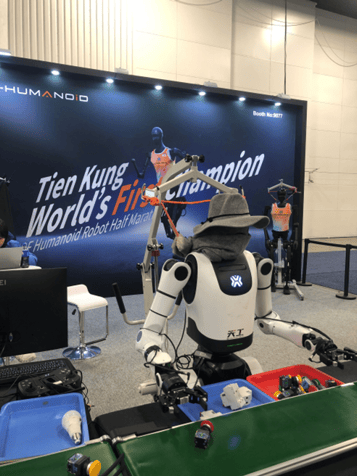
Humanoids and Physical AI were front and center.
Credit: ABI Research
Consumer AI: The Rise of Personal Intelligence
Ben Chan, Industry Analyst, observed that “CES 2026 was all-in on Personal AI within consumer device ecosystems.” His commentary pointed to a deeper industry pivot. “Almost all the major device vendors at CES were showcasing their conceptual approach to integrating multiple data points from smartphones, laptops, smartwatches, and AR-enabled smart glasses into a centralized AI agent for daily living.”
According to Chan, hardware was finally catching up to the AI trend. “There was much anticipation about announcements from major chipmakers like Qualcomm and Intel about chipsets that would enable the next generation of AI Personal Computers.” Qualcomm leaned into “AI-first” messaging with its Snapdragon X2 Plus, while Intel positioned its Core Ultra Series 3 around x86 compatibility.
The metric to watch, Chan explained, is NPU performance. “AI capabilities are increasingly being judged by Neural Processing Unit (NPU) performance as the main way to differentiate PCs.”
Lenovo’s Qira agent, launched at the show, represented a step toward a unified hybrid AI experience. Chan noted that Project Maxwell was especially interesting: “an AI perceptive companion that can exist in the form of a pendant or smart glasses.”
Chan also observed a “staggering number of smart devices outside of smartphones” entering the ecosystem. The expansion into ambient sensing, UWB integrations, and perceptive wearables shows how hybrid AI is shaping personal technology.
Rugged Intelligence in IoT
Dan Shey, VP of Enabling Platforms, remarked that CES 2026 “was smaller in attendance, which made it more manageable and facilitated better conversations.” Importantly, he noticed an uptick in younger and smaller companies showcasing serious innovation powered by AI.
Shey emphasized the role of AI in transforming IoT devices into standalone decision makers. He cited MountAln’s remote monitoring solution as a prime example. “What makes its solution impressive is that it combines several of the newest technologies to address a real-world need,” from thermal cameras to solar power and satellite communications.
He added, “AI provides the detection capability for the various visual events specified by the customers,” and also “monitors battery levels and connectivity capabilities to determine how much data should be sent for alerts and alert assessment.” This level of layered intelligence enables longer device life and real-time responsiveness.
Algorized was another standout tech company at CES. “It is leveraging existing technologies, but through the power of AI to improve and enable perception capabilities for human-machine coexistence,” including the detection of human state and activity via radio signals.
Wireless Connectivity Anchors AI Performance
Andrew Zignani, Senior Research Director, described this year’s CES as an evolution of past themes. “There was continued evolution in consumer robotics, the AI smart home, smart appliances, XR glasses, wearables, and healthcare devices.”
Zignani observed that AI integration with networking was central even to infrastructure announcements. “Wi-Fi 8 featured prominently at the show,” with new chipsets and concept routers from MediaTek, Broadcom, ASUS, and TP-Link. He added that Wi-Fi 8’s enhanced latency, coverage, and reliability would “be tightly coupled with future messaging around AI capabilities and service enablement.”
Sub-GHz was another key area. “The delivery of extended home and neighborhood-level connectivity looks to be a key theme for 2026,” he said, especially as Z-Wave Long Range gains traction.
Zignani also pointed to new UWB use cases. “SPARK Microsystems demonstrated its wireless transceiver in applications such as AI wearables, presence detection, gaming, and HIDs,” while “NXP demonstrated a range of UWB use cases, including wireless battery management systems.”
XR made a strong return, with vendors like XREAL showcasing multi-device, AI-enabled smart glasses. “Ultimately, these announcements reaffirmed that 2026 will be a breakout year for XR glasses across multiple form factors.”
What Comes Next for AI
AI is no longer a fancy feature that technology vendors can leverage for marketing buzz. Instead, AI is becoming the core platform for driving differentiation across sectors. CES 2026 confirmed that tech companies are moving beyond vision to viable AI deployment. As Jennie Baker observed, this was not a show about future promises, but about present capabilities. "The focus of the event felt less about novelty and more about how existing concepts are being applied in practice."
As enterprises look to scale and standardize AI, ABI Research will continue to provide the guidance needed to make informed, future-proof decisions. Download our full CES 2026 Whitepaper to explore these insights in greater depth.
 Michela Menting