
Author: Mark Lydon, Senior Content Marketing Manager
“Those who succeed will propel the Internet forward as a marketplace of ideas, experiences, and products-a marketplace of content.” Thirty years later, Bill Gates’ 1996 “Content is King” essay feels more relevant than ever in today’s AEO-driven marketing landscape.
Key Insights
- AEO strategies require publishing B2B content that AI cannot confidently generate on its own. The strongest visibility gains come from expert answers, proprietary data, and a first-hand market perspective.
- Generic SEO content is losing value as zero-click search grows. B2B marketers need to target narrow, high-intent questions that require evidence, judgment, or real-world experience.
- AI search visibility is shaped well beyond your own website. Third-party mentions, expert bylines, customer validation, and consistent brand signals across trusted domains all influence whether answer engines surface your content.
- Content freshness now carries more weight in AI search. Teams that regularly update strong legacy pages with new data, FAQs, tables, and expert commentary are more likely to stay visible.
- The most effective AEO programs are built around repeatable inputs. B2B sales questions, webinar Q&As, SME insight, and original research give marketing teams a steady stream of content that answer engines can cite.
Content is king. You’ve been hearing this line at least since that Intro to Marketing course you took as an undergrad.
For a while, the logic was simple: write Search Engine Optimization (SEO)-friendly blogs to drive web traffic. Once users visit your site, you offer downloadable assets, such as whitepapers and guides, to generate leads. A personalized drip campaign for a few months, and off to your sales team to complete the conversion.
Then Artificial Intelligence (AI) search came along, putting a wrench in this once-reliable marketing strategy. Business-to-Business (B2B) buyers now get many of their questions answered without ever clicking a link (zero-click).
Back to the drawing board.
B2B marketing teams must now focus on Answer Engine Optimization (AEO) to get seen by buyers. This shift to AI search began in 2024, became more pronounced in 2025, and has now completely redefined which B2B content wears the king’s crown in 2026.
HubSpot originally coined the term “inbound marketing” more than a decade ago. Much of the strategy followed the traditional SEO, keyword-centric approach. Even it has evolved beyond this marketing methodology, recently rebranding its annual Inbound event to Unbound. SEO remains a core priority, but competitive differentiation is increasingly emerging through AI search (also known as AEO).
AEO is still very much in its Wild West phase. My email inbox is flooded with new webinar invitations, survey requests, and thought leadership articles every week. Agencies are licking their chops, recognizing a trendy topic they can capitalize on. But the truth is, nobody has all the certainties right now. In fact, I’ve heard so-called “industry experts” completely contradict each other’s findings on more than one occasion.
Several data-backed studies show a correlation between specific content marketing tactics and increased AI-driven traffic. Some tactics generate significant results, while others not so much. To cut through all the noise, we share the methods that work best for AEO strategies in 2026.
Using the following tactics, we increased our AI referral traffic (ChatGPT, Perplexity, Gemini, Claude, and Copilot) by 93% over the last 10 months. And that doesn’t even count traffic from AI Overviews, which we are currently cited in 765 search results, according to Semrush data.
Table of Contents:
Our Experience with AEO and AI Search
Third-Party Validation and Mentions
How to Identify Questions to Answer for AEO
Our Experience with AEO and AI Search
Like nearly every company out there, our organic traffic took a noticeable dip in the first half of 2025. Between several Google algorithm updates and the rise of AI search tools, B2B buyers increasingly get the information they need without visiting a vendor's website. Naturally, our Click-Through Rates (CTRs) were down. While ABI Research isn’t necessarily a technology vendor, our content focuses on the same topics that technology vendors cover.
This was an eye-opening reality check for our marketing team. We needed to start optimizing content for AEO. This means providing answers that AI cannot replicate.
Our traditional SEO strategy mostly focused on high-level informational queries. Securing a first-page Google ranking (Search Engine Results Page (SERP)) for keywords such as “top technology trends” would be a major driver of traffic for us (and leads!).
Soon enough, AI search tools ate up all this would-be traffic volume. So, we began implementing new techniques to expand our visibility to Large Language Models (LLMs). While not an exhaustive list, key pillars of our AEO strategy included:
- Writing more Q&A formatted articles, with answers provided by our technology experts
- Adding Frequently Asked Questions (FAQs) on pages to be featured in rich snippets
- Expanding our brand visibility across trusted third-party domains
- Ensuring a detailed author byline is included in technical content pieces
- Doubling down on our original research and data-driven storylines
- Updating high-performing pages with fresh perspectives
- Inserting JSON schema markup for each blog (Article schema, FAQ schema, etc.)
It didn’t take long to see the results. Between June 2025 and September 2025, our AI referral traffic (excluding Google AI Overviews and AI Mode) increased rapidly by 70%.
That was all accomplished by a small team in just 4 months of AEO. We were back in full swing, and our search volume has only continued to increase through the first quarter of 2026. We’ve seen some seasonal fluctuations, but overall, our AI search visibility for technology-focused queries is light-years from what it was before we implemented our AEO best practices.
ABI Research AI Referral Traffic, June 2025 to March 2026 (Excluding Google AI Overviews and AI Mode)
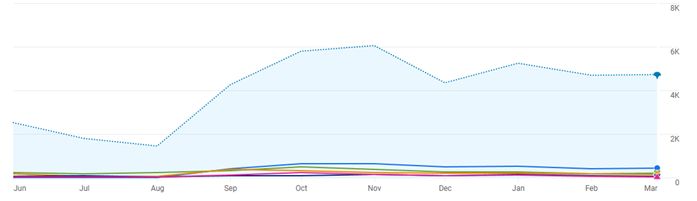
It’s important to point out that the data above don’t include Google AI Overviews or AI Mode, which are categorized as organic. It’s tricky to find accurate source data for these platforms in Google Analytics.
But we can draw inferences from our overall organic traffic from Google, Bing, Yahoo, DuckDuckGo, and Chinese search engine Baidu. We recorded a 126% surge between June 2025 and March 2026. So, in many ways, what works well with AEO also works well for traditional SEO strategies.
ABI Research Organic Traffic, June 2025 to March 2026
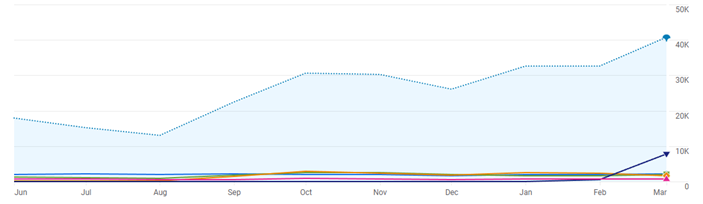
AI-driven visitors also tend to be higher-quality website users, according to our own analyses. They are less likely to bounce compared to non-AI sources and dwell on our site longer. In other words, these are highly engaged buyers you can’t afford to miss out on in the sales funnel.
AI search platforms generated about 1% of global web traffic as of December 2025. That number is hovering around 4% for our site. It’s likely even higher than that when factoring in AI Overviews and AI Mode. We expect that proportion to continue to increase as more B2B buyers turn to LLMs for their most urgent questions.
To replicate our results, marketing leaders should incorporate the following AEO tactics.
Q&As and FAQs
To optimize content for AEO, marketing teams must understand how B2B buyers use ChatGPT, Perplexity, and other AI search engines. They are asking very specific questions about your technologies and markets. In many cases, they have follow-up questions, too.
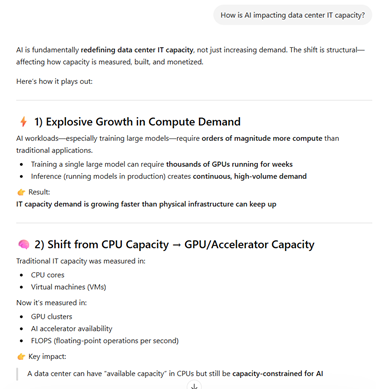
LLMs prioritize direct answers because they are easily parsable. Therefore, Q&A blogs work well for AEO-driven traffic. You shouldn’t be answering generic questions like “How is AI impacting data center IT capacity?” LLM-based search platforms generally omit citations for basic questions of this kind, because they are viewed as general knowledge rather than information that demands expert input.
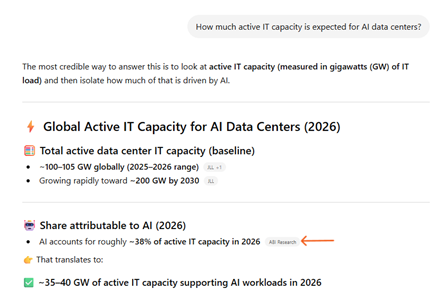
A more AEO-aligned question would be “How much active IT capacity is expected for AI data centers?” Answering this highly specific question requires quantitative data that AI search tools cannot replicate. Therefore, it cites trusted domains that provide the answer with evidence.
The ChatGPT results below demonstrate what I’m talking about.
Generic technical question with no citations:
Now here’s an answer engine-optimized question:
Bottom line: Forget about universal questions that LLMs can answer. Focus on niche, long-tail questions that can only be answered through original studies.
Experience-Led Narratives
In the age of AEO and Generative Engine Optimization (GEO), experience-first content is a must. It echoes Bill Gates’ point from 30 years ago: successful brands are those that bring new ideas to the table, shaped by what they have learned in the trenches.
B2B buyers, now more than ever, want content made by humans, for humans—not AI slop. Decision makers have grown tired of reading content that merely regurgitates what’s already out there. As mentioned earlier, your piece should be impossible for AI to produce on its own.
Top-performing marketing leaders utilize Subject Matter Experts (SMEs). They publish digital content that captures the unique experiences of their people on the frontlines. Give your company ambassadors, who reflect your brand’s tacit knowledge, a voice.
Your product development manager can discuss the evolution of your technological niche. Your sales leader could take a deep dive into how your company is aligning with customer behavior. When your SMEs are unavailable or camera-shy, consultants can help fill that gap with their own raw experience. To get more mileage from this tactic, embed expert quotes into articles and press releases.
For example, ABI Research’s analyst team conducts between 2,000 and 3,000 primary interviews per year. They pick the brains of the brightest minds across the technology sector. These first-hand accounts are then translated into business impact, which is precisely what B2B buyers seek today.
Experience-led narratives uncover the nitty-gritty details that make content come to life. While your competitors publish AI-written slop, your company delivers human-led stories. Before long, this tactic will help your brand consistently appear as a top citation on AI search platforms.
Just remember that consistency is key to sustained visibility on the AEO frontier. AI-driven search results are highly dynamic, changing continuously as new viewpoints surface. A short-term approach won’t cut it in 2026.
Don’t Forget About EEAT
There is also the matter of Experience, Expertise, Authority, and Trustworthiness (EEAT). Yes, this is a term coined by Google for traditional SEO. However, it’s just as critical for AEO. Nearly every webinar I’ve observed within the last year included at least one slide on the importance of EEAT for AI search visibility. This is one of the few tips that has actually given us solid results.
Chatbots and B2B buyers alike prefer insights presented by real people with the right expertise. Nobody wants to hear what a freelance writer thinks about the shift to quantum computing. Your SMEs shine here, offering authentic viewpoints that leave a lasting impression.
For B2B marketers, the message is clear: your blogs, videos, and other indexed content should include a detailed byline from genuine thought leaders. For example, all of ABI Research’s content is authored by expert analysts. AI search platforms are far more likely to surface brands that produce content grounded in real-world practice.
Data, Data, Data
Proprietary data are gold for an AEO strategy, given that AI search models only trust verified sources. In a sea of informational content, data-backed answers stand out.
Marketing leaders must share groundbreaking studies that demonstrate credibility in their industry. You can survey B2B buyers, summarize customer usage data, and publish results-driven case studies.
Numbers simplify technical concepts that are challenging to put in layman’s terms. This is why infographics perform so well on LinkedIn and other social media platforms. Data helps buyers associate your products with tangible benefits. Research-based insights also build trust with customers because they demonstrate you know what you’re talking about.
On AI search platforms, buyers are more likely to click the link and learn more about your study after seeing an interesting stat. Your data point is the appetizer, your research is the full-course meal.
If you’re publishing data-driven analyses, ensure machine-readability. We have seen stronger AEO outcomes by summarizing stats and forecasts into HTML tables and charts. AI crawlers have a tougher time processing PNG/JPG screenshots. LLMs, while leveraging Computer Vision (CV) capabilities, are not as confident in extracting complex code.
For good measure, you should summarize your key findings in FAQs at the bottom of the page (this goes for pricing and service pages, too). This structured data makes it much easier for LLMs to parse your URL and identify it as the answer to user questions.
What If You Don’t Have Data?
While the strategic imperative is clear, it’s not so clear how original data can be obtained. Many marketing leaders report fulfilling multiple roles due to staffing shortages and budget constraints. Acquiring and interpreting data requires time and expertise, both of which are elusive. LinkedIn poll results from a limited number of respondents won’t cut it either in the AEO era.
Some marketing teams source data from government databases, third-party surveys, and other external sources. But AI search platforms are smart enough to recognize the original publisher, which means your content is unlikely to be cited. Therefore, marketing teams need data that isn’t widely available.
This is where a market research partner is invaluable. Organizations like ABI Research live and breathe data. We have compiled 59 million (and counting) data points over the years. Our B2B surveys also deliver the customer insights buyers look for on AI platforms. People want to know how their industry peers are adapting to change.
Combined with analyst interpretation, our data fuels content marketing strategies for a number of global technology leaders. Product adoption forecasts, market shares, and vendor rankings all make articles, press releases, videos, and other content reputable in the eyes of AI search engines.
Third-Party Validation and Mentions
AI search platforms judge your brand based on a small portion of your website. A winning AEO strategy ensures a broad presence across the Internet, including third-party publications, forums, review sites, and social media.
LLMs look for an unbiased consensus when evaluating which vendors to prioritize in answers. That means seeing if other entities trust you. Equally important, it means that what you say on your own site must match what you and others say on external platforms.
Obviously, your own site will have plenty of content that places you in a positive light. But marketing teams need to expand beyond that to solidify their thought leadership role. At ABI Research, we began ramping up our guest articles on industry publications such as Via Satellite (for space tech topics), RCR Wireless (for telecom and cloud topics), and similar outlets.
The content we publish on these third-party sites helps train AI models on who we are and where our expertise lies, all while generating high-quality backlinks to our own site. This broader web presence also shows LLMs that other trusted domains consider us a valuable source for user questions.
Beyond third-party content placements, AEO strategists can expand their AI search visibility by getting mentioned across the following disparate sources:
- Customer review sites (e.g., G2 for B2B software)
- Quora
- Reddit (more for Business-to-Consumer (B2C))
- YouTube
- User-Generated Content (UGC)
- Press releases
Achieving a broad, authoritative web presence requires consistency and collaboration. You must regularly boost positive engagement across social platforms, encourage customers to leave reviews, and share your proprietary findings on industry-specific sites. Combined, LLMs can then accurately evaluate brand sentiment.
You have to remember that LLMs essentially mimic human nature. They judge your brand and products the same way B2B buyers do. According to recent survey results, tech buyers prefer insights from independent, expert-led publishers. Unsurprisingly, AI search platforms also prefer such sources when serving up answers. Without these “stamps of approval” from other corners of the web, your brand will be invisible in answer engines.
ABI Research’s vendor assessments align well with answer engine-optimized content. Having published Competitive Rankings well before AEO came along, we have helped shape how AI platforms identify leaders in niche technology markets. While the reports themselves are not indexed, we typically publish an accompanying press release that explains why certain vendors receive high scores. The more recent the results, the more likely your company will be cited in AI-based search queries.
We also frequently write blogs and insights that add further context on various technology brands. Product features, Go-to-Market (GTM) strategies, pricing, and company updates all feed into the AI platforms where B2B buyers seek answers.
Content Refresh
Our final winning AEO tactic is updating already published content. Last year, Ahrefs analyzed nearly 17 million citations across AI assistants. The study found that the URLs cited by AI search tools were 25.7% fresher than the URLs cited by traditional organic SERPs. And when older URLs are cited, they are pushed further down the list of answers on ChatGPT and Perplexity.
This analysis makes it clear that marketers must revisit old pages and incorporate new insights. This doesn’t mean simply adding a sentence or two to a blog and re-publishing it under a more recent date. You need to add depth to your content.
To update existing pages, content teams can:
- Summarize and contextualize fresh data your company has compiled
- Insert machine-readable comparison tables
- Discuss recent and/or newsworthy trends
- Add FAQs at the bottom of the page
- Convert long blocks of text into easily scannable lists
- Incorporate quotes from industry experts
Marketing teams should start by prioritizing traditionally high-performing pages for content refresh. You know, the pages that used to drive significant traffic volume but now have lower visibility. This was actually the very first thing we did in our AEO strategy. Content marketers can use historical Google Analytics data to identify these pages. Or at least identify any dips after July 1, 2024, when Google cut off historical data.
How to Identify Questions to Answer for AEO
AEO is all about answering questions. But if you’re not answering the right questions, what’s the point?
B2B marketers cannot go the “spray-and-pray” route in an AEO strategy. There may be many angles to pursue, but a spray-and-pray approach lacks the precision needed to resonate with buyers. Digital marketing industry leaders focus on the questions that truly matter to B2B decision makers.
The first place to look for potential questions is keyword research tools such as Semrush and AnswerThePublic. Google’s “People Also Ask” feature is another useful source for uncovering popular questions.
These tools get the ball rolling in AEO, but there are limitations. You’ll find that questions are often clearly intended for consumers, not B2B technology buyers. In other cases, questions are very high-level, which can be interpreted as general knowledge (no citations needed in AI search).
Here are other valuable sources for identifying questions to address for AEO:
- Sales Transcripts: Hear it straight from the horse’s mouth. Marketing teams can surface common questions that prospects ask during discovery calls and answer them on their website. These FAQ-style pages not only strengthen AEO outcomes but also save your sales team time by answering high-level questions before a call.
- LinkedIn Groups: Use scraping tools to pull numerous questions being asked in LinkedIn Groups across your industry. Run these questions through AI to identify recurring themes.
- Bing Webmaster: In February 2026, Microsoft introduced Bing’s AI Performance report. This allows you to see which questions and phrases drive B2B buyers to your website. While Bing is not a huge traffic driver, it’s reasonable to think people are asking similar questions on other answer engines.
- Independent Research: Market research firms like ABI Research talk to technology leaders every day—both vendors and buyers. Their most important questions are reflected in subsequent insights, surveys, and syndicated reports.
- Webinar Q&As: At the end of hosted webinars, offer viewers the opportunity to ask questions. The questions they ask there are also being asked in answer engines. The transcripts can be repurposed for FAQs or blogs elsewhere.
These sources enable content teams to build AEO/GEO strategies around the questions that users actively search on AI search engines; there is no guessing game.
Key Takeaways
Always remember that the goal in AEO is to do whatever AI cannot do. The best techniques focus on original research and first-hand insights. B2B content marketers can raise their brand’s voice across AI search platforms within a relatively short time with the following best practices:
- Leverage SMEs for Q&A roundups, trend analysis, and similar indexed content
- Publish original data and research-backed content
- Improve brand visibility across the broader worldwide web
- Aim for more positive customer feedback on G2 and other review sites
- Update existing pages with fresh perspectives
These foundational best practices should form the basis of any AEO strategy. To build on them, B2B marketers should also consider a few additional actions shown to improve visibility across AI-driven search environments:
- Double down on short-form video content. According to Surfer SEO, YouTube is the top-cited domain in AI Overviews. This makes sense, as Google wants to keep users within its own ecosystem. ABI Research’s Snapshot videos featuring SMEs and analysts are one possible avenue to pursue.
- Publish more LinkedIn articles. LinkedIn ranks second in AI citations, per Semrush. Your in-house experts should consistently write thought leadership content here. This overlooked medium is also where millions of B2B buyers are already scrolling through feeds each week.
- Consider AI prompt tracking tools. Marketing/SEO platforms increasingly include AI prompt tracking capabilities. For example, HubSpot launched its beta AEO feature in April 2026. It empowers teams to assess their share of voice across AI search platforms. Be cautious of expensive software with limited capabilities. It is still early, and many platforms are attempting to monetize the AEO shift without delivering meaningful value.
Fuel Your AEO Strategy with ABI Research
The only limitation in an AEO strategy is time and manpower. Consistently publishing new content and updating old pages requires SME interviews, drafts, and in-depth, technical writing. If you’re a marketing leader for a B2B technology firm, ABI Research’s analyst team can fill that gap.
Although we do not offer SEO, AEO, or GEO services, we equip technology organizations with the data-backed, expert-authored insights needed to win in AI search visibility. Our global team undertakes custom content marketing programs that incorporate 5 to 10-year market forecasts, product benchmarks, and experience-led stories that resonate with B2B buyers.
This research can fuel content marketing programs that include blogs, whitepapers, webinars, short-form videos, social media posts, and press releases. Our custom research team can also conduct granular B2B surveys to evaluate buyer sentiment regarding technology challenges, investment priorities, and more.
Clients also gain access to our AI-powered research assistant, Ask ABI. Unlike generic AI tools, Ask ABI is only trained on our proprietary research. Marketers can leverage this tool to surface the most important data points, analyst viewpoints, and technology trends in seconds.
If your team needs to fuel its AEO strategy with research, reach out to a member of our team today.
Or learn more about our content marketing solutions at the following links:
Frequently Asked Questions
What is Answer Engine Optimization (AEO)?
Answer Engine Optimization (AEO) is the process of creating content that helps your business appear in AI-driven search results such as Google AI Overviews, ChatGPT, Perplexity, and other answer engines. It focuses on publishing direct, expert-led, and data-backed answers that AI platforms can easily parse, trust, and cite. For B2B companies, AEO is becoming essential as more buyers research solutions through zero-click and AI-assisted search experiences.
What should be included in an AEO strategy to improve your business website?
An effective AEO strategy should include Q&A-style content, FAQs, expert bylines, proprietary data, schema markup, refreshed high-performing pages, and visibility across trusted third-party websites. Strong AEO programs also rely on original research, experience-led insights, and structured content such as tables, lists, and concise answers that are easy for AI systems to extract. Together, these elements improve your chances of being surfaced in AI search results for high-intent buyer questions.
How do you identify questions to answer for AEO?
To identify questions for AEO, businesses should focus on the specific questions buyers ask during research and purchasing decisions. Useful sources include keyword research tools, Google’s “People Also Ask,” sales call transcripts, webinar Q&As, LinkedIn discussions, AI search performance data, and market research. The best questions for AEO are narrow, high-intent, and require expert insight, first-hand experience, or proprietary data to answer well.