

ABI Research forecasts that more than 32,000 wind farms will be operational globally in 2026. Wind farms are growing both in the number of sites and power capacity. Increasingly, wind farm operators are building Gigawatt (GW)-scale sites that ultimately will go toward increasing the share of clean energy utilized in a country.
Amid this decarbonization shift, regional trends are emerging and wind farm operators face several persistent challenges that inhibit their sustainability impact. A diverse technological marketplace is materializing to accommodate the evolving operational requirements of wind farm operators.
Here are four things to know about wind farm operations in 2026 based on ABI Research’s latest analysis. Technology vendors, energy providers, and investment firms can leverage these insights to help map out their product, implementation, and financial roadmaps.
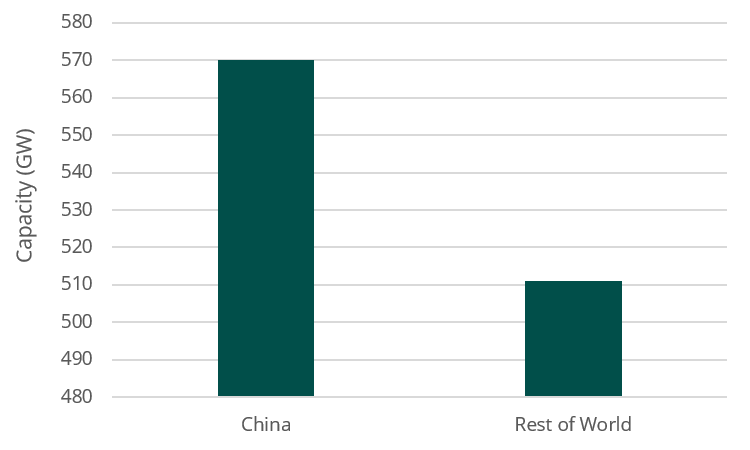
1. Europe controls 69% of total wind farms globally, while China dominates in terms of capacity
According to ABI Research data, Europe operates 21,846 wind farms as of 2026—out of 32,368 worldwide. From a country-level perspective, Germany leads the way with 6,954 wind farms in operation. France and the United Kingdom follow, totaling 1,463 and 817 sites, respectively.
The largest wind farm on the continent will be Markbygden 1101 in Sweden, with up to 4 GW of capacity planned. The currently largest offshore wind farm not only in Europe but globally is Hornsea 2 in the United Kingdom, running 1.3 GW of capacity. The Dogger Bank Wind Farm, also in the United Kingdom, is set to overtake it once its 3.6 GW target is reached.
Chart 1: Number of Wind Farms, Europe Versus Rest of World
(Source: ABI Research)
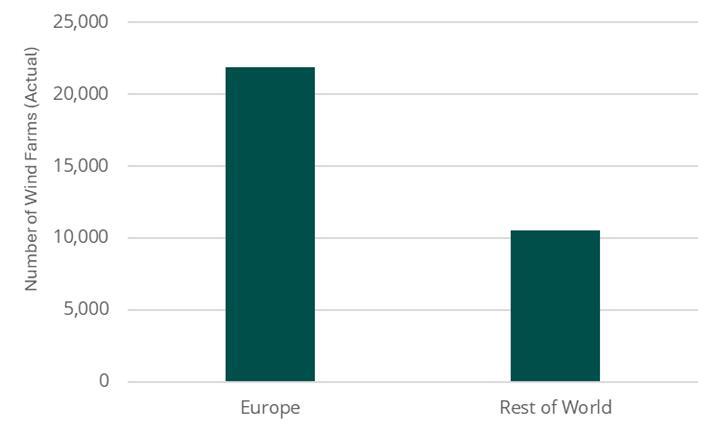
While Europe holds the most wind farms, its total power capacity pales in comparison to China.
Chart 2: Wind Farms Installed Capacity, China Versus Rest of World
(Source: ABI Research)
2. Harsh operating conditions make reliability and uptime an ongoing challenge
Wind turbines are not immune to mechanical failure, despite being built for harsh environments. Components are exposed to wide temperature swings, strong wind gusts, and persistent environmental stressors such as dust, ice, and saltwater. Each of these natural processes can gradually degrade blades, sensors, and other critical systems.
Even with ruggedized hardware in place, maintaining consistent operational uptime remains challenging because wear and tear often builds over time, rather than appearing all at once. For wind operators, this means reliability is less about avoiding all failures and more about detecting equipment issues early enough to prevent costly downtime later.
3. Wind farm operations are shaped as much by logistics and staffing as by turbine design
Operating a wind farm is not just a technical exercise; it is also a significant logistical undertaking. Operators are tasked with transporting blades longer than 100 meters, nacelles weighing up to 130 tons, and towers reaching 170 meters. Maintaining operational continuity requires specialized routes, permits, cranes, and crews, all of which can strain both construction and maintenance work.
Once a site is operational, skilled staff are still essential for interpreting turbine data and carrying out preventive maintenance. Monitoring turbine temperature, vibration, and acoustics is only valuable when the right people and processes are in place. Without them, small issues can quickly escalate into larger failures that cause downtime. Therefore, capturing tribal knowledge and acquiring workers with extensive experience within the energy sector is essential.
4. Sensors, control hardware, and software all play a central role in keeping wind farms productive
Modern wind farm operations rely on a tightly connected mix of sensing, control, and power-management technologies. Sensors tracking vibration, wind, temperature, strain, and acoustics help operators understand turbine condition in real time. Control systems manage pitch, yaw, and power output to protect equipment and optimize performance.
Software is equally important, particularly where operators need to coordinate turbines across a site, manage export levels, or oversee multi-brand fleets. Given wind energy’s intermittent nature, operators must deploy both physical and digital systems that respond dynamically to changing grid requirements.
Notable technology vendors serving wind farm operators are listed below:
Hardware
On the hardware side of things, notable solutions include sensors for pitch control, environment/condition monitoring, wind speed sensors, switchgears, and power converters. Leading technology providers here include Balluf, Hansford, Sentech, Emerson, Phoenix Contact, Siemens Energy, Vector Instruments, ABB SafeWind, Schneider Electric EcoStruxure, GE Vernova, and more.
SCADA
A Supervisory Control and Data Acquisition (SCADA) system serves as the command center of a wind farm, supporting real-time monitoring, predictive maintenance, and remote grid compliance. Solutions from vendors such as ABB, GE Vernova, and Schneider Electric, Bachmann Wind Power SCADA (WPS), and Siemens WinCC OA help operators optimize turbine performance, improve asset reliability, and manage wind farms from a centralized platform.
Software
Wind turbine control software is essential for managing pitch, yaw, and power optimization. These platforms execute the complex algorithms that maximize energy production while protecting turbines from excessive mechanical stress. Solutions from vendors such as ABB, Emerson, Phoenix Contact, and DEIF support functions including tower stabilization, grid integration, wind farm power management, and multi-vendor turbine control through a unified interface.
Get Access to ABI Research’s Smart Energy Market Insights
This research, part of our Smart Energy advisory services, can be used by wind farm operators, hardware and software providers, and investors to identify key trends, technological evolution, and new business growth vectors. To explore our Smart Energy research and discuss the value our clients gain from a subscription, contact us today.
Related Resources:
- 8 Renewable Energy Statistics to Know in 2026
- Seven Trends in the Built Environment That Technology Vendors Need to Know (2025 to 2030)
- Managing Energy Crises Will Be a New Source of Competitive Advantage for Industrial Firms