

Key Insights
- U.S. data center growth has run into a political wall as community opposition turns permitting into the next major bottleneck.
- A Democratic Congress raises the pressure, but the bigger constraint sits at the local level where counties, cities, and regulators can delay or block new projects.
- Projects already under construction are more likely to move forward. New capacity in planning now faces higher costs, tougher scrutiny, and greater risk of delay.
- Providers need to rethink the U.S. as the default build location. Faster paths may come from federal land, self-powered campuses, or allied markets abroad.
The Artificial Intelligence (AI) infrastructure boom has reached a political limit. U.S. data center plans have grown faster than almost any other part of the technology economy, backed by roughly US$730 billion of hyperscaler capital spending this year and about US$1 trillion of NVIDIA chips on order through 2027. That growth has brought large campuses into communities, along with higher power bills, heavy water use, and backup generators. Three in four Americans now say they do not want a data center nearby.
The November 3 midterms turned that unease into votes. Democrats won both chambers of Congress. Candidates promising to pause or restrict data centers won in the states where most new capacity is planned, including Texas with about 27% of the pipeline, and local restrictions passed almost everywhere they were on the ballot.
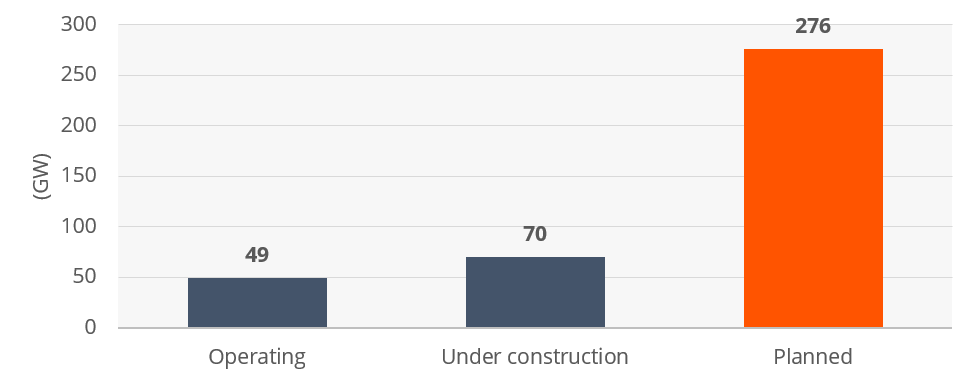
Projects already under construction are better protected, and the national administration will fight to keep them and the wider build-out moving, because AI infrastructure has become an important source of American soft power. Even so, these projects now face intense scrutiny from communities, utilities, and state regulators. Capacity still in planning is more exposed, and some of it may shift toward locations with more predictable permitting, whether elsewhere in the United States or in allied markets abroad.
Chart 1: U.S. Data Center Capacity by Stage (GW), 2026
(Source: ABI Research)
Key assumptions: "Planned" covers announced projects that have not started construction. Inputs: Singularity Research U.S. build-out model.
Permission to Build Is the New Bottleneck
Local resistance had been building all year. By late summer, more than 500 counties and municipalities had restricted or banned data centers, and opposition had blocked or delayed about US$130 billion of projects in the first quarter alone. The objections cut across party lines: electricity bills, water use, generator emissions, and lost farmland. Single votes can stop very large projects, as Trenton, Ohio, showed on election night by blocking a planned 1,000 Megawatt (MW) Amazon campus.
Over the past 2 years the industry’s bottleneck moved from chips to power. ABI Research now expects permission to build to become the tightest constraint of all.
The Grid and the Cost of Waiting
Beneath the politics sits a physical constraint. Data centers account for most of the 224 Gigawatts (GW) of U.S. peak demand growth projected over the next decade, and campuses go live far faster than the transmission that serves them. According to PJM, US$7.3 billion of this year’s extra capacity charges are attributed to data centers, and those charges reach household bills.
Reliability is a second concern. In July 2026, nearly 4 GW of data center load in Virginia dropped off the grid at once, and the Federal Energy Regulatory Commission (FERC) has since ordered mandatory reliability standards that add cost and time to every new site. Delays are expensive because chips lose value from delivery onward, running or not, which makes lenders wary of projects without a signed tenant and a secure site.
Washington Pushes Back, Within Limits
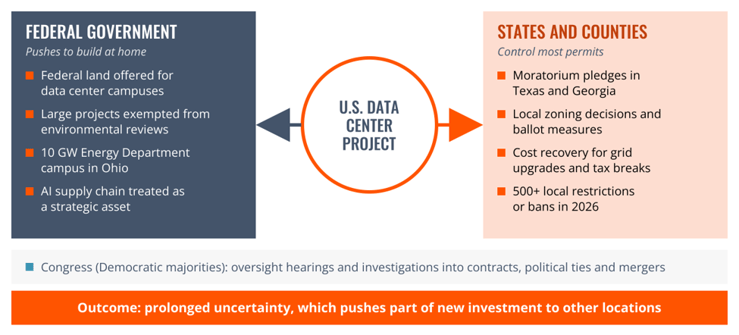
The new Congress raises the political cost further. New laws face a presidential veto, but committee investigations into tech companies’ government ties, contracts, and mergers need no signature. The administration will push the other way, because access to American compute has become an instrument of foreign policy: an executive order makes federal land available and fast-tracks large projects, and the Energy Department is leasing land in Ohio for a 10 GW campus. But counties and cities issue most permits, and the resulting tug of war will push investment elsewhere.
Figure 1: The Federal Government and the States Are Pulling U.S. Data Center Projects in Opposite Directions
(Source: ABI Research)
Our Base Case for the United States
ABI Research expects two outcomes to play out together: 1) cost recovery, with developers paying for the grid upgrades they trigger and losing tax breaks such as Texas’ sales tax exemption on data center electricity, worth more than US$1 billion a year; and 2) targeted pauses in contested states and counties, likely exempting self-powered projects. Broad statewide moratoriums are less likely, but the odds are increasing.
Capacity due in 2026 and 2027 largely arrives, but new starts slow down, costs per megawatt increase, and the build-out consolidates around hyperscalers with cash, contracted demand, and their own power. Leveraged builders without tenants carry the most risk, and a meaningful share of the chips on order will be installed outside the United States.
Where the Capacity Goes Instead
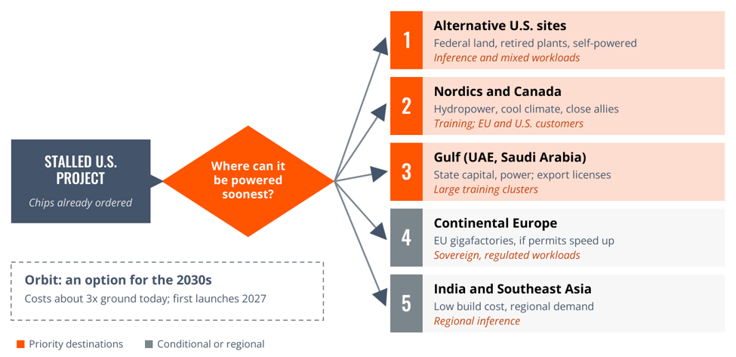
When a U.S. site stalls, the question is where chips can be powered soonest; lower construction and power costs abroad matter far less than time to energization. Export controls also shape the map, favoring allies with projects that fit within U.S. rules. In order of priority:
- Alternative U.S. sites such as federal land, retired power plants, and self-powered campuses, which keep inference close to users.
- The Nordics and Canada, with clean firm power and political stability, though their power surpluses are shrinking.
- The Gulf, the most scalable option for large training clusters, provided export licenses are secured early.
- India and Southeast Asia, mainly as regional markets rather than overflow for U.S. workloads.
Figure 2: Where Capacity Displaced from Contested U.S. Sites Is Likely to Go, in Order of Priority
(Source: ABI Research)
Continental Europe is the wild card. The European Union (EU) plans up to seven AI gigafactories with up to €10 billion of public money, and a proposed law would cap permit decisions at 12 months in acceleration zones. Paired with Nordic hydropower or French nuclear power, that could make Europe the most data center-friendly democracy available, although the law has not yet passed and power prices outside the Nordics remain high.
Orbit, despite Elon Musk’s enthusiasm, remains more expensive than even a long delay on the ground for the rest of this decade.
What Providers Should Do
Providers should stop treating the United States as the default location for new capacity:
- Choose sites communities can accept, such as federal land, retired power plants, and industrial zones.
- Bring their own power, pay for the grid upgrades a project triggers, and offer peak-hour curtailment for faster connections.
- Make binding commitments on water use, generator emissions, and community benefits.
- Engage policy makers early, especially Texas’ legislature ahead of its January 2027 session.
- Build abroad through government partnerships, applying early for export approvals.
- Fund speculative sites with equity and long-term contracts rather than leverage.
The midterms turned community consent into a cost of building AI infrastructure in the United States. If legislatures settle on cost recovery, the slowdown may prove short; if restrictions spread, the build-out of the late 2020s will be far more international than anyone planned a year ago.
For a deeper discussion on how data center infrastructure will evolve, connect with an ABI Research rep.
 Larbi Belkhit