

Energy as a network design constraint
Operators face pressure from both directions. Growing traffic volumes, 5G network densification, and Artificial Intelligence (AI)-driven workloads are increasing network energy requirements, but net-zero commitments and rising electricity prices limit operators' ability to increase energy consumption at the same rate. As a result, sustainability is increasingly being treated as a network design and economics challenge rather than an environmental initiative alone. Around 75% of network energy use occurs in the Radio Access Network (RAN), making it the primary focus of both sustainability initiatives and operating cost reductions.
The key question is how to reduce energy consumption while preserving customer experience and profitability. The answer involves looking at carbon not just from the operator perspective but in the full lifecycle of equipment starting from design and delivery to operation and decommissioning.
Beyond scheduled sleep modes: AI-driven optimization
The existing practice of shutting off carriers during nighttime and the manual optimization of parameters has reached its limits. Schedules are not flexible enough to consider real-time traffic patterns, manual parameter tuning cannot be done for hundreds of thousands of cells, and extreme parameters may affect operators’ Key Performance Indicators (KPIs).
There are three key drivers of the market today: increased hardware efficiency, new and more efficient sleep modes, and traffic prediction powered by AI.
Software-controlled sleep is the most mature solution of the three. Micro Sleep Tx turns off the amplifier and other related hardware when there is a short gap between transmission bursts, while Deep Sleep mode can help reduce energy usage of massive Multiple Input, Multiple Output (mMIMO) radios by up to 70% during idle hours. AI is the next layer. Another vendor’s solution optimizes multiple daily sleep periods at the cell level based on site configuration and traffic patterns, and the vendor says AI adds up to 15% in further savings without compromising performance.
Vendors increasingly package hardware, software, and AI energy optimization under integrated energy-efficiency frameworks. Huawei's "0 Bit, 0 Watt, 0 Loss" initiative is one example, which includes the following commitments:
- 0 Bit, 0 Watt: When there is no data traffic, then the radio consumes no energy. Huawei talks about its super deep dormancy, which lasts throughout the day instead of just at nighttime.
- 0 Loss: Shutdown works in milliseconds, cascading from modules to carriers, channels, and individual symbols, such that the capacity is restored right away.
- Three layers: This technique is based on the use of equipment, sites, and networks. In addition to GigaGreen Plus equipment that guarantees 30% reduction in energy consumption of equipment, the “Ambient Site” layer is responsible for turning on sleeping modules and adjusting antenna angles for hotspots, while a RAN agent creates energy policies using digital twins.
Real-world results
A Deutsche Telekom whole-site modernization project is another example of how much value consolidation brings. Eight bands, namely 700 Megahertz (MHz) up to C-Band, were supported by outdated multi-generation radio and baseband. They were modernized with newer modules, such as a 320-Watt (W) 32 Transmit (T) Active Antenna Unit (AAU) in place of a 240-W unit, higher-power Remote Radio Units (RRUs), and leaner baseband configurations. Daily consumption per site was reduced from 70 Kilowatt-Hours (kWh) to 37 kWh, while energy efficiency on-site increased from 60% to 95%. According to Huawei, the annual gains equal 11,800 kWh, 6.8 tonnes of Carbon Dioxide (CO2) and approximately US$2,600 of Operational Expenditure (OPEX) per site. The key here is AAU’s increased rated output, which means higher capabilities for lower energy consumption.
In the case of Türkiye, there is a grid-solar hybrid project addressing the power-related aspect. Shading caused by towers, buildings, and snow may severely disrupt the performance of a traditional solar string because the worst-performing panel affects all the others. Optimization on the component level increased the output in the case study from 1,290 W to 1,575 W, which is a gain of 22%. Each location produces some 12,000 kWh of green power a year, with renewable energy coverage reaching 70%. This has led to savings of about US$1,200 OPEX and CO2 emissions being reduced by 7.1 tonnes per site, per year.
This is an industry-wide trend. Telefónica Spain was the first operator to trial Radio Deep Sleep Mode, discovering that 5G energy consumption could be optimized by between 8% and 26%, while Micro Sleep Tx trials produced up to a 16% reduction. stc in Saudi Arabia achieved a 15% decrease in RRU power consumption for all Long Term Evolution (LTE) bands by software sleep only.
The above studies highlight that renewables, intelligent management, and modernization complement each other. Hardware sets the efficiency floor, this is then exploited by software and AI, and solar-hybrid power handles what's left.
Sustainability as an aspect of network lifecycle management
Operational efficiency matters, as emissions are mainly produced during the use phase. A lifecycle assessment of one vendor shows that the use phase accounts for 80% to 95% of the total impact of the radio product. However, this does not diminish the importance of other lifecycle phases, as each stage determines how much work the use phase has to do.
Design involves weights and integration. Multi-band radios replace several single-band radios, saving materials and associated Scope 3 emissions. In the manufacturing and supply chain phases, clean energy and logistics are considered, whereby some vendors now report that clean electricity covers almost half of their own consumption, while their largest suppliers have also adopted strict carbon reduction goals. At the logistics stage, Three-Dimensional (3D) packaging simulation has enabled the reduction of carton volume by over 20% while increasing vehicle loading rate by more than 30%. By the end of life, the focus shifts to reduce, reuse, and recycle: modular, upgradeable, and disassemblable equipment and reverse logistics.
Figure 1: Where a network’s carbon sits: share of lifecycle emissions, radio equipment
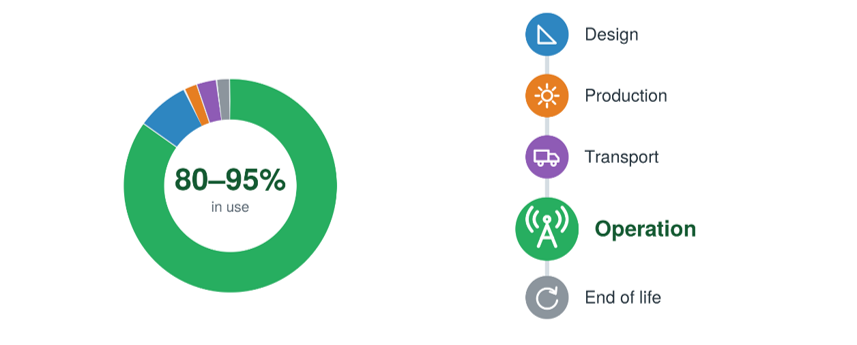
(Source: ABI Research, based on vendor lifecycle analysis)
Reducing the number of components in a network can also lower the materials, transportation, and installation required to deploy it. In rural Nigeria, where grid power is unreliable, there is no existing fiber network, the villages are widely spread out, there is low revenue per user, and networks are small in size, the classic model of using macro cell sites has proven unfeasible. According to one vendor, a specifically designed rural base station commercially deployed in December 2025 saves approximately 85% on site electricity consumption and 70% on equipment quantity when compared with a traditional macro cell site. It also doesn’t require any heavy-lifting machinery for installation, fiber, or microwave backhaul, and reduces the Return on Investment (ROI) from 5 to 10 years for villages between 1,000 and 3,000 inhabitants down to 3 years. Reduced energy usage, less hardware, and easy implementation means that a previously uneconomical endeavor can prove financially feasible.
Networks already have the capabilities needed to lower their energy footprint, and operators are starting to utilize this technology on a large scale. The problem has shifted from one of technological limitations to one of setting metrics, establishing lifecycle assessment frameworks, and encouraging industry-wide adoption. Vendors capable of showcasing reductions that can be measured throughout the whole process cycle are likely to define the future standard for low-carbon networks.
 Dimitris Mavrakis