

NVIDIA CEO Jensen Huang has stated that humanoids could be one of the largest markets ever created. And Elon Musk suggests there will likely be more humanoid robots than there are people by 2040. But what does the future really hold for this embryonic market, according to industry analysts?
Key Insights:
- Humanoid robots have strong long-term potential, but the market is still in its pilot phase and far from mass adoption.
- The clearest near-term split is between enterprise humanoids built for Return on Investment (ROI) in controlled settings and open platform humanoids built for scale, experimentation, and lower-cost access.
- The most likely outcome is commercial and industrial adoption first, with humanoids gaining traction in environments where labor challenges, safety needs, and productivity gains are easier to prove.
- Market success will depend less on hype and more on repeatability, safety, cost, and real-world deployment value. Vendors with strong supply chains, funding, and industrial partnerships are best positioned.
Humanoid robots have captured the hearts and minds of pop culture for decades. From the deadly cybernetic organism starring in James Cameron’s The Terminator (1984) to the emotionally gripping characters we follow in Quantic Dream’s Detroit: Become Human PlayStation game (2018), humanoids are a major driver of technological curiosity.
Thankfully, humanoid robots today are not causing a global apocalypse or truly mimicking human consciousness. However, they are increasingly being deployed into real-world enterprise settings to improve productivity and worker safety. Research indicates that the strongest early potential for humanoids comes from manufacturing, warehousing, retail/hospitality, education, and entertainment. There will be other, albeit smaller, opportunities across healthcare, agriculture, defense, and civil engineering. The home segment is one of the grand prizes, but technological maturity is still needed before we arrive at broad uptake.
The humanoid market is both immature and commercially alluring. Funding is strong, technological capabilities are accelerating, and cost barriers continue to dissipate, helping democratize accessibility. Despite these rosy conditions, there are no guarantees of success in any fledgling market. According to ABI Research assessments, the humanoid market will follow one of three trajectories in the coming years: whole-economy penetration, commercial/industrial capture, or technological stagnation.
Before reviewing our market scenarios, let’s take a look at the two primary product segments that define the market.
Enterprise Humanoids Versus Open Platform Humanoids
ABI Research recognizes two distinct humanoid models on the market: enterprise-grade and open platform.
- Enterprise Humanoids: Commercial solutions built for controlled environments where the overarching goal is to address labor shortages and/or boost overall productivity. These types of humanoids generally provide higher performance, but also sell at higher price points. Leading vendors in this market segment are largely based out of the United States and Europe.
- Open Platform Humanoids: Designed to be accessible, lower-cost solutions enabling more rapid experimentation and developer engagement. For example, the semiconductor Bill of Materials (BOM) for open platform humanoids in 2025 was ~US$1,400 compared to ~US$3,200 for enterprise humanoids. Chinese companies account for 58% of the companies offering open platform humanoids.
Currently, all vendors are battling to demonstrate value: for open platform, this is dictated by consumer demand; for enterprise-grade, this involves successful Proofs of Concept (PoCs) with industrial partners.
Table 1: Humanoid Robot Company Type Comparison
(Source: ABI Research)
|
Category |
Enterprise-Grade Humanoids |
Open Platform Humanoids |
|
Core purpose |
Commercial ROI in controlled environments |
Broad access, experimentation, market seeding |
|
Typical buyers |
Industrial operators, manufacturers, logistics firms |
Developers, universities, labs, consumers |
|
Current use cases |
Pick-and-place, material handling, inspection, assembly |
Research and Development (R&D), education, and entertainment |
|
Product model |
Solution-led; includes integration and support |
Product-led, turnkey, and broadly available |
|
Cost profile |
Higher BOM and Average Selling Prices (ASPs) |
Lower BOM, lower ASP |
|
Market position today |
Low shipments, higher strategic value |
High shipments, less clear long-term value |
|
Key success factor |
Reliability, repeatability, ROI |
Scale, affordability, ecosystem adoption |
|
Leading examples |
Figure, Tesla, Agility Robotics, Apptronik |
Unitree, UBTECH, Booster Robotics |
Three Market Scenarios
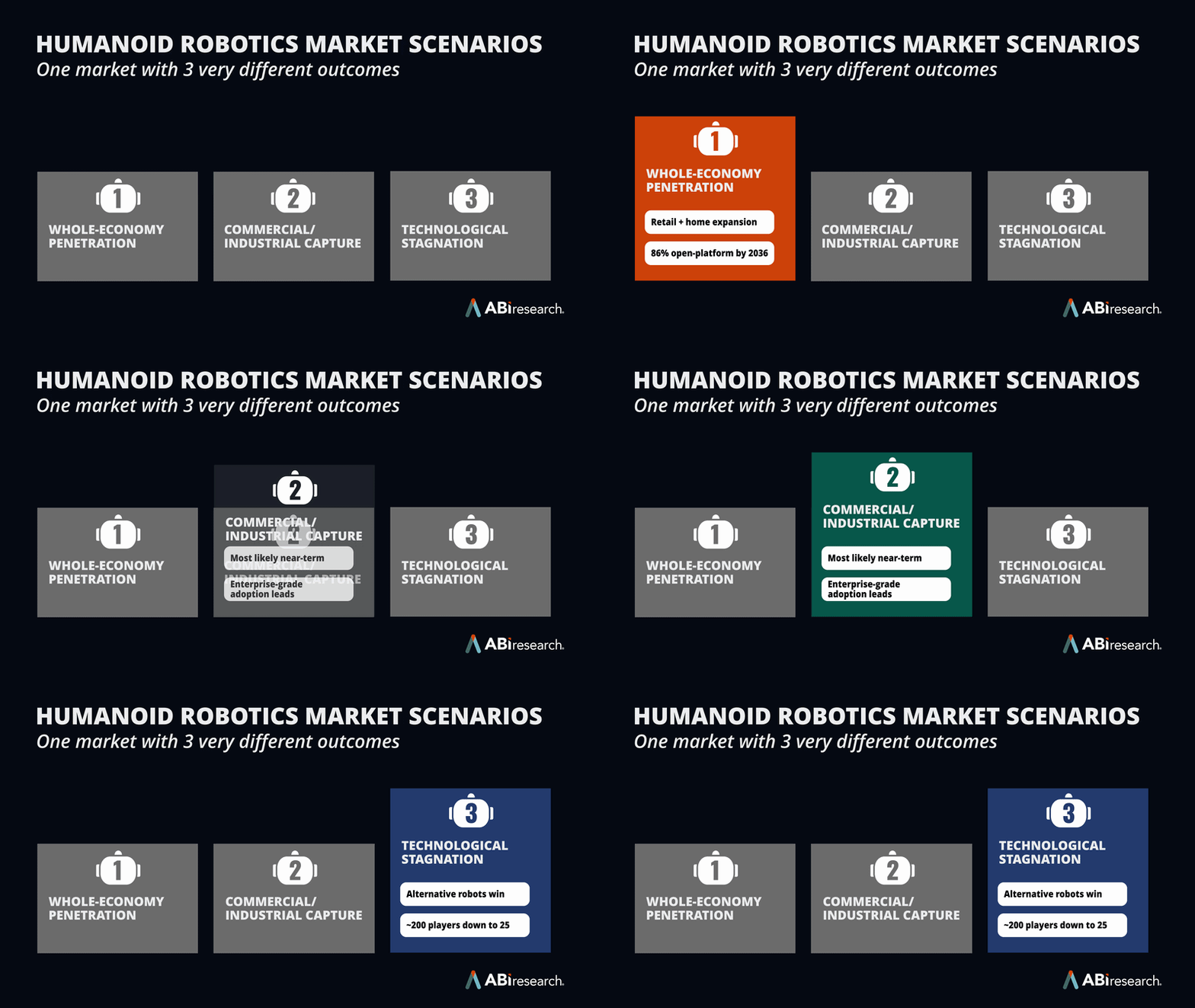
The humanoid market could move in three different directions, shaped by model developments, silicon innovation, supply chain resilience, investor sentiment, and customer appetite.
Scenario 1: Whole-Economy Penetration
- Humanoids expand beyond commercial deployments into retail and home markets.
- Open platform humanoids make up 86% of total shipments by 2036.
- Enterprise-grade humanoids are mostly confined to defense, civil, and industrial sectors.
- The market is driven by Vision-Language-Action (VLA) and world model breakthroughs, accessible edge Systems-on-Chip (SoCs), and manufacturing at scale.
- Tesla is the best positioned in the West due to advantages in production, supply chain verticalization, and brand recognition.
Scenario 2: Commercial/Industrial Capture
- The most likely and grounded scenario to occur in the near future.
- Artificial Intelligence (AI) models fail to alleviate concerns around humanoid deployment costs, generalization, repeatability, and safety.
- The market consolidates, with enterprise-grade adoption taking precedence to address commercial and industrial customer challenges.
- Enterprise-grade humanoid shipment share jumps from 4% in 2025 to 83% in 2036.
- Robotics companies with mature distribution and supplier channels hold a competitive advantage.
- Several Asian open platform vendors, such as UBTECH, ROBOTERA, Kepler Robotics, and Kawada, may turn to partnerships, Mergers and Acquisitions (M&As), and closer industrial alignment to shift to enterprise solutions.
Market Scenario 3: Technological Stagnation
- Robot transform models’ non-deterministic nature undermines humanoid commercial appeal.
- Enterprise decision makers prioritize alternative robot form factors and approaches for AI deployment.
- Investor prospects dwindle, causing pure-play humanoid vendors to spend more than the capital they can raise.
- The number of market players shrinks from roughly 200 to 25.
- Chinese subsidies start to wane as enterprises look elsewhere for automation capabilities.
- Only companies with significant manufacturing and technological strengths or that have business vectors beyond humanoids will have a shot.
Looking Ahead
It is still early days for those hoping to cash in on the humanoid market. Indeed, humanoids remain largely confined to research, development, and pilot deployments.
There is a wide gap between the various market potential outcomes, ranging from mass appeal and a vendor-rich environment to a niche and greatly consolidated space. The reality is, scenario 2 is most likely to materialize, where progress will resemble traditional robotics markets.
We are still at least a decade away from the mass humanoid market due to technological shortcomings (safety, determinism, legality, ecosystem support), particularly in the home segment. Moreover, Go-to-Market (GTM) strategies are embryonic, so sharing roi calculations with enterprise prospects is very hard to do. Moving the needle is going to take immense collaborative effort across the entire value chain.
The market pie could be gargantuan—as much as multitrillion in size if Huang’s prediction comes true. And everyone will want a slice. Companies like Tesla (Optimus), UBTECH, Agility Robotics, Apptronik, Figure, and more already show early market advantages thanks to strong data, funding, and supply chain capabilities. Beyond humanoid robot Original Equipment Manufacturers (OEMs), their vital technology partners will also have a seat at the table. From semiconductors and industrial automation software to simulation tools and system integration services, commercial implications are broad. Analyzing these emerging business opportunities is the bedrock of ABI Research’s robotics advisory services. Reach out to one of our representatives today to learn how we have helped companies like yours optimize their robotics technology roadmaps. Let’s talk
