
The global edge Artificial Intelligence (AI) chipset (inference & training) market size is forecast to increase from US$34.4 billion in 2026 to US$96 billion in 2031, according to ABI Research’s Artificial Intelligence and Machine Learning Edge AI market data published in 2Q 2026. The forecast is segmented by architecture, use case, workload, region, and vertical to deliver a granular overview of where semiconductors should prioritize resources. Based on the market update, here are four edge AI trends to know.
GPUs Are the Fastest-Growing Edge AI Architecture
Edge AI chipset shipments for Graphics Processing Unit (GPU) architectures are forecast to grow at a Compound Annual Growth Rate (CAGR) of 31%. Today, GPU shipments are dwarfed by Application-Specific Integrated Circuit (ASIC) and Central Processing Units (CPU) shipments within the market. However, explosive demand for AI compute will propel GPU shipments to overtake CPU shipments by 2030.
ABI Research also anticipates the edge AI revenue gap between GPUs and second-place ASICs to widen from US$3.2 billion to US$19.2 billion.
Asia-Pacific Will Generate More than US$46 Billion in Edge AI Chipset Revenue by 2031
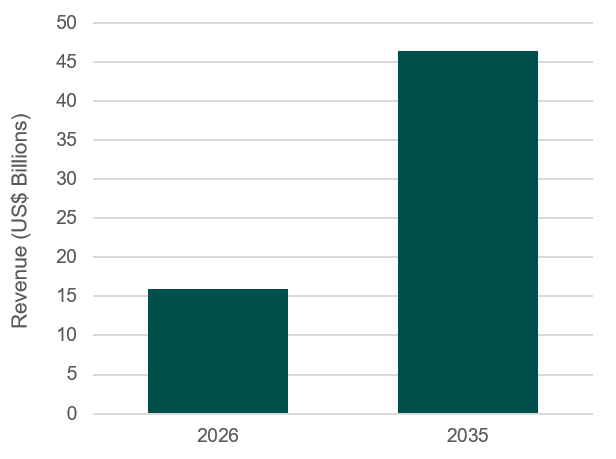
Asia-Pacific leads the edge AI market in both total chipset shipments and revenue. Its shipments and revenue figures already outstrip the technologically advanced North American and European regions, and it will also experience slightly higher CAGRs throughout the forecast. By 2031, edge AI chipset revenue in Asia-Pacific will reach US$46.4 billion—more than North America and Europe combined.
Chart 1: Total Revenue of Edge AI Inference & Training Chipsets
Asia-Pacific: 2026 Versus 2035
(Source: ABI Research)
China is obviously a major catalyst for edge AI demand as the government and domestic enterprises digitally transform. Technologically advanced economies such as Japan, South Korea, and Singapore are also key growth levers.
However, one trend that vendors should watch is the ascendance of developing countries like Indonesia and Malaysia as manufacturing demand continues to proliferate in Southeast Asia. Edge AI’s ultra-low-latency capabilities will be essential in scaling mission- and safety-critical applications such as industrial robotics, workplace safety, and preventative maintenance.
It should be noted that Asia-Pacific’s market dominance in the edge AI space largely boils down to sheer size and population. North America and Europe are comparatively larger markets on a per capita basis.
Edge AI Use Cases for Audio and Sound Processing Will Plateau
According to ABI Research, edge AI chipset shipments for audio and sound processing will grow at 0% between 2026 and 2031, hovering around the 100 million mark annually. At the same time, revenue will fall at a negative 14% annual rate. This is an outlier in the market data, as every other use case will experience strong positive shipment growth.
Audio and sound processing refers to signal processing that involves the electronic analysis and manipulation of audio signals to extract actionable insights. Notable applications include speech recognition, voice control, conversational AI, scene recognition, device personalization, security, surveillance, and ambient sound analysis.
Table 2: Total Shipments of Edge AI Inference & Training Chipsets by Use Case
World Markets: 2026 to 2031
(Source: ABI Research)
|
Use Case |
Units |
2026 |
2027 |
2028 |
2029 |
2030 |
2031 |
CAGR |
|
Audio and Sound Processing |
(Millions) |
102.8 |
100.2 |
95.8 |
96.5 |
96.8 |
101.9 |
0% |
|
Machine Vision |
(Millions) |
206.6 |
243.6 |
291.2 |
351.9 |
436.1 |
522.1 |
20% |
|
Sensor Data Analysis |
(Millions) |
192.6 |
202.0 |
212.8 |
225.4 |
243.8 |
261.7 |
6% |
|
Others |
(Millions) |
84.0 |
129.0 |
184.3 |
216.7 |
256.3 |
342.4 |
32% |
|
All (Gateway) |
(Millions) |
122.9 |
152.7 |
204.9 |
264.0 |
329.0 |
358.3 |
24% |
|
All (On-Premises Server) |
(Millions) |
2.5 |
2.7 |
4.2 |
4.8 |
5.2 |
5.8 |
18% |
|
Total |
(Millions) |
711.3 |
830.0 |
993.2 |
1,159.4 |
1,367.3 |
1,592.2 |
17% |
Manufacturing Offers the Largest Edge AI Market Opportunity
While the smart home and automotive continue to easily drive the most edge AI shipments across all market verticals, manufacturing drives the most revenue. Manufacturing is projected to generate US$24.9 billion by 2031, compared to the smart home’s US$18.4 billion and automotive’s US$14.6 billion.
Chart 1: Edge AI Shipments and Revenue for Manufacturing, Smart Home, and Automotive
World Markets: 2026 to 2031
(Source: ABI Research)
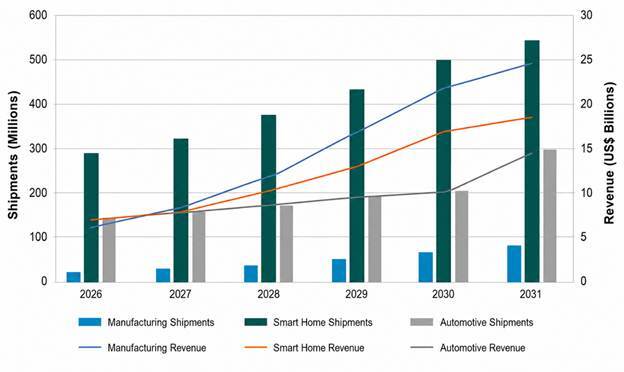
There is a major discrepancy between edge AI shipment and revenue figures due to differences in Average Selling Prices (ASPs) across verticals. Edge AI silicon must be more specialized for complex, device-dense industrial environments, resulting in higher price points. In contrast, smart home edge AI devices like smart speakers, doorbells, and thermostats are typically low-cost, high-volume products.
Automotive (US$14.6 billion), smart city (US$12.3 billion), and healthcare (US$6.5 billion) round out the top five market verticals for edge AI.
Strategic Recommendations for Semiconductors Targeting the Edge AI Market
The edge AI market looks very different today than it did a year ago, reflected at embedded world 2026. The market is consolidating (e.g., Qualcomm acquisitions) and the memory crunch is delaying AI rollouts. Despite turbulence, semiconductors still have a ripe opportunity to differentiate themselves through the following strategic moves:
- Reducing Time to Market (TTM): Demonstrate the ability to enable narrow, vertical-specific use cases and end-user applications to reassure developers of the viability of silicon offerings.
- Lowering Complexity: Offer easy-to-use toolkits that provide the model development flexibility needed for AI talent-constrained customers.
- Address Vendor Lock-In Concerns: Build a diverse partnership ecosystem up the vertical solution stack to lessen developers’ concerns about being stuck with a single, long-term vendor.
Download ABI Research’s Artificial Intelligence and Machine Learning Edge AI market data (published in 2Q 2026) for access to all 21 datasets, including deep vertical-specific trends.
 Larbi Belkhit