
Authors: Malik Saadi, Chief Research Officer; Jake Saunders, VP of Asia-Pacific & Advisory Services; Dimitris Mavrakis, Senior Research Director
The ABI Research team attended the latest ZTE analyst summit that took place in Kuala Lumpur, at the same time as the M360 ASEAN conference. The main topic of M360 events has traditionally been telco-focused but this year, the discussion was solely centered on the role of telcos in the Artificial Intelligence (AI) supercycle, and how they can prepare their networks, systems, workforce, and processes to become a main piece of the AI puzzle.

The ASEAN region has a bold strategy, shared by GSMA Director General: “.. ASEAN has a bold ambition: a $2 trillion digital economy by 2030,” driven largely by telcos. ZTE shared its updated strategy at the show toward “connectivity and computing,” positioning AI as the brain, communication as the nervous system, and terminals as the body. In fact, all telco infrastructure vendors are now pivoting toward enabling AI rather than focusing on connectivity and telco infrastructure only, helping telcos become AI infrastructure and application providers.
However, successful telco AI monetization requires more than just making telco versions of frontier models, which are robust enough for carrier-grade telecoms industry environments. These attempts depend on practical, scalable, and readily deployable frameworks that can operate securely and reliably across complex carrier-grade infrastructure. Completing pilots and trials will likely not expose enough challenges and integration points needed, certainly on the internal process and workforce level. In this domain, large-scale implementations matter and that’s what ZTE is hoping to bring in the ASEAN region.
The following sections highlight some of the findings of the ABI Research team from the show. They are just highlights of the event itself, which proved to be a glimpse into the future of the telco business models. Please contact the ABI Research team for further information, quantitative analysis, and insights.
Computing and AI Are Now a Core Business for ZTE, Not a Side Bet
Computing and AI have become central to ZTE’s business. At its September summit in Kuala Lumpur, the company put computing at 35.1% of 1H 2026 revenue, compared with 5.2% in 2021. ZTE is expanding into the technology and services that operators need to generate growth beyond connectivity, while continuing to invest in its network business.
ZTE has not walked away from radio. It is still filing 6G patents at pace, still selling differentiated 5G and 5.5G infrastructure around the world, and still securing design wins across both radio and core. What has changed is that the company now runs two businesses instead of one, and it came to Kuala Lumpur with the numbers to explain why. For a deeper quantitative analysis, get in touch with ABI Research team for more details.
So, why does diversification matter?
The market for traditional network equipment has matured, and carrying more traffic has not reliably produced more revenue for operators. AI and computing offer ZTE access to a broader pool of investment. Its advantage is the ability to build on network expertise and established customer relationships, helping operators participate in markets they would struggle to enter alone.
The pitch addresses a problem every operator recognizes. Boards are asking what the AI strategy is, and most carriers have no credible answer. They lack the model talent, the developer ecosystem, and the iteration speed that hyperscalers have, and they know it. What they do have is the customer relationship, regulatory standing, security accountability, and control of national data. ZTE's proposition is straightforward: we build and run the infrastructure, you sell the services that sit on top, and you keep the customer.
For operators, the value lies in combining connectivity, computing, and AI into services customers can use. They can build this business around strengths they already possess: local networks, business relationships, and responsibility for service quality. ZTE’s advice at the summit was to build on these assets through trusted enterprise AI and services that combine connectivity, intelligence, and security. Telkomsel’s call to monetize outcomes captured the same point: customers need a service that improves their business and justifies its price.
China provides a useful illustration. In Donghai’s crystal market, ZTE reported around 6,000 subscriptions to livestreaming plans priced at RMB199 to RMB599 a month, with 98% active usage. AI helps the network maintain the video quality merchants need to reach buyers. For a seller whose income depends on a live broadcast, reliable connectivity has an immediate commercial value. This is how technology becomes a product customers are willing to pay for.
The overseas examples show how the proposition extends into operations and computing. In Indonesia, ZTE reported that an AI trial with XLSMART reduced network analysis time from about 32 hours to under 7. In Pakistan, it reported handing over the power and cooling systems for an AI data center with 8.5 Megawatts (MW) of total power capacity in 8 months. These cases illustrate the value of bringing technology, integration, and delivery expertise together.
The wider opportunity is to apply that capability to enterprise services and national AI programs. Governments want to use local languages and retain control over sensitive data; businesses want AI that works with their existing systems. ZTE’s partnerships in Southeast Asia point toward this opportunity. Success would give operators new service revenue and ZTE a larger role in software, implementation, and ongoing support. Its competitive reach would extend well beyond traditional network equipment.
What about the West?
Western operators that cannot or choose not to partner with ZTE may lose a source of price competition and a supplier able to take responsibility across networks and computing. They may also have less direct access to deployment experience accumulated in China and other Asian markets. Security and regulatory concerns remain part of the decision. The commercial response is to demand comparable integration, delivery, and operating performance from alternative partners.
For the wider industry, ZTE's diversification moves the contest from who sells the best equipment to who can help operators build and run distributed computing and connectivity as a profitable service. Ericsson, Nokia, and other telecommunication infrastructure vendors will increasingly be judged on that broader result. Western operators should demand the same of whichever suppliers they choose: clear accountability for delivery, firm customer commitments, and measurable returns. They can pursue a different supplier strategy and still succeed but they cannot afford to ignore the commercial model ZTE is building.
ZTE and Huawei’s (which is also embarking on an aggressive diversification strategy) own challenges are substantial. Computing hardware can swell revenue while thinning margins. Chip supply remains hostage to export restrictions, and any shortage would stall the equipment its customers are waiting for. And delivering a complete infrastructure stack, implementation included, across dozens of global markets demands local skills, long-term support, and a far deeper and contractual commitment to the operators it serves. Many of those markets, moreover, have little capital to invest. ZTE has set a credible course for diversification. Its next test is to make that broader business consistently profitable, for itself and its customers. ZTE has shown that a telco equipment vendor can remake its revenue mix in just 5 years. It also exposes the potential cost of doing so: thinner margins, a fragile supply chain, and a political ceiling in the West.
The message from Kuala Lumpur is clear: AI infrastructure is not won by the rules of telco equipment, but telco operators hold vast advantages in reaching consumers and enterprises with AI services.
ZTE Shows That Telcos Now Have the Foundation to Offer a Lot More than Connectivity
Telco network operators have been deploying next-generation infrastructure for fixed and mobile networks over the past decade and have now reached an inflection point, where both networks are capable enough to offer advanced services. In the mobile domain, this translates into differentiated services, including network slicing, whereas in the fixed broadband domain, this translates into smart home services and much more. Both domains are an ideal foundation for AI services, where networks become the connectivity medium for outcomes rather than token transport. This is illustrated in the next chart shown by ZTE, highlighting that European telcos and their networks are ready for this transition, to start selling services rather than mobile or fixed network traffic.
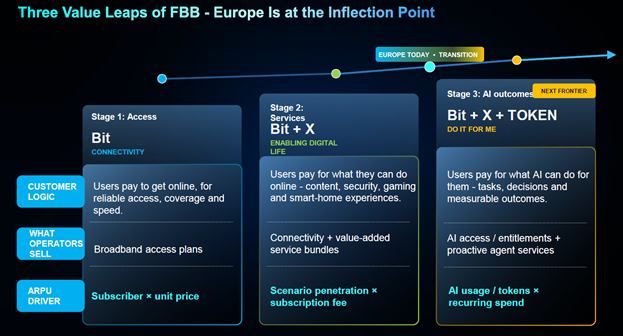
This transition has already taken place in China, where all three telco operators now bundle tokens and new services with their subscriptions. For example, China Telecom offers a smart home service on top of its fixed broadband subscription that includes a smart terminal, security, and AI guardian applications. Moreover, all operators offer fixed-mobile-convergence packages that include voice, mobile broadband data, 1 Gigabit per Second (Gbps) fixed broadband, and AI tokens, becoming a one-stop shop for consumers.
AI networking driven by computing—not energy—constraints in China
The U.S. AI data center market is currently constrained by energy shortages and long lead times for grid connection, forcing data center operators to either rely on behind-the-meter energy generation or start distributing their AI data centers in different regions, taking advantage of multiple energy grids.
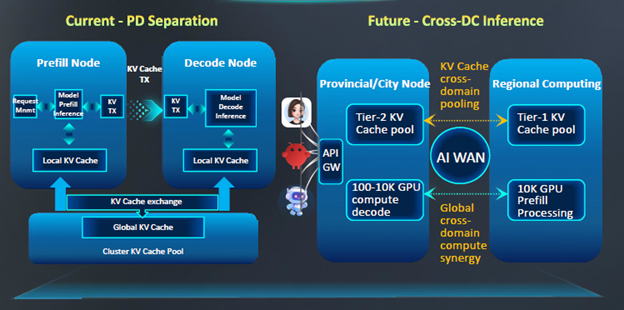
China’s constraint is computing, specifically accelerator supply and per-chip performance. The market cannot get access to NVIDIA Graphics Processing Units (GPUs) and American silicon, whereas domestic accelerators deliver significantly less per chip and rack, meaning a training workload will require significantly more servers. Moreover, data center locations in China are geographically distributed: a large part of its compute capability sits in Inner Mongolia, Guizhou, and Ningxia for low-cost energy whereas most of the demand is in the East. Telco operators, including China Mobile and China Telecom, have demonstrated training runs that have taken place over 1,000+ Kilometer (km) distances. The constraint in China is aggregating weaker, dispersed, and heterogeneous compute, not operating in the extreme bandwidth requirements of Western scale-across networks.
The deployment model for scale-across is also significantly different across the two markets. In the United States, scale-across is wholly deployed by the AI data center operator. In China, scale-across is deployed by telco operators and sold to third parties, including hyperscalers like Alibaba Cloud, Tencent, and others. This is a blueprint for other telcos to follow, offering AI networking to AI data center operators and creating completely new business models and addressable markets.
5G Still Has Momentum but Needs to Deliver “Trust”
At ZTE’s Analyst Conference 2026, 5G and 6G were front and center, but ZTE’s senior team underscored how communications need to integrate with other technologies and AI.
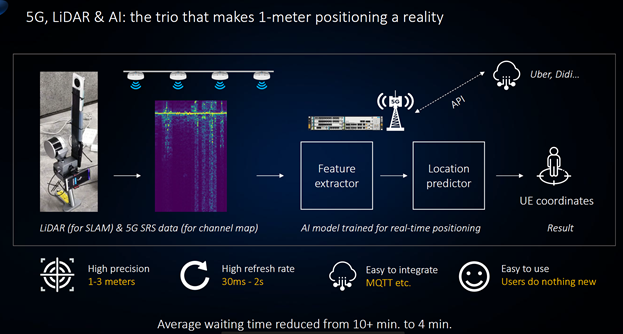
Addressing the immediate, tangible realities of telcos, ZTE argued that 5G-Advanced and AI can act as practical enablers of communications and trust across different industries. For e-commerce, ZTE advocated that improved connectivity scales livestreaming and expands market reach. In tourism and transportation, context-aware services and high-precision indoor positioning can enhance user confidence and convenience. In healthcare, the patient must be the focal point of the treatment process, and yes, doctors and nurses have innovative tech at their fingertips, but there is still the challenge of moving patients to and from various departments. Smart wheelchairs could combine AI triage, navigation, and workflow coordination to improve patient experience and operational efficiency.
Throughout all the 5G-Advanced and AI profiled use cases presented by ZTE, the key message was that reliable connectivity, precise positioning, low latency, and localized AI can not only deliver enhanced value but also enhanced “trust.”
An Example of How 5G Can Leverage Other Technologies to Provide “Trust”
(Source: ZTE)
ZTE’s Vision for 6G Emphasizes Distributed Intelligence
Expectations and debate have been swirling around 6G for a while. In my own discussions with telcos, some are extremely keen to be on the cutting-edge of the tech, while others want a middle-of-the-road approach. There is palpable concern in the telco community.
From ABI Research’s wider discussions, there is the expectation that 6G should deliver:
- Terahertz (THz) spectrum for far higher capacity
- Sub-Millisecond (ms) latency
- Embedded AI for autonomous optimization
- Integrated sensing with communications
- Combined terrestrial and satellite networks to extend truly global coverage
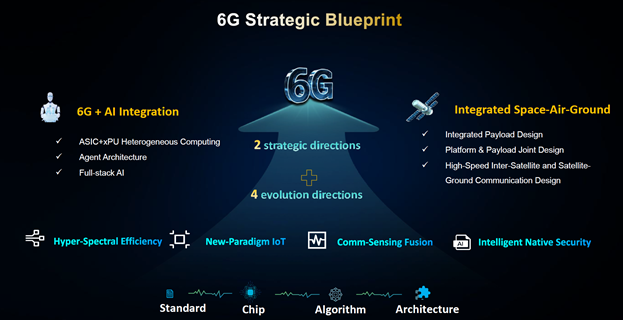
From ABI Research’s investigations, ZTE is working hard on those underlying technologies, but the vendor believes 6G should enable a shift from human-centric to agent-centric connectivity. Networks should support not only “people and devices” but also “intelligent agents.” This implies a broader service model, moving from conventional audio-visual communications toward more immersive, multi-sensory, and AI-driven interactions.
ZTE’s 6G Strategic Blueprint
(Source: ZTE)
How Will ZTE Deliver This?
1. ZTE’s standards and Intellectual Property (IP) development has put significant emphasis on software and AI coding, Integrated Sensing and Communications (ISAC), and protocol simplification to improve efficiency, reduce complexity, and help telcos deliver more capable networks.
2. ZTE’s 6G technology roadmap is centered on delivering AI-native infrastructure and integrated space-air-ground networks. AI strategy needs to be able to leverage heterogeneous computing, combining Application-Specific Integrated Circuits (ASICs) for efficient deterministic workloads with more flexible accelerators for AI functions. The Random-Access Memory (RAM) crunch has not just spiked prices but even capped supply. Therefore, a pragmatic approach to AI rollouts will be needed.
3. 6G will also bring in new service requirements, including more advanced Multiple Input, Multiple Output (MIMO) architectures, simplified network design, and resilient connectivity for autonomous and multimodal applications.
Conclusions from ZTE’s Wireless Sessions
ABI Research appreciated ZTE’s “hard-nosed” vision of 5G-Advanced and 6G. It is likely to go down well with the telcos that are financially stretched and looking for solutions and “not” just more tech. ABI Research does agree that 6G’s value will need to depend less on headline speed gains alone and more on how effectively networks can support intelligent, distributed, and increasingly autonomous services. ZTE should note that it will also be critical for infrastructure providers to not just cater to telcos’ needs but also allow third-party software and AI developers into their ecosystem to harness their initiatives and momentum.