

Fresh off the heels of ABI Research’s MES Software: Discrete Manufacturing competitive assessment comes a bold and seemingly contradictory declaration: there is no one completely ideal Manufacturing Execution System (MES) solution that will perfectly meet the needs of every manufacturer.
This is not to take any achievement away from Tulip Interfaces or the other assessment leaders (or other assessed companies). Each of these six providers deserves the acclaim bestowed upon them, performing exceedingly well in the metrics of the competitive assessment’s ranking methodology. They each bring viable, high-quality solutions that can really help manufacturers compete in the 21st century; they are all helping to shape the conversation on MES evolution, and the assessment itself is a thorough, objective breakdown of how that change is happening and which MES providers are responding most effectively to it.
The larger reality of the MES space, however, is that not every manufacturer prioritizes the same value proposition when it comes to selecting a MES platform. To more fully address this market need, ABI Research created The Manufacturer’s Guide to MES to serve as a companion piece to our competitive assessment analysis.
Table of Contents
The Increasing Un-Standardization of the MES Market
Which Manufacturers Should Choose an Out-of-the-Box MES?
Which Manufacturers Should Choose a MES Ecosystem?
Which Manufacturers Should Choose a Modular MES?
The Increasing Un-Standardization of the MES Market
Segmenting the MES market is a challenge, as most standard divisions do not lend themselves to meaningful differentiation. The obvious go-to is discrete and process, but plenty of providers provide both services—and even the nature of these can vary (slightly) by industry.
Okay, so let’s do by industry. Well, with that logic, we punish a provider such as iBase-t for only being in one industry (Aerospace and Defense (A&D)) while rewarding broad vendors such as Siemens and Dassault Systèmes, even if (for an A&D provider) iBase-t’s solution is equally valid or superior. Most manufacturers only play in one or two industries, so an MES provider servicing 20+ is not much more useful than one servicing three.
We could break the market down by region, but this again unfairly punishes smaller players and does not provide intrinsic value in and of itself. We could segment by intended client size, but this can be misleading as many of the solutions more ideally suited for larger manufacturers (Siemens, Dassault Systèmes, Rockwell Automation) also have solutions aimed toward smaller customers.
Certain MES providers would prefer segmentation by capability, but even this is flawed, in part because recent evolution and expansion have blurred the line between what is and is not an essential MES functionality. Certain organizations, such as the Manufacturing Enterprise Solutions Association (MESA), attempted to standardize MES through 11 concrete capabilities, but most MES solutions do not address them all to fully meet MESA requirements. MESA itself also went out of business in January 2026, showing how little manufacturers cared or appreciated its attempts to provide regulation. Tulip is not a traditional MES, nor are MTEK, MachineMetrics, or Pico. That does not disqualify them from the conversation.
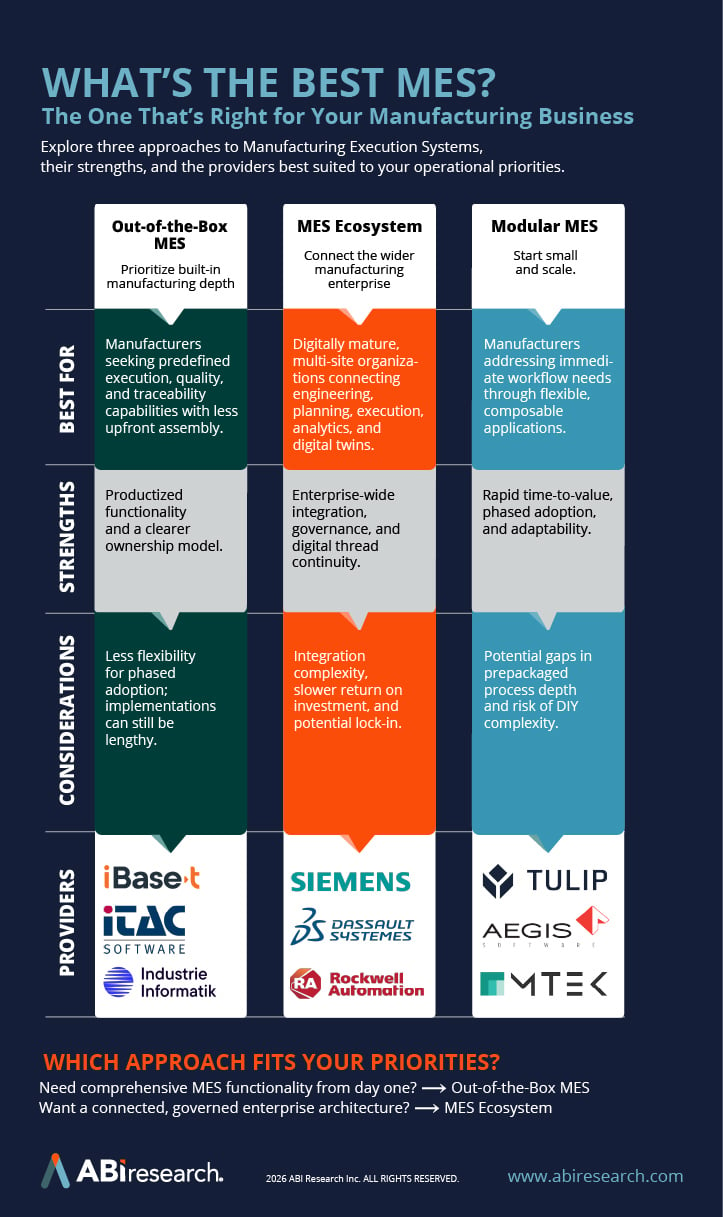
After months of research, ABI Research has concluded the best (and perhaps only) way to effectively segment the MES market is through value proposition. Even this division is not perfect as, from a technology standpoint, many solutions blur capabilities and functionalities. For a manufacturer beginning the MES purchasing journey, however, the table below provides incredibly useful guidance. In segmenting MES into out-of-the-box, ecosystem, and modular solutions, we can begin to have real conversations around not what is the “best” MES, but what is the right one.

Which Manufacturers Should Choose an Out-of-the-Box MES?
Out-of-the-Box MES solutions, as their name implies, tend to come with less upfront architectural assembly needed from the manufacturer. They are intended for the audiences for which a fully-rounded and “standard” MES still resonates. When learning about these products, the buyer will hear about the value of the comprehensive MES product first and foremost. It is important to note, however, that these solutions are not necessarily the most fully-featured MES platforms on the market.
Buyers can expect platforms with predefined MES functionality that is already fully productized, and solutions with robust industry knowledge to draw from. For those manufacturers still placing significant value in MESA-11 standards, VDI-5600 compliance, or even the traditional Isa-95 understanding of an MES, these are the primary types of solutions that will appeal to you.
Which Manufacturers Should Choose an MES Ecosystem?
The MES ecosystem is a tricky category because, from the nature of its segmentation, it implies these solutions are fundamentally weaker on their own. This is not the case. There is nothing inferior about Opcenter, for example. It is a tremendous platform on its own merits. The value proposition for an MES ecosystem really states that the true value goes beyond these MES platforms to much richer, more interconnected digital thread narratives.
These implementations are not always cheap, and they do not always happen quickly, but the Return on Investment (ROI) is the digital transparency throughout various stages of not just execution but the broader product manufacturing lifecycle. For larger, more digitally mature manufacturers ready to take the next step in their digital transformation journeys, these solutions make tremendous sense. They are not necessarily the first choice for small or mid-sized manufacturers or industries just starting out (unless said industry player wants to go all-in on a thoroughly comprehensive overhaul).
Which Manufacturers Should Choose a Modular MES?
Modular MES providers are riding a current wave in customer preference for composability. Almost every provider offers some form of modularity in their deployments, but MES solutions in this category stand apart in the sheer flexibility and versatility of their platforms. It is their first and foremost strength. These solutions have considerable appeal for the risk-averse manufacturer that wants to be sold on initial value before committing a notable investment.
On the flipside, these providers must often defend themselves when it comes to solution depth and feature breadth. An organization such as Tulip, for example, needs no help being seen as innovative, but a complex discrete manufacturer in a highly regulated industry such as A&D might question if its solution provides everything it is looking for. This is why modular MES providers are now improving their claims on scalability, data governance, and feature integration (see Tulip’s announcements at Ops Calling for proof of this).
The Future of MES Positioning
MES providers struggle for differentiation, with some still resisting aspects as basic as the label “MES.” Alternative terminology such as Manufacturing Operations Management (MOM), connected manufacturing platforms, procedure execution systems, manufacturing integration platforms, and others clutter the market—each adding more confusion and vagueness than clear and consistent competitive understanding (see my thoughts in Beyond MES: The State of Manufacturing Operations Management (MOM) and MOM-Like Solutions). The only consistent guiding light for the market is customer demand and client preference.
ABI Research is confident that its market segmentation represents an actual step forward in better understanding the market, both for providers looking to stand out and for manufacturers looking not necessarily for the more complex or feature-rich platform, but the one that will actually provide the best value in their specific situation. In this world, there may be no best MES, but we can certainly help manufacturers find the right ones.
For more information, please see my full report: The Manufacturer’s Guide to MES. Also, if you have a strong point of view on the topic, please feel free to reach out! Market understanding is not, and should never be, static.

 Ben Weaver