NEWS
A Fifth Consecutive Year of Decline in the Smart Card Market
|
In 2025, Removable Subscriber Identity Module (rSIM), payment and government ID smart card shipments hit 7.14 billion, marking a -1.3% reduction Year-over-Year (YoY), defining a fifth consecutive year of decline.
The overall smart card market continues to stagnate, and since COVID-19, a host of impacts have affected the market, including the chipset shortage, subsequent high levels of inventory, and inventory correction. Looming on the horizon is another possible impact on the memory shortage, with a foundry strategy shift to support higher-end/value form factors that may indirectly reduce manufacturing capacity of the required smart card Integrated Circuits (ICs), likely resulting, at the very least, in price increases.
But what will all this mean for the smart card market over the next 5 years and what areas/applications are expected to be impacted the most?
IMPACT
Top-Level Findings and the Top Three Markets
|
The top three smart card markets (a combination of rSIM, payments, and government ID) account for over 90% of all smart card shipments. Therefore, it’s important to focus on these three markets to understand the market dynamics, drivers, and inhibitors, as any fluctuation in these three markets will have the greatest impact on the overall market picture.
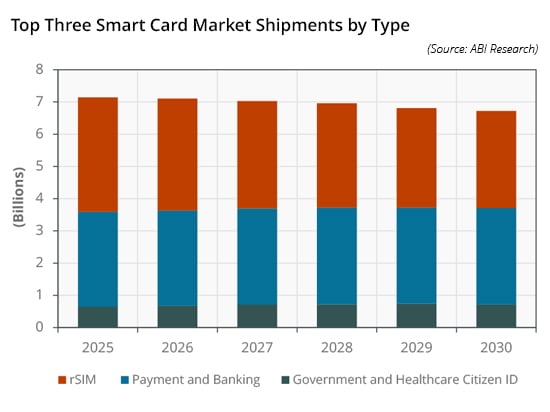
- Government ID: Over the forecast period the government ID market is expected to be one of modest growth, achieving an annual growth rate between +2% and +5% annually. ID1 credentials (driver’s licenses, national IDs, etc.) remain on a growth trajectory with a business-as-usual expectation with low-to-mid single-digit percentage growth expected each year. ID3 (passports) will remain a lumpy market, closely aligned with economic performance and consumer confidence with the market directly impacted by macroeconomic conditions.
- Payments: High levels of inventory continued to hamper the payment card market in 2025. Although a level of recovery is expected in 2026, market dynamics related to short-term unfavorable macroeconomic conditions, indirect impact from mobile, and expectations that issuers may look toward card expiry extension will limit future growth and result in a flat market at best.
- rSIM: The SIM market continues to be one of significant business transition, with more emphasis now being placed on Embedded SIM (eSIM) with the transition from rSIM. Apple eSIM-only device expansion, China adopting eSIM smartphones, continued success of travel SIM, and the launch of SGP.32 to address the Internet of Things (IoT) market will further compound an rSIM market already in decline prior to any significant eSIM impact.
RECOMMENDATIONS
The Top Four Impacts and Where to Place Your Focus
|
The smart card market is generally one of extreme maturity & saturation with limited organic growth opportunity. This is paired with increasing levels of digitization, which is applying further pressures to overall volumes.
For the forecast period ending 2030, the top three smart card markets will decline with projected annual YoY growth rates forecast in the -0.5% to -2.1% range, and annual shipments declining from 7.14 billion in 2025 to 6.72 billion in 2030.
Although the overall picture is one of decline, most of the impact is coming from the SIM market, thanks to the continued transition from rSIM to eSIM. Payments will remain a flat market with government ID bucking the trend with good levels of growth. A saturated and commoditized market nature means that vendors need to be more selective in the projects on which they want to compete. The ability to balance market positioning without getting drawn into an Average Selling Price (ASP) race to the bottom scenario will define success and future margins.
Despite a declining market picture, the physical smart card is not going away anytime soon. For the top three markets, annual forecast expectations will remain above the 6.7 billion range, a very significant number, demonstrating a clear market requirement and continued demand for physical products. Although it might be tempting to exit the smart card market, a digital-only business approach will limit market activity, particularly in markets where digital is underpinned by physical (e.g., payments) and in markets where a staggered and measured approach to digitization is taking place (e.g., SIM).
As it relates to the physical, vendors need to shift attention toward niche market areas to continue meeting demand for physical products, despite high levels of digitization. Operating in the market is a balancing act, with vendors required to ensure continued availability of and evolutions in physical products, while supporting the digitization initiatives of their customer base. This is especially the case among fintechs and neobanks, which have pivoted from early ambitions of “digital-only” models, initially forced to issue physical cards and now recognizing the value of differentiated physical product offerings in accelerating tiered digital business models. These physical niche areas are demonstrating far greater growth potential for smart card vendors, paired with higher ASPs, making them extremely attractive to incumbent players looking to draw additional value out of the market. These include alternative materials under the broader banner of eco cards and/or metal, and other higher value form factors such as 5G SIMs.