
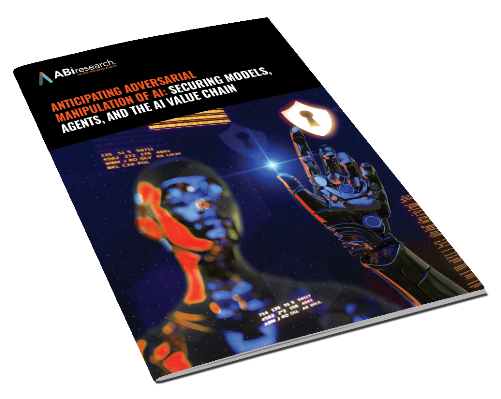

Actionable Benefits
- Prioritize Artificial Intelligence (AI) security investments across guardrails, agent identity, posture management, observability, model security, data security, and governance based on market maturity and growth potential.
- Develop enterprise strategies to mitigate adversarial AI risks across models, agents, prompts, orchestration layers, and software supply chains.
- Identify technology vendors and ecosystem partners capable of securing AI workloads across the entire AI lifecycle.
- Understand how AI security requirements differ between enterprise, operational technology, edge AI, and defense environments.

Research Highlights
- Comprehensive analysis of the expanding AI attack surface, including foundation models, Retrieval-Augmented Generation (RAG) systems, Agentic AI, Application Programming Interfaces (APIs), prompts, orchestration layers, and data supply chains.
- Market assessment of defensive, responsive, offensive, and assurance-based AI security technologies, including forecasts for adoption trends and growth opportunities.
- Evaluation of leading AI security vendors and platform providers across major security control domains.
- Strategic recommendations for A&D organizations focused on mission assurance, operational resilience, and sovereign AI security.

Critical Questions Answered
- What forms of adversarial manipulation present the greatest risk to enterprise and operational AI systems?
- Which AI security controls are experiencing the strongest market adoption and commercial demand?
- How should organizations secure AI agents, foundation models, data pipelines, and orchestration layers?
- What role do governance, compliance, and assurance frameworks play in AI security strategies?
- How will AI security requirements evolve for edge deployments and mission-critical Aerospace and Defense (A&D) applications?

Who Should Read This?
- Chief Information Security Officers (CISOs), Chief Risk Officers, and security leaders responsible for AI governance and cybersecurity strategy.
- Product, technology, and innovation executives evaluating the risks and security implications of AI adoption.
- Compliance, governance, and risk management professionals responsible for AI regulatory readiness and assurance.
- Defense contractors, aerospace organizations, public-sector agencies, and critical-infrastructure operators deploying AI in high-assurance environments.
Related Insights

Evidence of Model Drift in GPT-4 Will Reinforce Enterprise Generative AI Trustworthiness Concerns
Insight | 3Q 2023 | IN-7039

Enterprise AI Adoption Is Outpacing Governance Implementation
Insight | 1Q 2026 | IN-8043
SpaceX Acquires Cursor for US$60 Billion Just Days Following Its IPO
Insight | 2Q 2026 | IN-8176
Related Research

Physical AI: Robotics Foundation Model Trends and Strategic Considerations for Semiconductor and Cloud Vendors
Presentation | 3Q 2026 | PT-3673

Commercial and Technical Opportunities for Artificial Intelligence Optimization Platforms
Report | 2Q 2024 | AN-6141