Public Safety Network Infrastructure: Typical Deployments
|
NEWS
|
First responders have started to transition from public safety narrow band communication systems (typically LMR or PMR) to broadband cellular communications such as LTE and 5G, since these cellular technologies enable the introduction of new forms of information such as video-to-video communications, real-time video surveillance, and video group calls, among others. To this end, the 3GPP standardized different features such as Critical Push to Talk (MCPTT) in R13, Mission-Critical Data (MCDATA) and Mission-Critical Video (MCVIDEO) in R14, with additional improvements in R15. In addition, R16 introduced improved features such as enhanced Ultra-Reliable Low Latency (eURLLC), the Future Railway Mobile Communication System (FRMCS), Time-Sensitive Networking (TSN), and the inclusion of 5G NR in Unlicensed spectrum (5G NR-U) for the use of the Industrial Internet of Things (IIoT). Future mobile networks will support a wide range of verticals such as smart retail, connected healthcare, and smart automation. However, commercial implementations for most of these features are still in development and have yet to become available for the market.
Public safety networks based on cellular technologies can be typically deployed in two implementation types while leveraging the carrier-grade LTE and 5G core. The first approach is a hybrid infrastructure that implements different mechanisms such as priority and preemption access for first responder users. For example, in the United Kingdom, the Emergency Service Network (ESN) runs on a commercial network (EE), and similarly Verizon in the United States provides services to first responders in its public commercial network. The second approach is the adoption of a dedicated network that consists of dedicated core and spectrum assets for first responder operation. FirstNet in the United States has a unique network deployment that encompasses a hybrid infrastructure with AT&T as well as dedicated FirstNet core and spectrum. The type of deployment between hybrid and dedicated networks will also depend on the spectrum assets available for the deployment of a dedicated network along with the regulations and legal aspects of the local governments.
Assessment of Hybrid and Dedicated Infrastructure for Public Safety Networks
|
IMPACT
|
In order to run a public safety network over commercial cellular infrastructure, Mobile Network Operators (MNOs) should enhance their networks in order to fulfill the requirements of first responders in three main aspects:
- Network Availability: Coverage, network resilience, and interworking with legacy narrow band networks.
- Network Performance: High prioritization—MNOs should leverage the periodization mechanisms standardized by the 3GGP in order to provide mission-critical services over LTE. These mechanisms are typically access class barring, preemption, and quality of service class identifiers.
- End-to-End (E2E) Network Security: From network to devices.
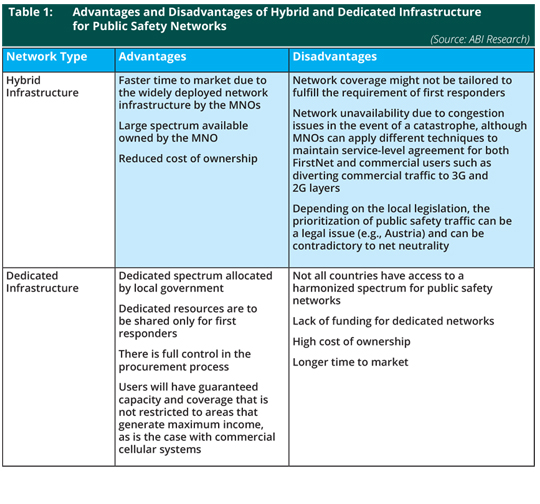
In a dedicated deployment, the public safety network can be tailored to fulfill specifically the requirements of first responders since commercial users do not need to be served. However, the deployment of hybrid and dedicated network infrastructure poses intrinsic advantages and disadvantages, which are described in the table below:
The Future of Public Safety Networks
|
RECOMMENDATIONS
|
Public safety is not a commodity. In fact, 2020 has been the year to test existing public safety networks since it has brought several natural disasters such as wildfires, hurricanes, and the global pandemic COVID-19. According to the Ericsson Mobility Report, AT&T reinforces the importance of having a network service specifically for public safety since through the pandemic FirstNet users consumed more than double the mobile data of an average consumer.
Considering the nature of mission-critical and life-critical aspects of first responder networks, ABI Research expects that a combination of hybrid and dedicated infrastructure should be adopted. To this end, local governments should work towards the harmonization of the spectrum for first responder operations as well as provide funding to extend cellular coverage to those areas that do not generate maximum income for MNOs. Thus, by combining commercial and dedicated infrastructure deployments, additional redundancy can be provided to the network while leveraging the economies of scale and the existing infrastructure owned by the MNOs. In addition, ABI Research believes that national roaming should be implemented to improve the resilience of the Public Protection and Disaster Relief (PPDR) networks as is the case of Belgium and Finland, which have already implemented it, although it is limited to first responders. If national roaming is implemented on a per region basis, border security and first responders’ response can also be improved.
ABI Research expects that with the advanced features that 5G brings to the telco industry, network slicing can be applied for first responder networks, thus tailoring the network Key Performance Indicators (KPIs) for each mission-critical and life-critical use case, providing low latency and additional capacity to the network. These improvements will take many years to implement, but 5G is an excellent candidate technology to unify many of today’s networks under a single umbrella.